Choosing an Intercooler for a Ford Focus ST
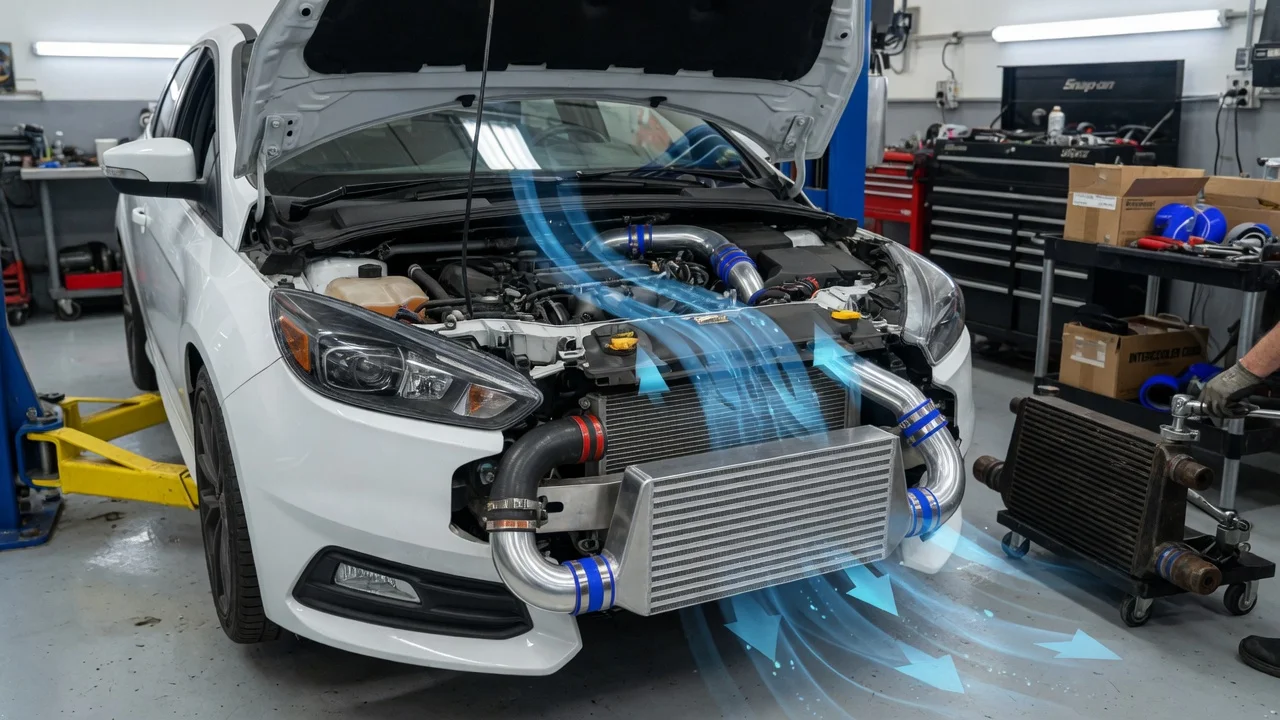
An upgraded intercooler is one of the most common changes Focus ST owners consider. The right choice depends on which generation you own, how hard the car works and whether the engine runs a stock or modified calibration. This guide explains how to match a front-mount core to your car, which specifications matter and what the swap costs to own, so you can narrow your options before spending money.
Define the job the product must do
Start with how the car is actually used. A daily driver on the factory tune in a mild climate is often well served by the original intercooler, provided it is undamaged and leak-free. Cars that see track days, repeated hard acceleration, long climbs in summer heat or an aggressive tune are different. Under those symptom conditions, intake air temperature climbs from one pull to the next, the engine computer reduces ignition timing to protect the engine, and power fades. The realistic goal of an upgrade is to keep charge air temperatures more stable under sustained load. By itself, a bigger core does not add much peak power to a cool engine making a single pull.
Separate symptom reports from verified failures before buying anything. Power that fades on a hot day is consistent with heat soak, but a boost leak, a boost control fault, misfires or a fuel delivery problem can feel the same from the driver's seat. Diagnostic codes such as P0299 (underboost) point toward a leak or boost control issue rather than a cooling limitation. A verified intercooler failure is something you can see or measure: a cracked end tank, a split coupler, a damaged core from road debris, or a pressure test that will not hold. Logging intake air temperature and boost over several consecutive pulls, combined with a smoke or pressure test and a look at the service history for past front-end repairs, tells you whether you need more cooling capacity or simply a repair.
Check compatibility
Generation and engine configuration come first. The Focus ST sold in the United States for the 2013 through 2018 model years uses a turbocharged 2.0-liter EcoBoost four-cylinder. Earlier European cars used a turbocharged 2.5-liter five-cylinder, and the later European ST uses a 2.3-liter EcoBoost, with diesel ST versions offered in some markets. Intercoolers, charge pipes and brackets are not interchangeable across these platforms, so a listing that only says it fits the Focus ST is not enough. The US car also received a styling update for the 2015 model year, so confirm that the kit names your exact years, and check the engine code on imported or unusual vehicles.
Next, look at the physical interfaces. Compare inlet and outlet position and diameter, and note whether the core reuses the factory charge pipes or requires new ones. Check the coupler and clamp style, how the core mounts to the vehicle, and the clearance it leaves to the bumper beam, the radiator and air conditioning condenser stack, and the lower bumper cover. Some kits require trimming plastic bumper supports or undertrays, which matters if you may want to return the car to stock. If the kit includes new piping, confirm it provides the correct sensor provisions and connection points so nothing in the factory setup is left without a home.
Features that affect the choice
Core construction is the biggest functional difference. Bar-and-plate cores are generally more durable and resistant to impact damage but heavier, while tube-and-fin designs tend to be lighter and can flow with less restriction but are more easily damaged. Frontal area usually matters more than thickness. A very thick core warms the air that then reaches the condenser and radiator, and its rear rows see progressively warmer cooling air, so the extra depth gives diminishing returns. A larger internal volume can also slightly affect throttle response. Many owners describe the change as minor, but treat that as a report, not a guarantee.
End tank design affects how evenly air is spread across the core. Cast tanks are typically shaped for smoother flow, while fabricated tanks vary widely in quality. Treat marketing labels such as race spec, stepped core or a headline percentage reduction in temperature with caution until you know how they were measured. Useful evidence includes logged intake air temperatures across several consecutive pulls, with ambient temperature, vehicle, tune and test procedure stated, plus pressure drop figures where available. A chart with no test conditions is advertising rather than data. Surface finish is mostly cosmetic and protective, so weigh it below core design, included hardware and warranty terms.
Limitations and ownership costs
Installation normally involves removing the front bumper cover and working around the cooling stack, so budget for labor if you are not doing it yourself, and allow time for any trimming the kit requires. A larger intercooler on a stock calibration is commonly installed without retuning. However, if the kit changes pipe routing or sensor placement, or the car already runs a custom tune, check with your tuner whether the calibration needs a revision. The total cost can therefore include the core, piping, couplers, clamps, labor and tuning time, not just the price of the intercooler itself.
Ongoing maintenance is modest but real. Crankcase ventilation leaves an oil film inside the charge system over time, so occasional cleaning is reasonable, and heavy oil pooling deserves an inspection of the turbocharger and ventilation system. Recheck coupler clamps after the first few heat cycles and during routine service, since a slipped coupler produces exactly the boost loss you were trying to avoid. A front-mounted core is exposed to stones, curbs and debris trapped between it and the radiator, so inspect the fins periodically. Finally, know what the part cannot do. It will not cure a boost leak, a worn turbocharger, misfires or fueling faults, and it adds little on a car that never reaches heat soak.
Build a practical shortlist
Begin by writing down your car's model year, market, engine and current tune, along with how you drive it and whether logs actually show rising intake temperatures. Keep only the products whose listings name your exact model years and engine, and note whether each includes charge pipes, couplers and clamps or reuses the factory pieces. Then record the core type, frontal dimensions and thickness, the end tank construction, any trimming requirement and the clearance notes from the installation instructions.
For each remaining option, ask for test evidence with stated conditions rather than relying on rankings or slogans. Compare warranty terms, the availability of replacement couplers and hardware, and whether clear installation instructions are provided. If your car is lightly driven on the stock calibration and the original intercooler passes inspection and a pressure test, repairing or keeping it may be the sensible choice. If sustained heat soak is confirmed in your logs, choose the option with documented fitment for your car and believable data, and plan the installation and any tuning revision as one job.