Choosing an Inner Tie Rod Boot Clamp: Fit, Types and Trade-Offs
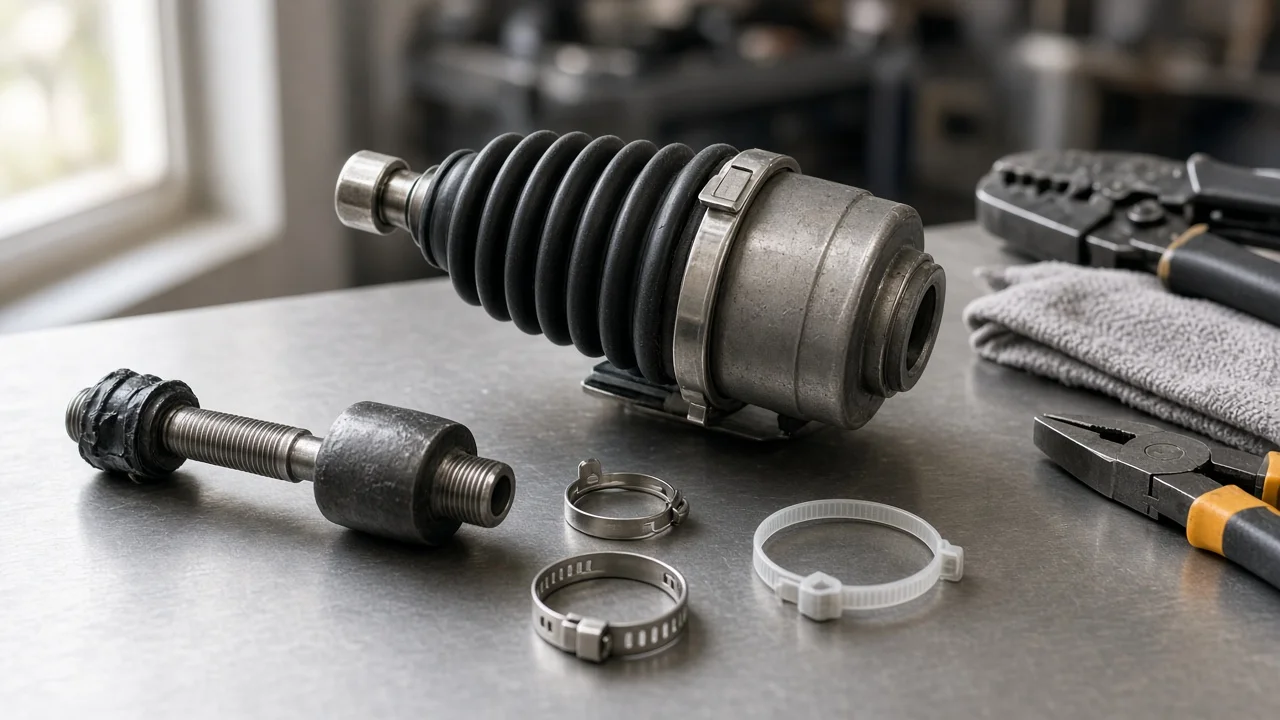
An inner tie rod boot clamp has one modest job. It holds the rubber steering rack boot tight against the rack housing and the tie rod, so water, grit and road salt stay out of the inner joint and the rack. If you pick the wrong size or style, the boot can slip, twist or leak, and the joint it protects wears out quickly. This guide explains how to match a clamp to your rack, which designs suit home installation, and what a clamp cannot fix.
Define the job the product must do
Most rack boots seal at two points. The large end sits in a groove on the steering rack housing. The small end grips the tie rod shaft near the outer tie rod end. Each end usually needs its own clamp, and the two rarely share the same diameter or style. Before you shop, decide which job you are doing: replacing a single lost or rusted clamp on an intact boot, or installing a complete new boot. If the rubber is cracked, split or soaked with grease or fluid, a fresh clamp only seals a damaged part. In that case, replace the boot. Many boot kits already include suitable clamps.
Be honest about your tools and workspace. Some clamp styles need dedicated pincers or a crimping tool. Reaching the large end of the boot can be tight on vehicles where the rack sits low behind the engine cradle. Work on a level surface, with the vehicle raised and held on rated jack stands at the manufacturer's approved lift and support points. Never work under a vehicle held only by a jack. With the wheel off and the steering turned, access improves considerably, and that affects which clamp you can realistically install well.
Check compatibility
The clamp must match the diameter of the boot end once it is seated on its mounting point, not the diameter of the bare housing or rod. Measure the boot end in place, or take the size from the boot or rack manufacturer's parts data for your exact vehicle. That data should cover model year, drivetrain and steering type, because hydraulic and electric power steering racks on the same model can use different boots. Clamps are typically sold with a usable closing range. Choose one whose range comfortably covers your measurement rather than one at the very edge of it.
Band width matters too. Boot ends are molded with a recessed channel for the clamp. A band wider than the channel rides up on the rubber edge and may not seal, while a very narrow band can cut into the boot. When you remove the original clamp, compare its width and profile. Finally, check clearance. No part of the clamp, especially a screw housing or tab, should touch the subframe, sway bar, tie rod or boot folds at any point through full steering lock and suspension travel. Some racks also have a breather tube linking the two boots, and the clamp must not pinch it.
Features that affect the choice
Single-ear and double-ear crimp clamps are common factory fitments. Stepless single-ear designs apply even pressure all the way around, seal well and sit low. However, they are single use and need ear-clamp pincers to close correctly. Band-style clamps with a locking tab, often used at the large end, also need a dedicated tool to tension and lock. Worm-drive hose clamps are easy to install and remove with a screwdriver or nut driver. The trade-off is that the screw housing adds bulk that can hit nearby parts, and the slotted band can bite into rubber if overtightened. Plastic locking ties are sometimes used on the small end. Heavy-duty, heat-resistant ties can work where the original was a tie, but they are not a substitute for a metal clamp on the large end.
Material is the other meaningful variable. Stainless steel resists road salt better than plain or zinc-plated steel. That matters in winter climates, because a rusted clamp loosens or breaks long before the boot wears out. Look for details you can verify: material, band width, diameter range and the tool required. Labels such as heavy duty, OE quality or universal fit tell you little on their own. A universal kit with many sizes is convenient for a garage drawer, but you still have to choose the right size from it.
Limitations and ownership costs
A clamp seals a boot; it does not repair a worn inner tie rod. Whenever a boot has been torn or loose, inspect the inner joint before closing it up. With the wheel off, grip the tie rod and check for joint play, and look inside the boot for rust, grit or missing grease. Noticeable play or contamination means the inner tie rod needs attention, and a new clamp would only seal the problem in. Your vehicle's service information governs the procedure and the fastener specification for the tie rod end nut and jam nut. Do not guess at torque values.
Replacing a boot usually means removing the outer tie rod end, which can change toe even if you count turns carefully. Plan for a wheel alignment after that kind of work. Alignment is normally checked at the vehicle's normal ride height with the steering centered. If toe is adjusted by rotating the tie rod, check afterward that the boot has not twisted, since a twisted boot can tear early.
Ongoing costs are small but real. Crimp clamps cannot be reused, so keep spares on hand, and ear-clamp pincers or band tools are an added purchase if you do not own them. Inspect the boots and clamps whenever the vehicle is raised for tire or oil service. Look for slipped ends, wet residue and cracks in the folds.
Build a practical shortlist
Start from the boot, not the clamp. Confirm the part number or measured diameter for both ends, the band width the channel accepts, and whether your rack uses a breather tube. Then narrow your candidates with a short checklist. The closing range should cover your measured size. The band width should match the boot channel. The material should resist corrosion in your climate. The profile should be low, with no tab or screw housing that can strike nearby parts at full lock. Finally, you need the right tool for the closing method.
If you are replacing the whole boot, a kit with matched clamps for your specific rack is usually the simplest path, because the sizes are already paired. If you are only replacing a clamp on a sound boot, match the original type wherever possible, since the boot channel and clearances were designed around it. A worm-drive clamp is a reasonable temporary fix when the right crimp clamp is not on hand. It must clear everything through full travel and be tightened only enough to seal. Whatever you choose, turn the steering from lock to lock after installation and confirm the boot ends stay seated and nothing rubs.