Choosing a Legal Replacement Catalytic Converter
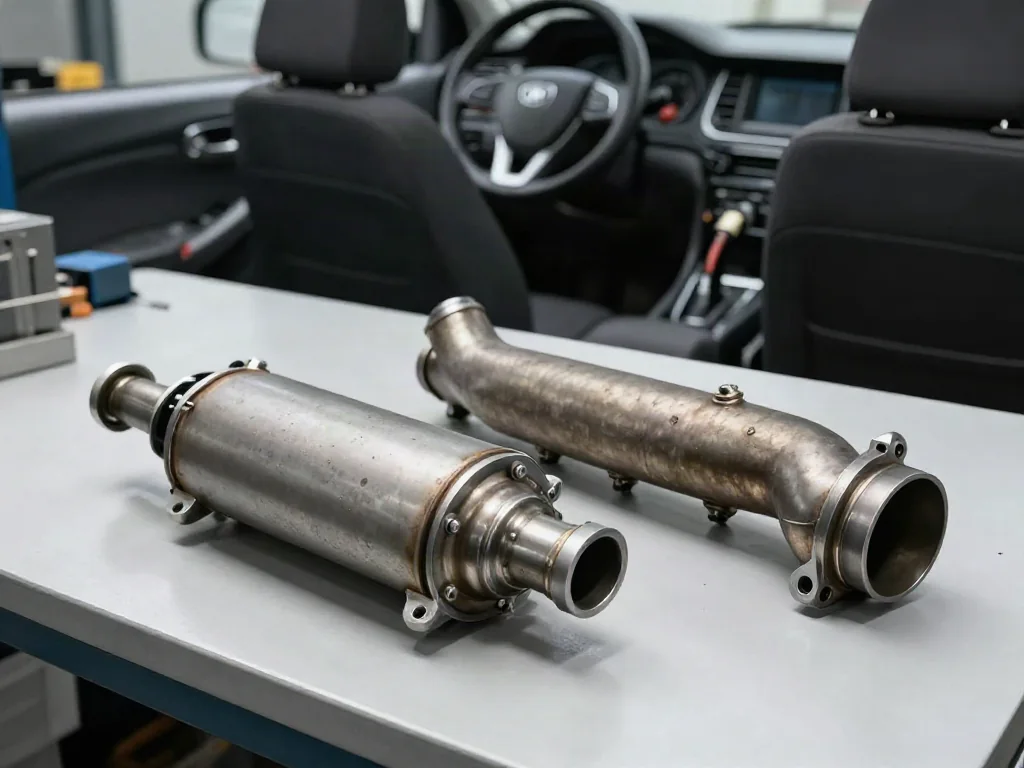
Replacing a catalytic converter involves more than finding a part that bolts in. The replacement has to match the vehicle's engine and emissions certification, suit its location in the exhaust, and meet the rules where the car is registered. Knowing how OEM and aftermarket, direct-fit and universal, and federal and California approvals differ helps you avoid a costly mismatch, a failed inspection, or a repeat failure.
Identify the Correct OEM or Aftermarket Application
In converter listings, OEM usually refers to a part supplied by or for the vehicle manufacturer, often sold through dealer channels. OE may describe the original-equipment design or a supplier's equivalent. Aftermarket converters are made by independent companies for specific applications. None of these labels shows on its own that a part is correct or legal for your car. To choose the right part, you need the model year, make, model, engine, emissions certification, and converter position, since many vehicles use more than one unit.
A VIN lookup in a parts catalog helps narrow down the application. The underhood emissions label shows which standards the vehicle was certified to, federal or California, along with details such as the test group. If the label is missing or unreadable, a dealer or qualified shop can confirm the specification. Before buying, confirm that replacement is actually needed. An efficiency code is evidence to interpret, not proof of failure. Misfires, oil burning, coolant loss, fuel trim errors, exhaust leaks, or sensor faults can trigger the code or ruin a new converter.
Check Direct-Fit Connections and Converter Location
A direct-fit converter is shaped to install in a specific position with the intended connections, usually without cutting or welding the existing pipes. That only helps when the listing matches exactly. Confirm the converter's position, whether front, rear, or underbody, and on V-type engines, which bank. Check the flange style and bolt pattern, the number and placement of oxygen sensor ports, the hanger and bracket locations, and any heat shielding the original carried.
A part that bolts up cleanly is not automatically legal. Physical fit and emissions approval are separate questions, so your vehicle must also appear in the part's federal or California application documentation. Before ordering, an installer can inspect the existing system. They can see whether new gaskets, studs, nuts, or clamps are needed and whether rusted flanges, damaged pipes, or leaking joints would undermine the repair. Some kits include hardware and some don't, so confirm before ordering.
Confirm Whether a Universal Converter Is Permitted
A universal converter is a generic unit sized for a range of engines and vehicle weights, and a shop has to adapt it to the car. The name means flexible installation, not suitability for every car. Before thinking about fit, confirm that the vehicle is eligible for this type of replacement. The manufacturer should list the engine and converter position, and its specifications should cover the application. Some jurisdictions and vehicle categories restrict or exclude universal units entirely.
Once eligibility is settled, an installer checks pipe diameter, available space, heat clearance, sensor locations, and the overall exhaust layout to judge whether installation is practical. Those measurements answer only a mechanical question. A matching pipe size says nothing about legal compatibility. Installing a universal unit usually requires professional fabrication. A qualified shop should keep the sensor placement and converter position consistent with the original design and document the work for future inspections.
Recognize a Manifold-Integrated Converter Assembly
On many modern engines, the first converter is built into the exhaust manifold or mounted directly on it, so engine heat brings the catalyst up to working temperature quickly. Replacing it then means buying an assembly that includes the manifold casting or header tubes along with the converter. Confirm the engine application, the bank on a V-type engine, the cylinder-head bolt pattern and port shape, the sensor ports, and whether the assembly carries the emissions approval your vehicle requires.
Read the listing closely, because an assembly may not include the heat shields, manifold gaskets, studs, nuts, or brackets needed to finish the job. Diagnosis matters here too. A ticking noise or exhaust smell can come from a cracked manifold, a warped flange, or a broken stud rather than a failed catalyst. A leak upstream of a sensor can also distort its readings. A technician should rule out leaks and mounting damage before recommending a whole new assembly.
Verify Federal EPA Replacement Requirements
In states without stricter rules, an aftermarket converter must meet federal replacement requirements and be chosen for the vehicle it will serve. Federal policy makes the manufacturer responsible for building and labeling converters that meet those conditions for the listed applications. So when a seller calls a converter EPA certified, don't take that as proof that the agency individually tested or approved that specific product.
Before buying, check the application documentation to confirm your vehicle is covered. Look for identification markings on the converter, such as the manufacturer and part number, and get the warranty terms in writing. Keep an installation record noting the vehicle, mileage, and reason for replacement with the car's paperwork. Federal rules are a baseline, and states can add their own. Check the requirements where the vehicle is registered and driven, especially if it may later move to a state with tighter standards.
Match California CARB Approval to the Vehicle
California requires a replacement converter to be either an appropriate original-equipment part for the vehicle or an aftermarket unit approved by the California Air Resources Board (CARB), subject to the state's replacement rules. Aftermarket approval comes through an Executive Order that lists the covered applications. Match that information to your vehicle's model year, make, engine, emissions test group or engine family, and converter position as applicable. Use the underhood label for reference.
A CARB sticker or Executive Order number on a listing does not mean the part is approved for every vehicle. Only the applications named in the order qualify. Several other states apply California-style replacement rules, and that group can change, so check current local rules instead of relying on a fixed chart. Even a correctly approved converter can't guarantee an inspection pass if an engine fault, exhaust leak, or monitor readiness issue is still unresolved.
Evaluate New, Used, and Discounted Converter Listings
A new converter removes some unknowns, but you still need a verified application, legal eligibility, identification markings, warranty coverage, and proof of purchase. A used converter carries much more uncertainty. You can't judge internal damage, oil or coolant contamination, or remaining efficiency by looking at it, and its origin may be unclear. California prohibits used replacement converters. Federal rules allow reuse only if the unit has passed qualifying testing and carries the required labeling.
An unusually low price or steep discount is a reason to look harder at the approval documentation, the seller's traceability, the return terms, and what's included. Price alone proves neither quality nor legality. Before committing, ask for an itemized installed quote covering the approved part, labor, and gaskets and hardware. It should also include any diagnosis needed to fix what damaged the original converter. An itemized quote makes offers easier to compare and lowers the risk of paying for the same repair twice.