Choosing a Battery Pack for a Classic Car EV Conversion
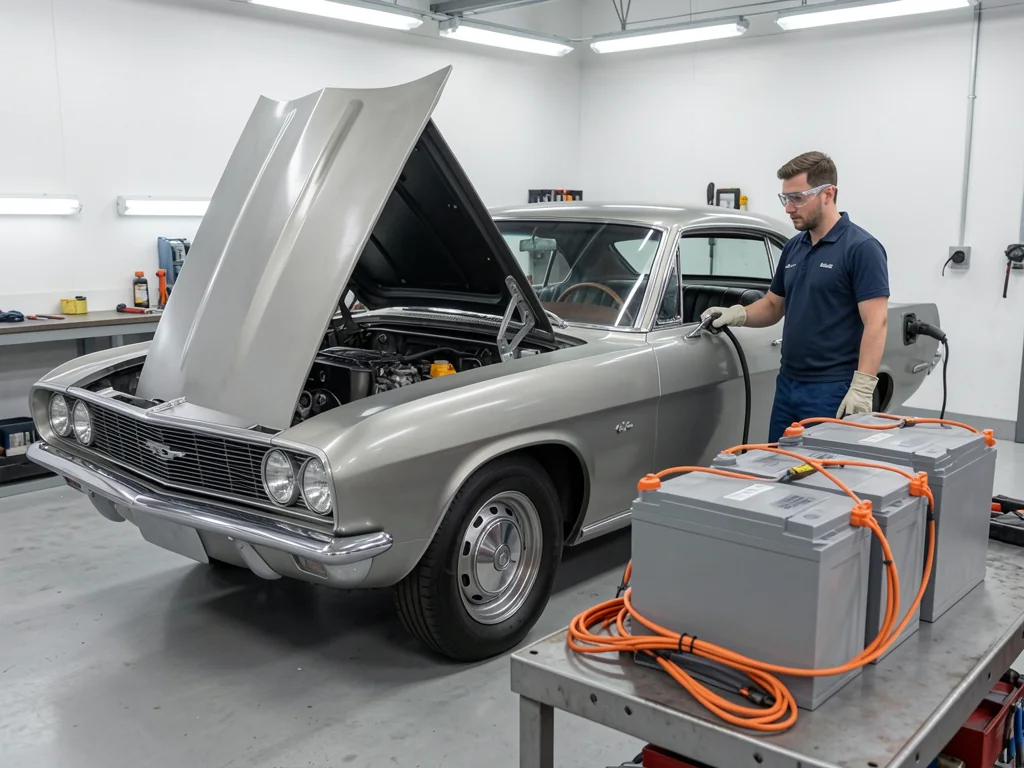
Choosing the right battery is the foundation of an EV conversion, especially when replacing a classic car’s engine with electric drive. Salvaged Nissan Leaf modules, Tesla modules, and custom packs each offer distinct advantages, but the best option depends on your car’s weight, space, intended use, and budget. This overview explains usable capacity, pack voltage, thermal management, and safety, helping you weigh options before spending on a high-voltage system that must match your motor, controller, and charger.
What a Battery Has to Deliver in a Classic Car EV Conversion
A battery’s usable capacity in kilowatt-hours (kWh) determines how far the car can travel per charge. A classic car’s heavy steel body and poor aerodynamics demand more energy per mile than a modern EV. Weekend cruisers can accept a smaller pack, but daily driving needs enough reserve to avoid deep discharges that shorten life. Voltage and discharge capability must match the motor and controller; if the pack cannot deliver the required current, acceleration will be weak even with sufficient capacity.
Weight affects handling, braking, and suspension. A large pack may provide range but overload the original springs and chassis, so placement is critical. The battery cannot be chosen in isolation: its voltage range, maximum discharge rate, and charging profile must align with the motor inverter, onboard charger, and DC fast-charging hardware if used. This overview covers general trade-offs, not wiring or assembly steps—those require professional engineering and local code compliance.
Salvaged Nissan Leaf Modules: Appeal and Trade-Offs
Salvaged Nissan Leaf modules are attractive because dismantled Leafs are widely available and the modules are relatively compact. Builders can often arrange them in various configurations to fit a classic car’s floor or trunk. However, each module’s state of health depends on the donor vehicle’s age, mileage, and charging history. A seller’s claimed capacity means little without a professional capacity test that measures actual amp-hours at a controlled discharge rate.
Leaf modules originally rely on passive air cooling in the donor car. When repackaged without proper airflow or thermal management, they may heat unevenly during fast charging or hard acceleration, accelerating degradation. Compatibility is not guaranteed: the chosen battery management system, motor controller, and charger must support the module’s chemistry and voltage range. Confirm these details for the specific module generation before purchase, and budget for testing each module individually.
Tesla Modules in Conversions: What to Consider
Tesla modules are prized for their high energy density and compact packaging. They pack substantial capacity into a small footprint, which helps fit a usable range into a classic car’s limited space. Their cylindrical cells and integrated cooling plates can handle higher discharge rates, but only when connected to a proper thermal management system. Without active cooling, sustained high loads or rapid charging can push temperatures beyond safe limits.
Module designs vary significantly between Tesla models and production years. A module from a Model S is physically different from a Model 3 or Model Y module, with different voltage, capacity, and mounting points. You must identify the exact donor vehicle before planning any enclosure or wiring. Check for visible damage, corrosion, or swelling, and obtain documentation such as the donor VIN and accident history. Teslas use complex monitoring and safety systems; a used module must be tested and handled by someone familiar with high-voltage battery protocols.
Custom EV Battery Packs: When a Purpose-Built Pack Makes Sense
A custom EV battery pack is designed specifically for your classic car’s dimensions, weight targets, and performance goals. A specialist supplier measures the available space—often the engine bay, transmission tunnel, and trunk—then builds a pack that fits without forcing compromises. Benefits include an integrated battery management system, a sealed enclosure designed for crash loads, and documentation that helps with inspection and insurance. The pack arrives ready to install with matching connectors.
Custom packs cost more upfront and have lead times of weeks or months. You depend on the supplier for warranty support, replacement parts, and firmware updates. Before ordering, ask about cell sourcing, capacity testing, cycle life rating, thermal management, built-in contactors and fuses, and the warranty’s terms and duration. Confirm that the pack’s voltage and current output match your motor and controller. Request an itemized quote that includes shipping, certification, and any required training for installation.
Sizing and Packaging an EV Conversion Battery Pack
Balancing capacity against added weight is essential because a classic car’s suspension, brakes, and tires were not designed for a battery that can weigh several hundred pounds. Extra weight increases stopping distances and body roll, so you may need upgraded springs, dampers, and brakes. That expense belongs in the conversion budget. A smaller pack with efficient motor tuning may be better than a huge pack that overwhelms the chassis.
Weight distribution matters as much as total weight. Placing all the mass in the trunk can make the car tail-happy; putting it all in the engine bay may overload the front axle. Splitting the pack between the front and rear improves balance but adds cabling and protection complexity. Structural mounting must be engineered to withstand crash forces—this is not a DIY bracket project. Local inspection, registration, and insurance requirements vary by region and may dictate enclosure standards, so check them before committing to a layout.
Budgeting for a Conversion Battery Beyond the Cells
Beyond the cells themselves, a battery system requires a battery management system, high-voltage cabling, fuses, contactors, a charger, and possibly cooling or heating. Each component adds cost and must be rated for the pack’s voltage and current. The enclosure needs to be strong, insulated, and waterproof where necessary. Skip these items and you create a fire or shock risk, even with good cells.
Used modules may look cheap at first, but testing each module, replacing weak ones, and building a reliable BMS can erase the savings. A new custom pack has a higher purchase price but often includes testing, warranty, and documentation. Professional installation by an experienced EV conversion shop adds labor cost but reduces the risk of mistakes. Get itemized quotes from multiple suppliers and installers; battery prices, shipping, and warranty terms change with the market and technology.
Battery Safety and When to Bring in Professionals
High-voltage traction batteries can deliver lethal electric shock and can ignite if damaged or improperly handled. Only trained technicians with insulated tools and personal protective equipment should open, test, or connect a pack. A battery management system monitors each cell group, prevents overcharging and deep discharge, and can trigger contactors to disconnect the pack in a fault. Fuses and isolation monitoring protect against short circuits and ground faults; a sealed enclosure contains a thermal event and protects against physical damage.
Inspect used modules before purchase: swelling, leaking electrolyte, corrosion on terminals, crash deformation, or unusual heat during a test discharge are warning signs that the module is unsafe. Do not buy a module that has been dropped or shows punctures. Have a qualified battery lab or EV conversion shop test any used pack. Pack assembly, installation, and final testing should be done by professionals, and you should update your insurance policy to cover an electric conversion. Store batteries in a dry, temperature-controlled area away from living spaces.