Chevy Volt Check Engine Light: Causes and Next Steps
What the light means
A check engine light on a Chevrolet Volt means the powertrain control module has stored at least one diagnostic trouble code related to the gasoline engine, emissions equipment, or hybrid propulsion. It is a warning that a monitored system is outside expected range, not a verdict that a specific part has failed. The Volt is a plug-in hybrid, so the lamp can come on during electric driving as well as when the range-extender engine is running.
Two generations are in use: 2011–2015 first-generation cars with a 1.4-liter range extender, and 2016–2019 second-generation cars with a 1.5-liter range extender. Owner-level checks overlap. Hybrid cooling layout, some propulsion codes, and a few engine-related faults differ by generation, so any diagnosis should start from the model year and the stored code, not from a parts list.
How this warning sits among other Volt messages
The malfunction indicator lamp is the amber engine symbol. The Volt also uses separate messages such as Service Vehicle Soon, Propulsion Power Reduced, Engine Unavailable, and high-voltage charging faults. Those messages can appear with the check engine light or on their own. A charging-system message points at the charge port, cord, or high-voltage charging path; a propulsion or engine-unavailable message describes how the car will behave now. None of those messages, by themselves, identify the failed component.
Plausible causes and what each check indicates
The most useful first split is whether the lamp is steady or flashing, whether the car still moves in electric mode, and whether other cluster messages are present. A stored code is a reason to investigate that circuit or system. It is not proof that the named sensor, valve, or catalyst has failed.
Fuel-vapor leaks and the filler cap
The evaporative-emissions (EVAP) system is a frequent source of a steady lamp after fueling. Check that the fuel cap is present, the seal is intact, and the cap turns until it clicks. A missing, loose, or cracked cap, or a filler-neck seal that does not close, can set a small-leak or large-leak code. If the cap was left loose, tightening it and completing several mixed electric and engine-running drive cycles may allow the lamp to clear on its own; if the leak is elsewhere (purge valve, vent valve, hose, or tank), the lamp will return and a smoke or tightness test is the next professional step. Do not keep driving with a strong fuel smell or visible fuel leak; that is a fire and inhalation hazard, not an EVAP nuisance.
Engine running quality and exhaust aftertreatment
When the range extender starts, misfires, a stuck thermostat, a lazy oxygen sensor, or catalyst efficiency codes can turn the lamp on. A flashing lamp during engine operation indicates an active misfire that can overheat the catalytic converter; reduce load and stop if the flashing continues, power drops, or you smell a sulfur or burning odor. A steady lamp with otherwise normal electric driving and a later smooth engine start is more consistent with a sensor, thermostat, or EVAP fault than with an immediate mechanical failure. Misfire codes should be treated as a combustion or ignition investigation (coil, plug, injector, compression, or intake leak), not as an automatic coil or plug replacement.
The 12-volt battery and low-voltage supply
The Volt still depends on a conventional 12-volt battery for computers, contactors, and accessories. A weak or failing 12-volt battery can produce a cluster of warnings, including a check engine light, delayed ready, or odd charging behavior. Slow interior lighting, repeated accessory warnings after the car sits, or a recent jump-start support that path. A passing 12-volt test does not rule out a high-voltage or engine fault; a failing 12-volt battery also does not prove the hybrid battery is at fault. Voltage and load testing of the 12-volt battery is an inexpensive check before hybrid-system parts are condemned.
Hybrid propulsion and high-voltage hardware
Codes in the hybrid and electric-drive range (often P0A-series and related manufacturer codes) point at the traction battery, inverter, electric motors, contactors, or their sensors and coolant loops. Observable clues include Propulsion Power Reduced, limited speed or acceleration, loss of electric-only range, or a refusal to go Ready. If the car will not move, isolation-fault or contactor warnings are present, or you see or smell coolant at high-voltage components, stop using the vehicle and have it diagnosed with a tool that can read GM hybrid modules, not only generic OBD-II engine codes. Orange high-voltage cables and the battery pack are not owner-service items.
Cooling loops unique to the Volt
The Volt uses more than one coolant circuit: engine, electronics, and, depending on generation, battery thermal management. Low coolant, a stuck thermostat, a failed electric pump, or air in a loop can set engine or hybrid codes and, in some cases, limit propulsion or engine use. Check the engine-coolant reservoir level on a cold car against the marks on the tank. Do not open a hot pressurized cap. Mix, specification, and bleed procedure are generation-specific and are not interchangeable with a conventional Chevrolet by guesswork; if a level is low, find the leak rather than topping off repeatedly. Overheating, a rising temperature gauge, steam, or a sweet coolant smell with power limiting are conditions to stop and arrange a tow.
What you can observe before a scan
Note whether the lamp is steady or flashing, the exact cluster wording, whether the car still enters Ready and drives electrically, whether it will charge from a wall outlet, and when the lamp first appeared (after fueling, after a charge, after sitting, or while the engine was running). Look under the hood and under the car for fuel, oil, or coolant. Confirm the fuel cap. Those observations do not replace a code read, but they tell a technician which system to open first and whether the car is safe to drive in.
Steady lamp, normal electric driving, no fuel smell: often EVAP, a sensor, or a non-urgent engine monitor; scan soon, continued short trips in electric mode are commonly acceptable if no other warnings appear. Flashing lamp while the gasoline engine is running: active misfire risk to the catalyst; reduce load and stop if it persists. Propulsion Power Reduced, Engine Unavailable, or no Ready: treat as a driveability and hybrid-system fault; if the car still moves electrically, drive only as far as needed to a safe stop or shop, and avoid high load. No movement, isolation or high-voltage warnings, leaking orange-cabled components, or a burning electrical smell: stop, do not charge, and have the car towed. Visible fuel leak or strong fuel vapor: stop and do not operate until the leak is repaired.
Reading codes without jumping to a part
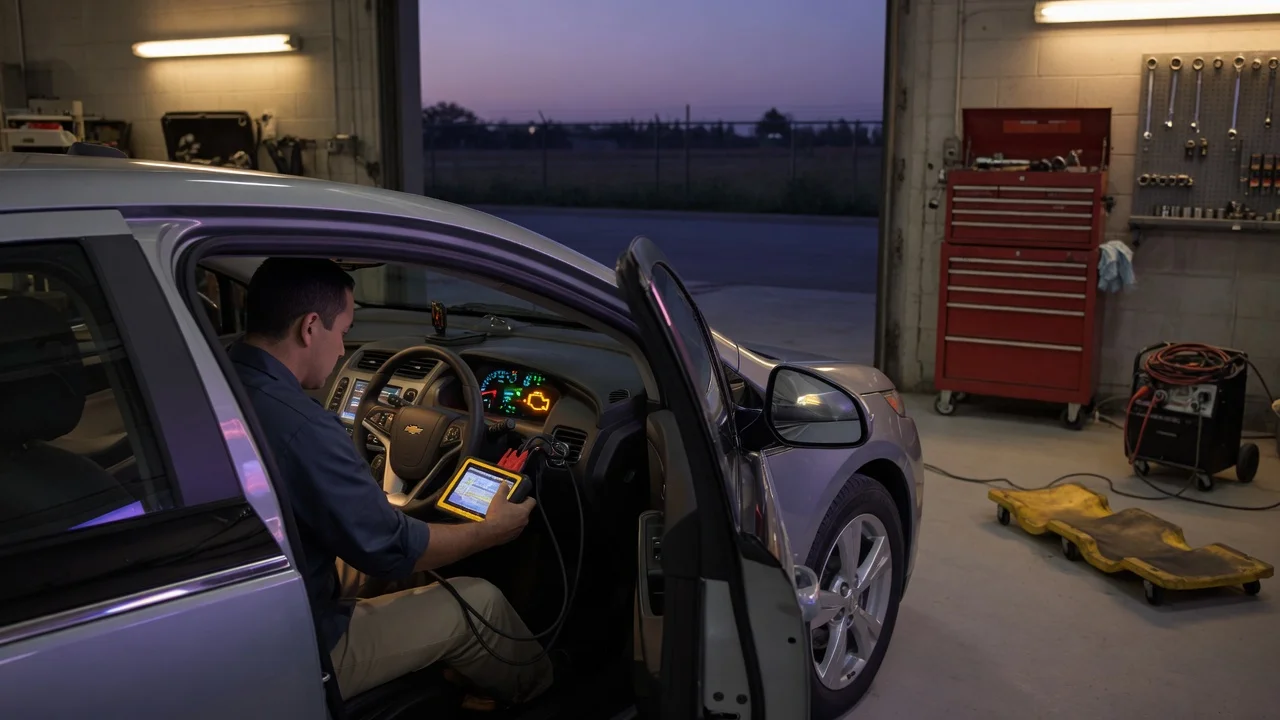
The Volt has a standard OBD-II port. A generic scan tool can show many powertrain codes and freeze-frame data (engine running or not, speed, load, fuel level). Hybrid, battery, and some body or charging codes may require a GM-capable tool. Record every code and whether it is current or history before anyone clears memory; clearing the lamp without a record erases the evidence that points to intermittent faults.
A code names a monitor that failed, not the part to replace. An oxygen-sensor code can be a sensor, wiring, exhaust leak, or fueling problem. A catalyst code can be the converter or a misfire that damaged it. A hybrid-battery code can be a module, a coolant issue, a contactor, or a sensor. Service information for the exact model year is the authority for test order, freeze-frame interpretation, and any software updates. Published tightening values, fluid specifications, and bleed procedures were not supplied for this guide and should be taken from that year-specific documentation rather than from memory or from a different Chevrolet.
Next action
If the lamp is flashing, the car will not move, high-voltage or fuel leaks are present, or temperature warnings accompany the light, stop using the vehicle and obtain professional diagnosis. If the lamp is steady, electric driving is normal, and there is no leak or reduced-power message, tighten the fuel cap if it was loose, scan for codes at the first opportunity, and keep a note of messages and driving conditions. Take the car to a shop equipped to read Volt hybrid modules when codes are hybrid-related, when the lamp returns after a cap or 12-volt battery check, or when propulsion or charging is limited. Until the code and freeze frame are known, replacing parts on guesswork is as likely to miss the fault as to fix it.