Chevy S10 4WD Actuator Bypass: How It Works and When It Makes Sense
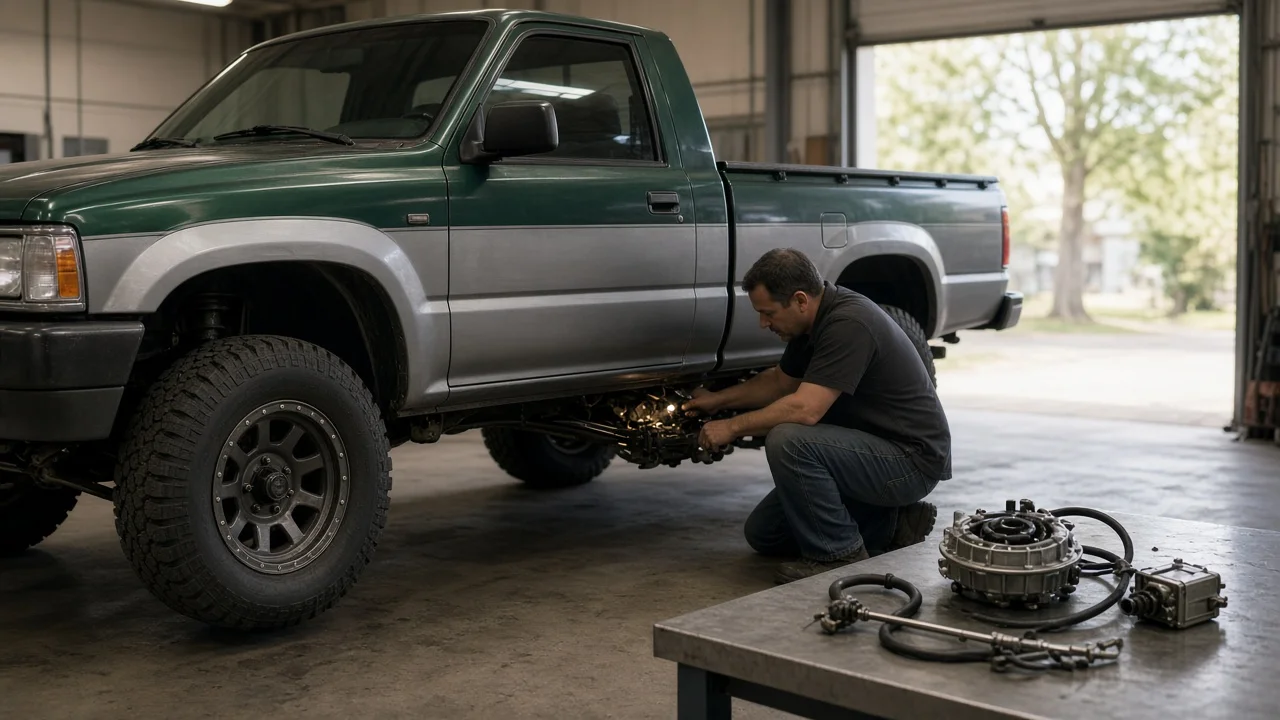
When an S10 won't pull with its front wheels after you shift into four-wheel drive, the front axle actuator is often the first suspect. A bypass replaces or overrides that actuator so the front axle stays connected, which can restore 4WD without buying a new part. It is a workable fix, but it changes how the truck behaves in two-wheel drive. It also only helps if the actuator is the part that failed.
The short answer
Yes, the front axle actuator on a Chevy S10, and on related trucks that use the same front axle disconnect design, can be bypassed. The usual method is to remove the actuator and install a lock-in kit. This is either a fixed plug or a cable-operated mechanism that holds the axle's sliding collar in the engaged position. Once that is done, the transfer case alone decides whether the front axle receives power. In 2WD the front driveshaft, differential and axle shafts keep turning with the wheels but carry no drive torque. In 4WD power reaches the front wheels without waiting for the actuator.
There are two conditions. First, the bypass only solves a failed or unreliable actuator, or a fault in its wiring or vacuum supply. It does nothing for a transfer case, shift motor, control module or driveshaft fault. Second, you give up the fuel and wear savings that the disconnect was designed to provide in two-wheel drive.
How the front axle disconnect works
The S10's four-wheel-drive system is part-time. In 2WD the transfer case sends power only to the rear axle. To keep the front differential from being spun by the wheels during normal driving, the passenger-side front axle is split into two pieces. A sliding collar joins the intermediate shaft to the differential output, and the actuator moves a shift fork that slides this collar in or out.
Depending on the vehicle configuration, the actuator works in one of two ways. Some trucks use a vacuum diaphragm, fed by engine vacuum through a switch or solenoid. Others use an electric thermal unit, in which a heated element expands and pushes a plunger. The thermal type is slow by design and can take noticeable time to engage after you select 4WD.
When the actuator fails to move the collar, the front driveshaft still turns the differential. However, one side of that open differential is spinning freely, so neither front wheel gets usable torque. That is why a dead actuator makes 4WD seem completely absent even though the transfer case has shifted.
What changes the answer
The type of actuator your truck has determines the right kit and the right diagnosis. A vacuum system can fail from a cracked hose, a leaking diaphragm or a faulty switch. An electric thermal actuator can fail from a blown fuse, a corroded connector, a broken ground or a burned-out element. Confirm which design your truck uses from its own parts and service information, not from a general model-year assumption.
The way the transfer case is shifted also matters. On trucks with a floor lever, the bypass removes the main electrical or vacuum link in the front engagement chain. On pushbutton models, a shift motor and control module move the transfer case. If one of those parts is the problem, locking the axle in will not restore 4WD. The dashboard 4WD indicator may also behave differently after the bypass, depending on how your system senses engagement.
Operating conditions affect whether the trade-off is worth it. A truck that spends most of its time on dry highway turns its front driveline for every mile, adding some drag and wear. A truck that often needs 4WD in snow, mud or on trails benefits from engagement that is instant and dependable.
Check before you bypass
Confirm the actuator is actually at fault. On an electric system, check the 4WD fuse. Then unplug the actuator connector and look for corrosion or water, and test for voltage and a good ground at the connector with 4WD selected. If power arrives and the actuator still does not move the collar, the actuator or the fork is the likely problem. On a vacuum system, inspect the hoses, check that the diaphragm holds vacuum, and confirm the switch sends vacuum when 4WD is selected. Also check whether the front driveshaft turns in 4WD. If it does not, the problem is upstream at the transfer case, not at the axle.
If the checks point to the actuator, a bypass or a replacement actuator are both reasonable. Choose based on how you use the truck and whether you want to keep the original 2WD behavior. Review the service history as well. A truck that has had several actuators may have an underlying wiring or water-intrusion problem that a new actuator would not solve.
Doing the bypass and living with it
The actuator bolts to the passenger side of the front axle housing. Follow the instructions supplied with the lock-in kit. Make sure the collar seats fully in the engaged position, seal the mounting surface so the axle does not leak or take on water, and check the front axle fluid level against the manufacturer specifications for your axle. If the actuator was electric, insulate and secure the unplugged connector so it cannot chafe or short.
Afterward, expect the front driveshaft to turn whenever the truck is moving. Some owners notice a little more driveline noise. The truck is still part-time 4WD, so keep it in 2WD on dry pavement to avoid driveline binding. Include the front U-joints, axle seals and differential fluid in your regular maintenance schedule, because these parts now run full time.
Limitations and next step
This guide does not provide part numbers, torque values, fluid capacities or a universal service interval. Those depend on your exact axle and vehicle configuration, so take them from the service manual for your truck or the kit maker's instructions. The bypass can be reversed by refitting a working actuator, which is useful if you later want the disconnect function back.
If 4WD still does not work after the bypass, the fault is elsewhere in the system. Common places to look are the transfer case and its shift mechanism, the front driveshaft, the differential, and the axle shafts. At that point, or if you cannot confirm the diagnosis yourself, an inspection by a technician familiar with these trucks is the sensible next step.