Charging an EV Across a Sidewalk: Cable Protectors, Gullies and Trip Hazards
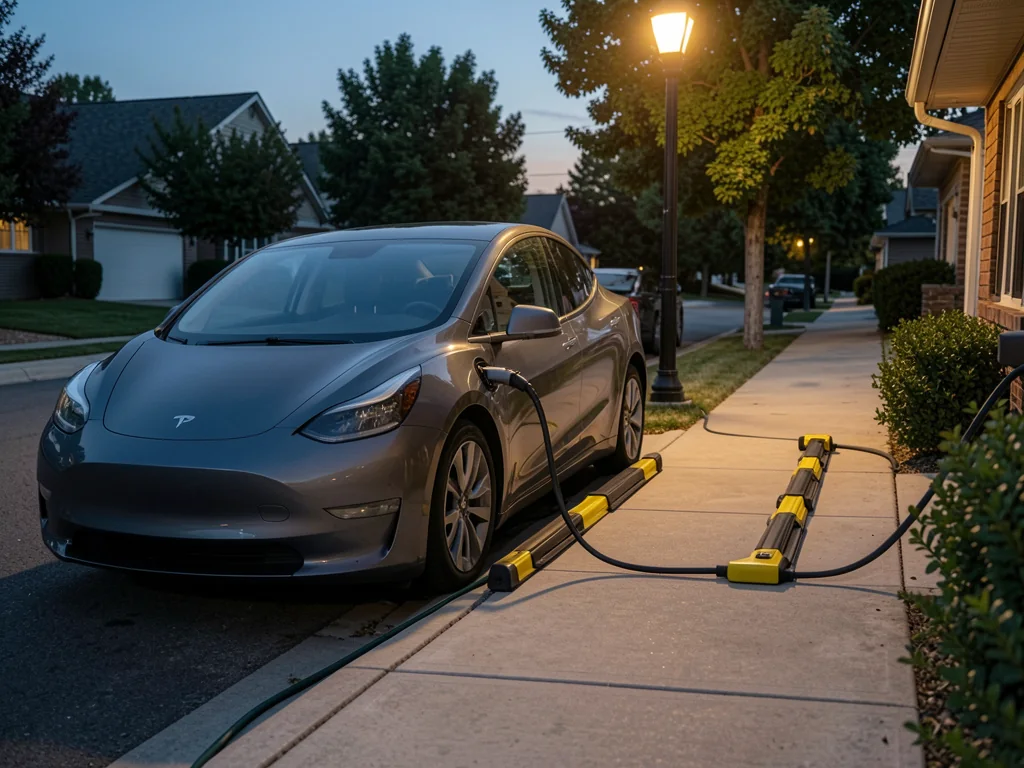
Charging an EV when you rely on street parking often means running a cable from your home across a public sidewalk. Without protection, that cable becomes a trip hazard for pedestrians, wheelchair users and strollers, and it can put you at legal and financial risk. The right outdoor EV charging cable protector or an approved gully route reduces those dangers, but each option has practical limits. This guide explains covers, ramps, flat cables and driveway concerns so you can charge more safely.
Why a Charging Cable Across the Sidewalk Raises Safety and Liability Questions
A loose charging cable across a sidewalk, known as a pavement in the UK, is easy to miss, especially after dark or in wet weather. Pedestrians with limited mobility, people using canes or wheelchairs, and parents pushing strollers can catch a shoe or wheel on the rounded jacket and fall. Even a bright orange cable disappears against fallen leaves or shadows, so the danger persists at all hours. That physical hazard is the starting point for every rule and product discussed later.
Local rules on crossing a public walkway vary widely between cities and counties, and what is tolerated in one neighborhood may be forbidden in another. Many authorities prohibit unapproved obstructions, while others offer pilot programs for on-street charging. Because liability often follows whoever placed the cable, a pedestrian injury could lead to a claim against your home insurance. Under-sidewalk routing is a different matter, normally requiring professional installation and explicit permission before any work begins.
Cable Protectors and Covers: What They Do and What to Look For
An EV charging cable protector, sometimes called a cable ramp or sidewalk cable cover, is a molded channel that sits over the cable and shields it from foot traffic. The cable rests inside a groove, while the outer surface forms a sloped, low-profile hump that is easier to step over than a round cord. Many protectors are made from rubber or heavy-duty polyurethane and snap or hinge closed, keeping the cable centered without pinching the insulation.
Outdoor use demands more than a bright color. The protector should resist UV cracking, stay flexible in freezing temperatures, and include drainage channels so water does not pool around the connectors. Non-slip tread helps in rain, and its load rating must match any possible vehicle crossing. Remember that a protector reduces the trip risk but does not remove it, and placing one on a public sidewalk may still require local approval. Lay it down only while charging, remove it afterward, and check for cracks or sharp edges before each use.
Cable Gullies and Under-Sidewalk Channels
A cable gully is a narrow, covered channel recessed into the sidewalk so the cable lies flush with the walking surface. The lid typically sits level with the concrete, leaving no raised edge to catch a shoe or wheelchair caster. Gullies are installed by cutting a slot into the pavement, laying a conduit or channel, and sealing it with a removable lid. The result looks almost invisible during the day and removes the need for a temporary ramp.
Because a gully alters public property, it nearly always requires permission from the local authority and installation by an approved contractor. Readers should never cut, trench, or modify a sidewalk themselves. Ask the city or local council whether an approved gully scheme exists before arranging anything. In practice, a gully offers a much lower trip risk and a tidier street, but it brings approval steps, higher installation cost, and ongoing maintenance to keep the channel clear of debris, sand and water.
Flat EV Charging Cables: What They Change and What They Don't
A flat EV charging cable uses a lower-profile, ribbon-like jacket instead of the usual round cross-section. This design lets the cable lie closer to the ground, reducing the height an unwary foot must clear. Some flat cables are marketed specifically for on-street charging because they fit more neatly under a protector or door threshold. However, flatness alone does not make a cable safe to leave uncovered across a busy sidewalk.
Even a flat cable can still be caught by a toe or a cane tip, and it still needs a protector or an approved gully where foot traffic is expected. Before buying, confirm that the cable is certified for your charger and vehicle and rated for outdoor use in wet and cold conditions. Purchase from reputable sources and avoid homemade, modified, or uncertified cables and adapters, since a non-compliant cable can overheat or create a shock risk even when it looks solid.
Can You Drive Over an EV Charging Cable?
Whether you can drive over an EV charging cable depends on what the cable manufacturer says, not on guesswork. Some cables are engineered with reinforced jackets and conductors that tolerate occasional vehicle weight, while others are only meant for foot traffic. Check the cable and charger manual for a load or crush rating before allowing any tire to cross. If the documentation is silent, treat the cable as not drive-over rated.
Repeated crushing, sharp driveway edges, or a parked tire resting on the cable can damage the outer jacket or internal conductors even when nothing looks wrong. After any potential drive-over, unplug the cable and inspect it for cuts, flattening, kinks, exposed wires, a cracked connector, or scorch marks. A damaged cable must be taken out of service and inspected or replaced by the manufacturer or a qualified professional, never taped or repaired at home. A load-rated protector can help where vehicles must cross, but only within its stated rating.
Safer Everyday Habits and When to Get Professional Help
Safer habits begin with planning the route. Charge at quieter times where practical, keep the cable as short and direct as possible, and cross the walkway at a right angle to minimize the length in the pedestrian path. Avoid leaving slack loops or coils on the ground, and unplug and store the cable as soon as charging finishes. Consider using a weatherproof outlet with a locking cover and keeping the connector off the ground with a small stand or bollard where allowed.
For longer-term safety, ask a licensed electrician to assess your outdoor outlet or charger installation, including weatherproofing and circuit protection such as a dedicated RCD or GFCI. Follow the charger and vehicle maker's guidance on extension cords and adapters, and never improvise electrical connections outdoors. Contact your local authority to ask about official options for street-parked drivers, such as approved channel schemes, gully permits, or nearby public charging. Being considerate of neighbors and pedestrians means removing every cable and protector once charging is done.