How to Change a Flat Tire Safely
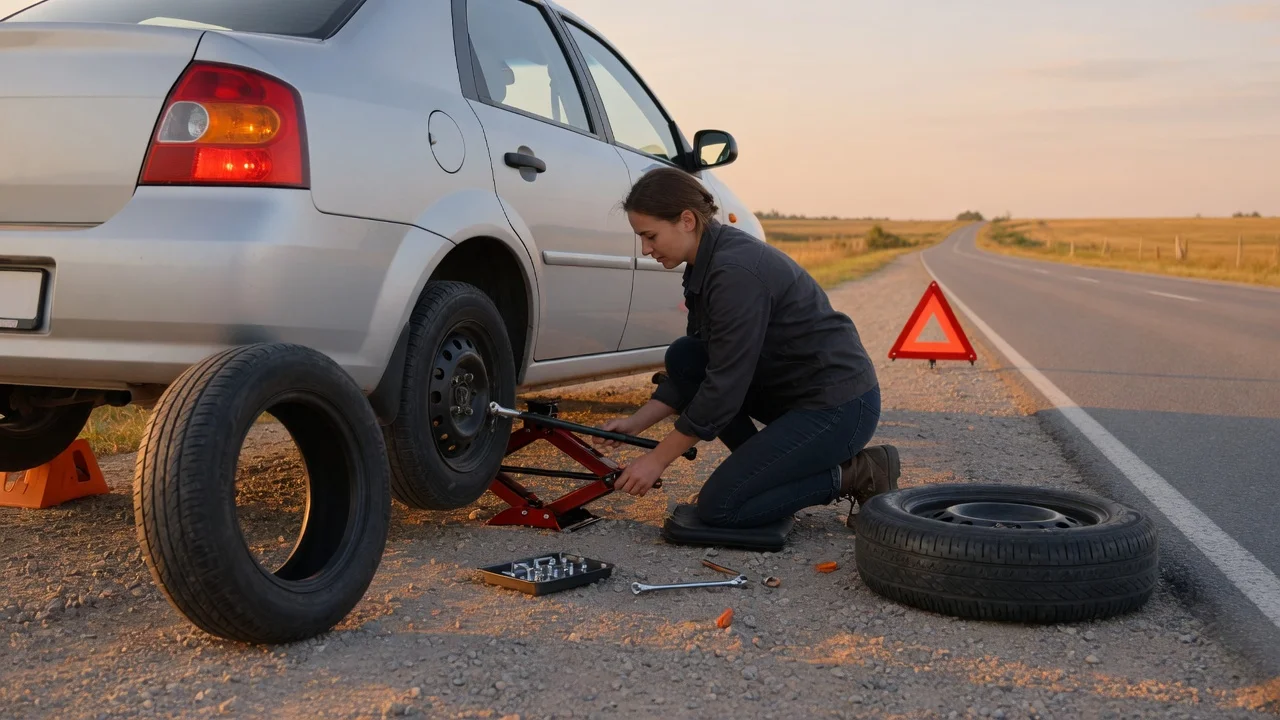
Before you start
Move the vehicle to a firm, level area away from traffic before lifting it. Set the transmission to Park for an automatic or first gear for a manual, apply the parking brake, and turn off the engine. If the wheel requires a locking key, keep that key with the tire changing tools rather than in the glove box where it may be hard to find later.
A spare wheel, jack, and lug wrench are the basic items needed. Some vehicles carry a tire repair kit instead of a spare; check the owner’s manual for the location of the jack points and any model-specific procedure. The process is normally performed locally beside the vehicle and does not require a connected service.
Step-by-step instructions
1) Place chocks or a suitable object against the wheel opposite the flat to help prevent movement. Remove the spare, jack, wrench, and any extension or key from their storage locations and set them within reach.
2) Remove the hubcap or wheel cover if needed to reach the lug nuts. Loosen the lug nuts slightly by turning the wrench counterclockwise while the tire is still on the ground; do not remove them yet.
3) Position the jack under the recommended lifting point for the affected wheel. Raise the vehicle only until the flat tire clears the ground enough to install the spare.
4) Remove the lug nuts, pull the wheel straight off, and set it flat under the vehicle frame as a temporary precaution while working. Fit the spare onto the hub, align the holes, and tighten the nuts by hand in a star pattern.
5) Lower the vehicle until the spare touches the ground and carries some weight, then tighten the nuts again with the wrench in the same pattern. Lower the jack fully and finish tightening according to the manual, if a specified order or torque is given.
Check the output
Press once on the vehicle at each corner of the changed wheel area and listen for movement or clicking. Confirm that a space-saver spare is centered and that the lug nuts feel uniformly tight when checked with the wrench. Recheck the nuts after a short drive when the manual recommends it.
Common problems and next steps
A wheel that will not come off is often held by corrosion around the hub; a careful kick to the tire sidewall or a rubber mallet can help, but keep the vehicle supported and never force the wheel while the vehicle is unstable. Avoid lifting on a slope or soft ground, where the jack may sink or shift. If the space-saver spare has a lower speed or distance limit printed on it, follow that limit until the full-size tire is repaired or replaced.