Catalytic Converter Delete: Consequences and US Legal Requirements
The essential answer
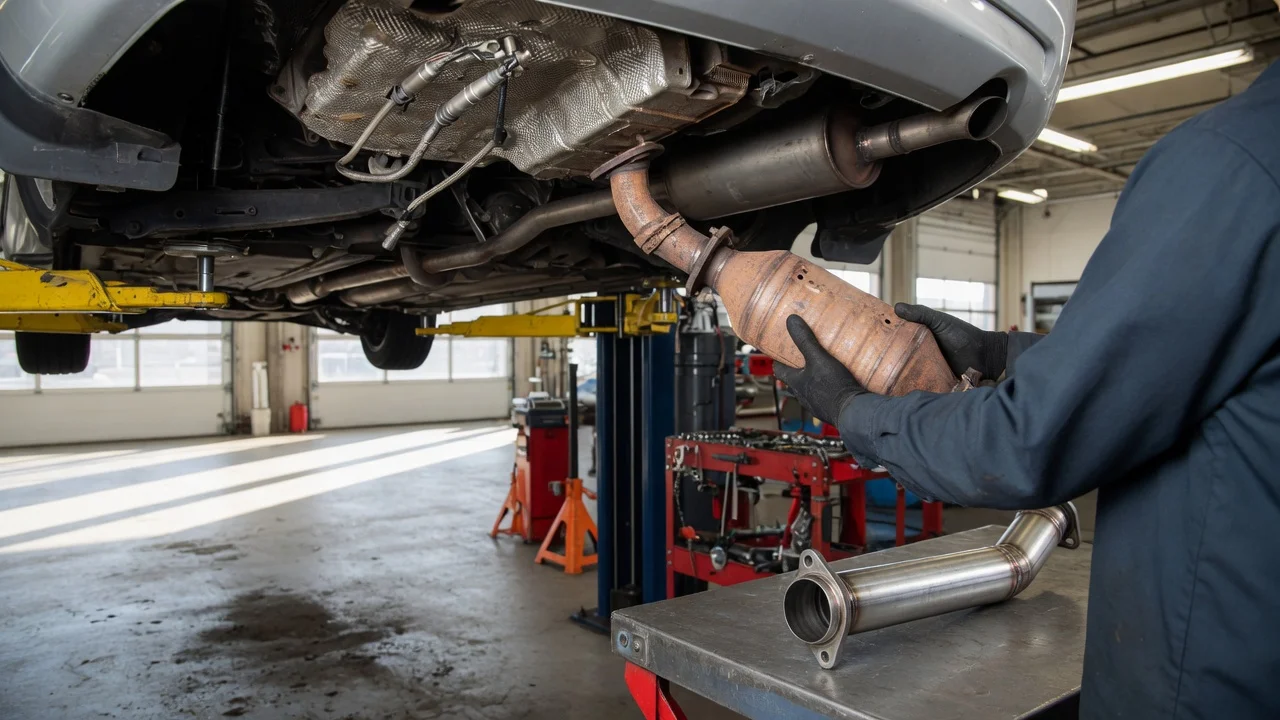
A catalytic converter delete is the removal of a vehicle’s catalytic converter, or its replacement with a straight pipe or other non-catalyzed exhaust section. In the United States, that modification is illegal on motor vehicles used on public roads. Federal anti-tampering rules treat the converter as a required emission-control device, and many states add inspection, registration, and smog-check barriers that a deleted system will not pass. The material qualifications are use and market: a dedicated off-road or closed-course vehicle can fall outside some on-road requirements, but driving a deleted vehicle on public streets remains prohibited. This article addresses U.S. on-road practice; rules in other countries are outside its scope.
What a delete actually changes
The catalytic converter sits in the exhaust and uses a catalyst (typically precious metals on a ceramic or metallic substrate) to convert carbon monoxide, unburned hydrocarbons, and oxides of nitrogen into less harmful gases before they leave the tailpipe. A delete removes that reaction path. Gasoline engines and diesel engines both use exhaust aftertreatment. On diesels, related hardware can include a diesel oxidation catalyst, a diesel particulate filter, and selective catalytic reduction; removing any of those systems for on-road use is the same class of tampering as a gasoline converter delete.
US legal requirements
Federal law under the Clean Air Act prohibits removing, disabling, or rendering inoperative emission-control equipment on a certified motor vehicle, and it prohibits manufacturing, selling, or installing parts whose principal effect is to bypass, defeat, or disable that equipment. Catalytic converters on federally certified on-road vehicles are covered. The prohibition applies to vehicle owners, independent shops, and parts makers. Labeling a pipe or kit “off-road only” or “for racing use” does not authorize street use of the modified vehicle.
State and local programs add a second layer. Jurisdictions that require onboard-diagnostic (OBD) or tailpipe inspections typically fail a vehicle with a missing catalyst, a non-functioning converter, or related diagnostic trouble codes. California and states that follow California emission rules are among the strictest. Registration, renewal, and title transfer can be withheld until the vehicle is returned to a legal configuration. Exact test methods, model-year cutoffs, and county-by-county coverage vary by state; a complete inspection table was not supplied for this article, so local motor-vehicle or air-quality rules should be checked for the vehicle’s registered location.
Civil penalties can apply to tampering and to the sale or installation of defeat devices. Specific current dollar amounts are set by statute and by Environmental Protection Agency (EPA) policy and are not quoted here because they change and were not provided as a fixed figure in the source brief. Commercial installers and parts sellers generally face higher enforcement exposure than a single owner, but owner tampering is still unlawful.
Consequences of removing the converter
Failed emissions inspection and possible inability to register or renew the vehicle in inspection states. Civil penalty risk for tampering, for the owner and for any shop that performed the work. A malfunction indicator (check-engine light) and stored catalyst-efficiency or oxygen-sensor codes on OBD-equipped vehicles. Higher tailpipe emissions of carbon monoxide, hydrocarbons, and oxides of nitrogen compared with a functioning factory converter. Possible increase in exhaust odor and noise. Warranty denial on related powertrain or emissions components when the modification is discovered. Complications for insurance claims, inspection stations, and resale if the delete is found.
Performance and fuel-economy claims for a delete are often advertised in the aftermarket. No independently documented horsepower, torque, or economy figures were supplied for this article, so those claims should be treated as unverified. Any modest flow change does not alter the legal status of on-road use.
Qualifications that change the picture
Use of the vehicle is the main split. A vehicle that never operates on public roads—for example a closed-course race car or a machine used only off highway—can be treated differently from a street-registered car or truck. Once that vehicle is driven on public roads, federal tampering rules and state inspection rules apply. Model year and original certification also matter: vehicles built with catalytic converters remain subject to anti-tampering rules for on-road use regardless of age in federal practice, while state inspection programs often use model-year cutoffs that should be confirmed locally. Trim and certification family matter as well. A California-certified vehicle can face different inspection standards than a 49-state federal vehicle. Gasoline, diesel, and hybrid powertrains that were certified with catalysts or related aftertreatment are all in scope; deleting aftertreatment on a modern diesel is not a lawful on-road workaround.
A supported next step
Keep the factory catalytic converter in place on any vehicle that will be driven on public roads. If the converter has failed, replace it with a legal original-equipment or aftermarket unit that meets the EPA or California Air Resources Board standard that applies to that vehicle’s certification, model year, and registered state. Do not install a delete pipe, test pipe, or off-road converter-delete kit on a street-driven vehicle. If a delete is already installed, restoring a compliant converter and clearing related faults is the path back to lawful inspection and registration. For a penalty, inspection failure, or commercial-install question, a qualified emissions shop or the relevant state motor-vehicle agency can apply the local rule set to the specific vehicle.