Catalytic Converter Delete: Consequences and Replacement Alternatives
What the essential answer is
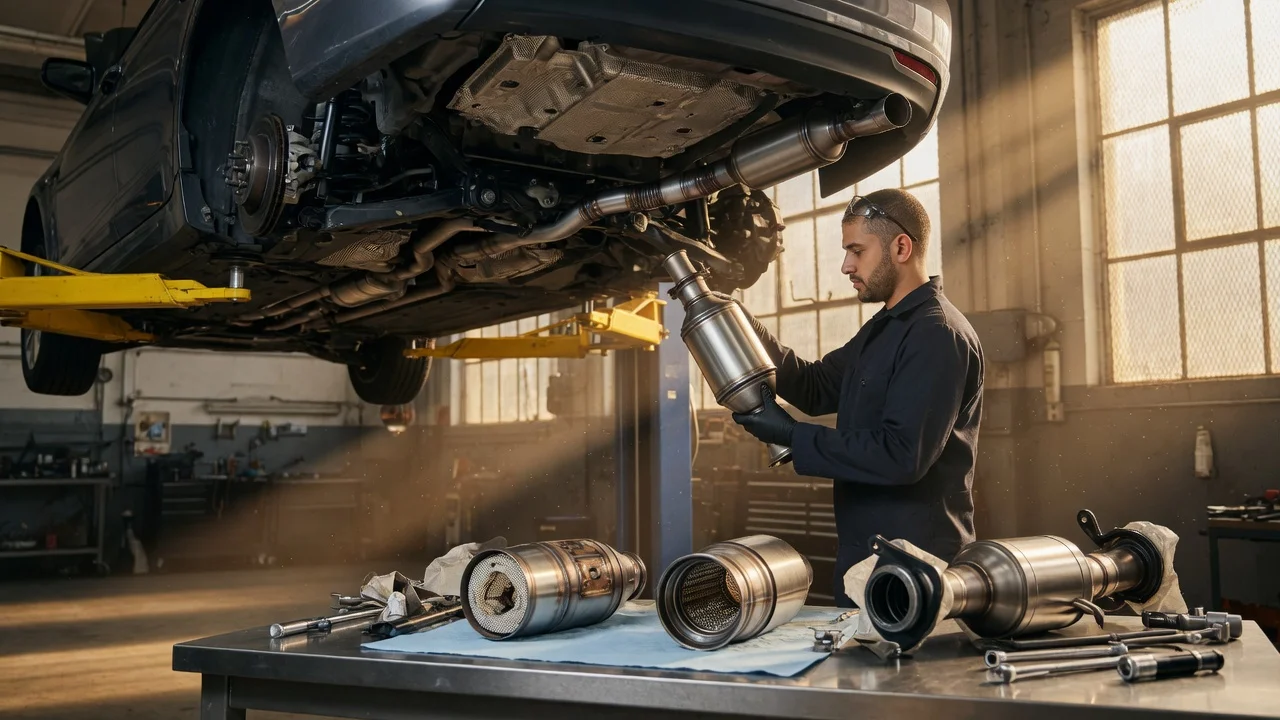
A catalytic converter delete means removing the factory catalyst and replacing it with a straight pipe, test pipe, or other non-catalyzing section of exhaust. On a vehicle driven on public roads, that change is treated as tampering with an emissions-control device in the United States and in most other markets that certify street vehicles. The practical result is higher untreated exhaust emissions, a high likelihood of a malfunction indicator lamp (check-engine light), failed inspection or emissions testing where those programs exist, and exposure to federal, state, or local penalties. Off-highway competition vehicles that never operate on public roads sit outside that street-use rule in many jurisdictions, but a race-only or off-road pipe does not make the same vehicle legal once it returns to the street.
The catalytic converter is the exhaust aftertreatment brick that uses a precious-metal washcoat, typically platinum, palladium, and rhodium on gasoline three-way catalysts, to convert carbon monoxide, unburned hydrocarbons, and nitrogen oxides into carbon dioxide, water, and nitrogen. A delete removes that chemical function. It does not repair a failed converter, restore fuel trim, or put the engine control unit (ECU) back into a compliant monitor state. If the converter is clogged, stolen, or inefficient, a legal replacement catalyst is the supported next action for a street-driven vehicle; a delete is a compliance and durability problem, not a maintenance substitute.
Legal, inspection, and ownership consequences
In the United States, the Clean Air Act prohibits manufacturers, shops, and vehicle owners from removing or rendering inoperative an emissions-control device on a motor vehicle used on public roads. Parallel anti-tampering rules apply in Canada, the United Kingdom, the European Union, and many other certification markets; the exact statute, inspection method, and penalty schedule vary by country, state, and province. Civil penalties can apply to the person who installs the delete and to the owner who operates the vehicle. Specific fine amounts, criminal exposure, and whether a shop or an individual is charged are jurisdiction-dependent and are not a single nationwide figure.
Where periodic inspection or on-board diagnostics (OBD) testing is required, a missing catalyst almost always fails. Inspectors look for the converter in the exhaust, for intact oxygen sensors, and for a ready OBD catalyst monitor with no catalyst-efficiency faults. Common stored codes include catalyst-system efficiency below threshold (often P0420 or P0430 on gasoline engines) and downstream oxygen-sensor circuit or activity faults. Even in regions without a tailpipe test, a lighted malfunction indicator can fail a safety or OBD inspection, complicate registration, and reduce resale value because a buyer or dealer can see the hardware and the scan-tool history.
Insurance, warranty, and resale effects follow from the same facts. An emissions-related warranty does not cover a deleted converter. A powertrain or aftermarket-parts warranty may be denied for damage traced to the modified exhaust. Insurers and later buyers can treat an illegal exhaust as a material modification. None of those outcomes is guaranteed in every claim file, and the size of any premium, payout, or price effect is not documented here.
How the vehicle behaves after a delete
Modern engine computers use at least one upstream oxygen or air-fuel sensor to control mixture and at least one downstream sensor to judge catalyst efficiency. After a delete, the downstream sensor typically sees a signal that looks like an empty pipe, so the catalyst monitor fails and the malfunction indicator stays on. Some owners add a spacer, mini-catalyst, or emulator on the downstream sensor. Those devices are still tampering when used to hide a missing converter on a street vehicle, and they do not restore legal aftertreatment.
Noise usually rises because the converter ceramic or metallic substrate is also a muffler of sorts. Exhaust smell and heat at the tailpipe can change. Untreated hydrocarbons and carbon monoxide increase; nitrogen-oxide control is lost on a three-way gasoline catalyst. Diesel vehicles are a different system: a cat-delete conversation often includes the diesel oxidation catalyst, diesel particulate filter, and selective catalytic reduction hardware. Removing those components on a highway diesel is likewise tampering, can trigger derate strategies, and is outside the legal replacement path described below.
Performance claims are not uniform. A melted or clogged converter can steal power by raising backpressure, so replacing that failed unit can restore output. A healthy factory converter on a late-model, computer-controlled engine is already a relatively low restriction; deleting it does not produce a documented, universal horsepower gain, and some naturally aspirated calibrations lose low-speed torque when exhaust velocity and backpressure change. Forced-induction engines may show a different response. No independent dynamometer set, fuel-economy test, or emissions laboratory result is supplied in this brief, so any specific gain, loss, or miles-per-gallon figure would be unsupported.
Replacement and repair options compared
For a street-driven vehicle the real choice is among legal catalyst replacements, not between a delete and a converter. Shared decision criteria are street legality, inspection and OBD readiness, drivability and warning-lamp risk, noise, durability, and cost. Sticker prices, labor hours, and precious-metal surcharges move with vehicle, converter location (manifold-mounted versus underfloor), market, and theft-driven demand; no comparable price table is available here.
Option Street-legal intent Inspection and OBD Warning-lamp risk Best-fit situation; Catalytic converter delete (straight or test pipe) No, for public-road use in typical certification markets Fails visual, tailpipe, or OBD catalyst checks where those exist High, unless further illegal sensor defeat is added Closed-course competition vehicles that never operate on public roads; Original-equipment (OEM) converter Yes, when it is the certified part for that vehicle Restores the intended catalyst monitor and visual presence Low when the rest of the fuel and ignition system is healthy Owners who want the factory calibration, fitment, and warranty path; Aftermarket converter sold as a legal replacement Yes only if it is certified for that vehicle and market (for example a CARB EO part in California, or an EPA-accepted replacement where that standard applies) Can pass when the part is the correct application and is welded or clamped in the original location Low to moderate; a cheap uncertified brick is a common source of P0420 returns Cost-sensitive street repairs when a correctly certified direct-fit or universal unit is available; High-flow or performance catalytic converter Street-legal only when it still meets the applicable replacement or exemption rules for that vehicle Varies with substrate cell count, loading, and whether the part is actually certified Moderate if the brick lights off slowly or is undersized for the monitor Enthusiasts who want less restriction than a clogged OEM unit while remaining inspectable; Used, recycled, or cut-and-weld take-off converter Only if the used unit is complete, undamaged, and legal to install on that vehicle Uncertain; age, contamination, and physical damage can fail the monitor quickly Moderate to high Short-term repair when a matching take-off is verified good and local rules allow used emissions parts
An OEM converter is the default when the goal is a quiet, inspectable, warranty-friendly repair. It matches pipe diameter, oxygen-sensor bung location, heat shields, and the ECU catalyst-efficiency thresholds. Direct-fit aftermarket units that carry the certification required in that market are preferable when OEM pricing is prohibitive and the catalog application is explicit for the engine, model year, and federal or California emissions group. Universal converters cost less in the box but need correct length, diameter, sensor placement, and professional welding; a bung in the wrong place will keep the monitor from passing.
High-flow converters trade some conversion margin for lower restriction. They are a fit only when the part is still a functioning, legal catalyst for that vehicle, not a hollow shell. Used converters can be a stopgap after theft, which is common because of the precious-metal content, but a take-off unit may already be aged out of the efficiency window the ECU expects. Manifold or close-coupled converters, common on many vehicles from the mid-2000s onward, are more expensive and more theft-prone than a single underfloor brick; replacement cost and whether the manifold and converter are one casting are model-year and powertrain specific.
Which option fits which priority
Choose a delete only if the vehicle is a dedicated off-highway competition piece and local law treats it as such. That path does not fit a daily driver, a leased vehicle, a financed vehicle with inspection requirements, or any car that must pass OBD or tailpipe testing.
Prioritize OEM replacement when you need the highest confidence of inspection pass, factory noise, and a clean scan-tool record, and when the converter is integral to the exhaust manifold or covered by remaining emissions warranty. Prioritize a certified aftermarket direct-fit converter when budget is the constraint, the catalog lists your exact engine and emissions group, and you will have it installed with the original sensor locations preserved. Prioritize a certified high-flow converter when the factory unit is damaged or restrictive and you still need a street-legal catalyst; treat uncertified race cats as deletes for legal purposes. Prioritize diagnosis before any hardware change when the complaint is a P0420-type code, loss of power, or sulfur smell: ignition misfire, rich mixture, coolant in the exhaust, or oil burning can destroy a new converter as quickly as the old one. Prioritize theft-prevention hardware (end-plate welds, shields, alarms) after replacement in high-theft areas; a new brick has the same scrap value as the one that was cut out.
A delete is not the better performance option on a street car relative to repairing a failed converter or fitting a certified high-flow unit. The failed converter is the restriction; the legal replacement restores flow without abandoning the catalyst monitor. If a shop proposes a test pipe just to see, understand that operating that configuration on public roads remains tampering even as a temporary experiment.
What to do next
Confirm whether the vehicle is a street vehicle or a true off-highway competitor, then confirm local inspection rules and whether the original converter is manifold-mounted, underfloor, or both. Scan for catalyst, misfire, fuel-trim, and oxygen-sensor codes, and repair mixture or ignition faults before installing a new brick. Quote OEM and certified aftermarket parts for the exact model year, engine, and federal versus California (or equivalent) emissions calibration. Have the replacement welded or clamped so heat shields and sensor bungs match the original layout, then complete a full drive cycle so the catalyst monitor can set to ready. If the converter was stolen, file the theft report your insurer requires and ask the installer about shields or welds that make a repeat cut harder. Specific part numbers, current prices, and penalty amounts for your plate jurisdiction are not included here and should be taken from the vehicle build data, a dealer or specialist quote, and the motor-vehicle or environmental agency that inspects the car.