Cars With the Worst Fuel Economy: What the Numbers Reveal
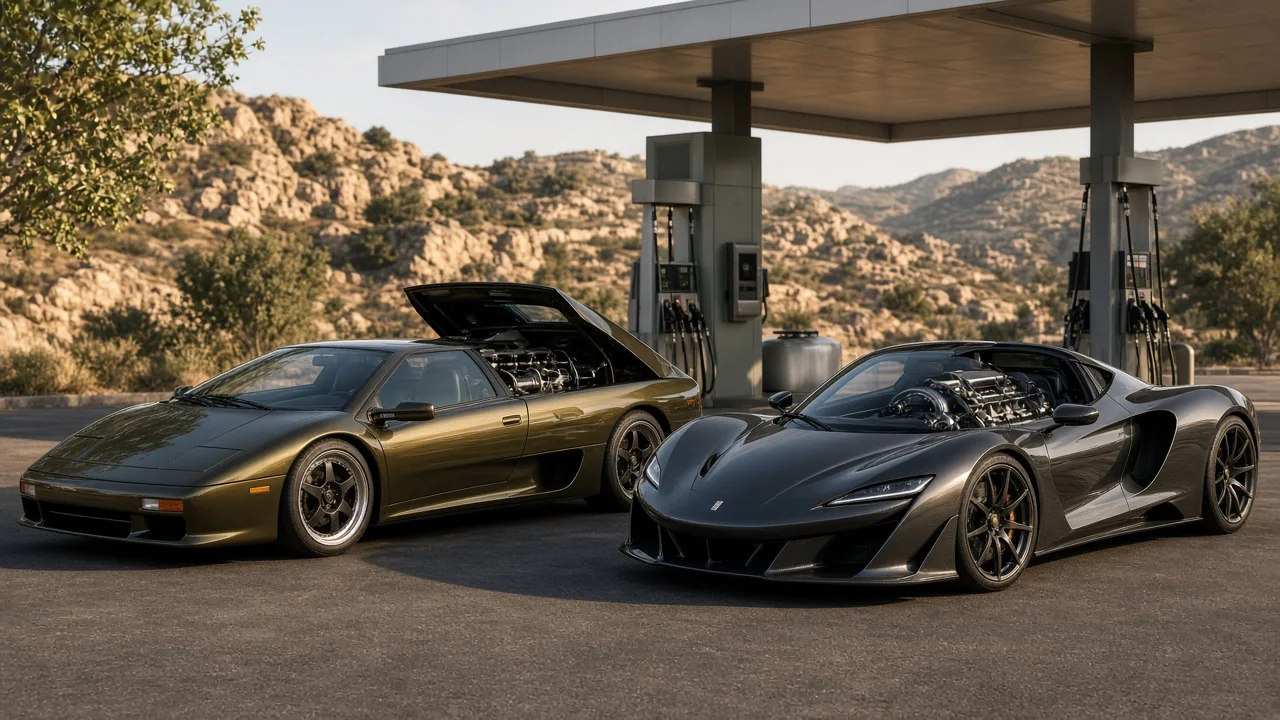
Interest in the car with the worst fuel economy is really a question about production cars and how their fuel consumption is measured. City MPG, highway MPG, and combined MPG describe different driving, and US miles per gallon is the usual American unit. Asking what car has the worst fuel economy, or naming a worst fuel economy car ever, still requires a defined group of road-legal passenger cars and a comparable test.
Why an All-Time Worst Fuel Economy Claim Needs Boundaries
An all-time claim about the car with the worst fuel economy cannot stand without first deciding which vehicles count and which rating is being compared. Road-legal production passenger cars, including exotics and luxury cars, form a coherent group for comparison. Race cars, prototypes, heavily modified vehicles, and commercial trucks sit outside that group because they were not sold or used as ordinary passenger cars. Mixing those categories turns a ranking into a comparison of unrelated machines.
Even inside that group, naming the worst fuel economy car ever still requires a measurement method. Historical test procedures changed over decades, so an older city MPG figure is not automatically comparable with a later combined MPG label. Incomplete records leave gaps for some model years and markets. National ratings also differ, which means a US miles per gallon number and a rating published under another country's procedure can describe similar fuel consumption in ways that do not line up. Those limits keep an all-time ranking from being a simple contest.
What a Worst-MPG Figure Actually Measures
A worst-MPG figure is only as useful as the driving cycle behind it. City MPG reflects stop-and-go work, frequent idle, and lower average speed. Highway MPG describes steadier cruising with fewer stops. Combined MPG blends those conditions rather than replacing them. A very low city rating does not by itself establish an overall record if highway or combined numbers tell a different story. US miles per gallon and Imperial miles per gallon also use different gallon sizes, so the unit must travel with every figure or the comparison is distorted.
Identifying what car has the worst fuel economy also means naming the specific vehicle behind the rating. Model year, engine, transmission, and the market where the car was certified all change the result. Two cars that share a nameplate can differ once engine displacement, gearing, or emissions calibration change. Owner reports and fuel use during track driving describe particular trips, weather, and driving style. Those observations are useful, but they are not the same as a standardized production-car rating, and a single fill-up should not be treated as a laboratory record.
Production Exotics That Illustrate Heavy Fuel Use
The Bugatti Veyron is a useful production example because it was built as a road-legal hypercar around a large, turbocharged W16 engine and the performance that engine was meant to deliver. That combination of engine displacement and sustained power demand points toward heavy fuel consumption without requiring an unsupported ranking. The Lamborghini Countach illustrates a different era of the same idea: a classic V12 exotic whose fuel demands belong to a particular version, with any available consumption records tied to that specification rather than to every Countach ever sold.
The Ferrari Testarossa adds another production twelve-cylinder example. Historical fuel economy figures for that car need their original measurement context, including whether a published number was a city, highway, or combined rating and which gallon was used. Together, these exotics show how production cars built for high performance can sit at the thirsty end of the scale. They do not establish a numerical order or name an absolute record holder. Without comparable test methods and complete records, they remain illustrations of heavy fuel use rather than a ranked all-time list.
Why These Cars Consume So Much Fuel
Engine displacement, internal friction, and pumping losses help explain why some production cars burn so much fuel. A larger engine moves more air and fuel during each cycle, and friction inside the rotating assembly consumes energy even before the car accelerates. Pumping losses rise when the engine works against restricted airflow at part throttle. Cylinder count alone cannot predict miles per gallon, because a smaller high-revving engine can still consume heavily under load. Delivering substantial power requires fuel, and both hard acceleration and sustained high engine load raise consumption quickly.
Vehicle mass affects the energy required for every acceleration, so a heavy exotic spends more fuel leaving a stop than a lighter car with similar gearing. Aerodynamic drag then takes over at speed, creating substantial demand as air resistance rises with velocity. Gearing decides whether the engine is turning in an efficient range or working hard at high rpm. Engine calibration and operating temperature also matter: a cold engine, an aggressive map, or a trip that never reaches a stable temperature can all increase fuel consumption even when the published combined MPG looks unchanged.
What Heavy Fuel Consumption Means in Everyday Ownership
In everyday ownership, short trips, idling, traffic, and repeated acceleration can make real-world fuel use depart from a published combined MPG rating. City driving often tracks the city MPG figure more closely than the highway number. Fuel tank capacity affects driving range, but a larger tank does not make the car more efficient; it only delays the next fill-up. Fuel cost can be estimated from annual miles divided by US MPG, then multiplied by the owner's local price per gallon, which reflects that driver's mileage and local fuel price.
A sudden change from a car's established consumption pattern deserves attention. If fuel use rises without a matching change in trips, weather, or load, the increase is a reason to inspect rather than a diagnosis by itself. Warning lights, rough running, or a fuel odor call for professional assessment. A stored fault code is evidence to interpret, not proof that a particular part has failed, and manufacturer-dependent codes need vehicle-specific confirmation. Until that assessment is complete, treating the car as if a component has already failed can send repair work in the wrong direction.