Car Water Pump Repair vs. Replacement: What the Job Involves
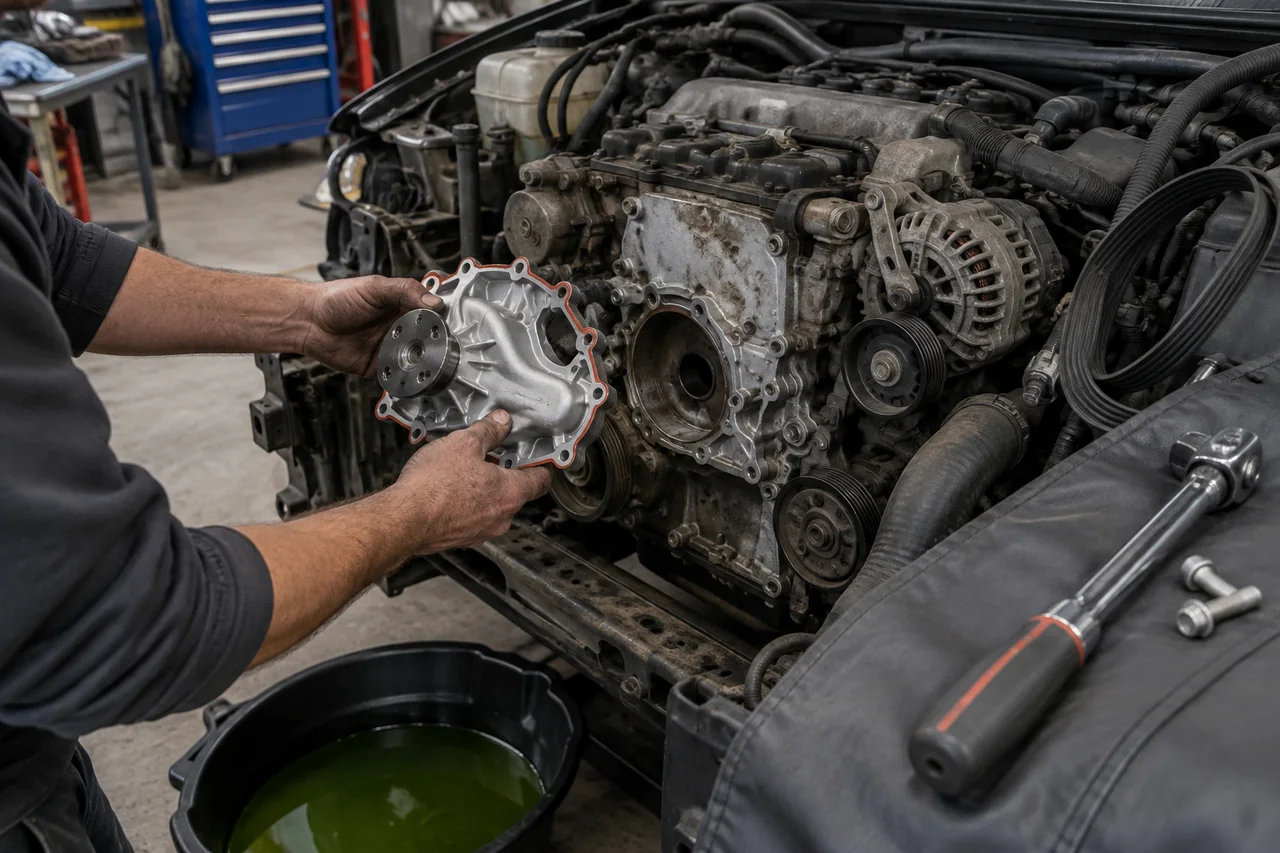
When coolant starts dripping from the front of the engine or a whine rises with engine speed, many owners wonder whether the water pump can be fixed. In practice, the answer is almost always replacement. The real question is how involved that job becomes on a particular engine. Here is what wears out, what the work involves, and where a shop earns its keep.
Why a Failing Water Pump Is Replaced, Not Repaired
A water pump has three parts that wear with use. The shaft seal keeps coolant from escaping along the spinning shaft. Once it hardens or gets scored, coolant seeps out through the weep hole, a small drain meant to show that the seal is leaking. The bearing carries the pulley load and eventually develops play or noise. The impeller can corrode, erode, or crack on some designs. On most modern engines these parts are pressed together in a sealed unit, with no service parts available.
That is why fixing a water pump really means installing a new or remanufactured unit. A home rebuild would mean pressing bearings and seals to precise depths, which few garages can do reliably. Stop-leak additives may slow a seep for a while, but they can't restore a worn seal or bearing, and some can clog radiator passages or heater cores. Tightening the mounting bolts won't stop a shaft-seal leak either. Pump design also matters: some bolt on as a complete housing, while others are a cartridge inserted into the block.
Symptoms That Point to the Water Pump and What to Check Safely
Classic signs include coolant weeping or crusty, colored residue around the weep hole, a whine or grinding from the front of the engine that changes with RPM, and a temperature gauge reading higher than usual. With the engine off and fully cool, you can safely look for dried coolant tracks below the pump and check whether the reservoir level keeps dropping between top-offs. You can also grasp the pump pulley and feel for wobble or roughness. Noticeable play suggests a worn bearing.
These checks give you clues, not a diagnosis. A leak near the pump may actually come from a hose connection, the thermostat housing, or a heater hose above it. Noise often comes from an idler pulley or belt tensioner instead. Confirm the source before buying parts. Never open the radiator cap or reservoir while the system is hot, because pressurized coolant can cause serious burns. If the gauge climbs or a warning light comes on, stop the engine and have the system tested instead of driving on.
What a Water Pump Replacement Job Involves Step by Step
The general sequence stays the same even though the details vary. Let the engine cool completely, drain the coolant into a suitable container, and remove the drive belt and any parts blocking access. Then unbolt the old pump, clean the block mating surface, and fit the new pump with a new gasket or seal. Access is the big variable. On some cars the pump sits right at the front of the engine. On others it hides behind the timing cover or under the intake manifold, which multiplies the labor.
Surface prep and bolt tightening decide whether the repair stays dry. Old gasket material, corrosion, or scratches on the mating surface can leave a leak path, so clean the surface carefully without gouging soft aluminum. Pump bolts usually have a specific tightening sequence and torque, and uneven clamping can distort the housing or crush the gasket. Follow the service procedure for your vehicle rather than a generic guide. Catch the used coolant and dispose of it according to local rules, since it is toxic to people and pets.
Belt-Driven vs. Timing-Belt-Driven Pumps and Preventive Replacement
What drives the pump changes the job dramatically. A pump turned by the serpentine belt is usually reachable once that belt is off. A pump driven by the timing belt, or on some engines the timing chain, sits inside the timing system. Reaching it means removing the timing covers and the belt or chain, then restoring exact camshaft and crankshaft alignment during reassembly. That extra work is why the replacement decision on these engines usually depends on when the timing service is due.
Because most of the labor overlaps, a timing-belt-driven pump is usually replaced during timing belt service. If the old pump failed later, the whole teardown would have to be repeated. Worse, a seizing pump can strip or snap the belt. On an interference engine, that can let valves hit pistons and cause serious internal damage. Whether the pump comes in a timing kit, and when the service is due, depends on the engine, so check the owner's manual or a service database.
Gaskets, Coolant Refill, and Bleeding Air From the System
The gasket or O-ring is always replaced with the pump, because a seal that has already been compressed won't seal reliably a second time. Some designs use a formed-in-place sealant instead, and the wrong product or too much of it can block passages or fail early, so use exactly what that engine calls for. Refill with the coolant type and concentration specified for the vehicle. Mixing incompatible coolants can cause gelling, sludge, or corrosion. A coolant flush may be worthwhile if the old fluid looks contaminated.
Bleeding the air out matters as much as the pump itself. Trapped air can cause overheating, erratic gauge readings, and weak heater output, especially when the thermostat or cylinder head sits higher than the radiator. Many engines have bleed screws or a specific fill procedure, and a vacuum filler can make purging easier. Afterward, watch the coolant level over the first several drives, look for drips at the pump and hose joints, and make sure the temperature stays steady in normal driving.
Tools Required, DIY Limits, and When to Use a Shop
A typical tool set includes sockets and extensions, a torque wrench, a drain pan, and often a belt tensioner tool. A pressure tester or vacuum fill kit helps with checking for leaks and refilling. The exact needs depend on the vehicle. The job goes beyond a typical home garage when the timing belt or chain is involved, when the pump sits under the intake or front cover, or when special locking tools are needed to hold the valve timing during reassembly.
A shop pressure test is often worth doing before replacing anything. Pressurizing the cooling system can show whether coolant is escaping from the pump, a hose, the radiator, or somewhere less obvious. The same inspection may turn up a worn thermostat or a cracked reservoir. Professional help is strongly recommended whenever the engine has overheated. A warped cylinder head or failed head gasket may need to be diagnosed along with the pump, and a new pump won't fix that damage.