Car Radiator Coolant: What It Is, Which Type to Use and What to Do When Your Car Overheats
The Short Answer
Car radiator coolant, often called antifreeze, is the fluid that circulates through the engine and radiator to carry heat away from the engine. It also protects against freezing in cold weather and helps prevent internal corrosion. The correct coolant for your car is the type specified by the vehicle manufacturer, usually listed in the owner's manual or service information. That type depends on the make, model year, engine and sometimes the market. No single coolant is correct for every vehicle, so the specification for your particular car matters more than any general recommendation.
If your car is overheating, adding coolant may restore normal temperatures if the level is simply low. Overheating can also come from faults that coolant cannot fix, and a low level usually means coolant is being lost somewhere. Topping up should be treated as a first step, not a complete repair.
Clarifying the Terms: Coolant, Antifreeze and the Radiator
People use "coolant" and "antifreeze" interchangeably, but there is a useful distinction. Antifreeze usually means the concentrated product, which is typically based on a glycol such as ethylene glycol or propylene glycol, with an additive package. Coolant usually means the working fluid in the engine, which is antifreeze mixed with water. Some products are sold as concentrate, which must be diluted, and others as premixed coolant, which is ready to use. Check the label before pouring, because the two are not handled the same way.
The radiator is one component of the cooling system. It is not the whole system. The cooling system also includes the water pump, thermostat, hoses, coolant reservoir (also called the expansion or overflow tank), pressure cap, cooling fan or fans and the passages inside the engine. Although the fluid is often called "radiator coolant," it flows through all of these parts. This matters when diagnosing a problem, because the fault may not be in the radiator at all.
Coolant Types and Why Matching Matters
Coolants are commonly grouped by the corrosion-inhibitor chemistry in their additive package. You will often see these abbreviations on labels and in service information:
IAT (Inorganic Additive Technology): an older formulation type, traditionally associated with older vehicles. OAT (Organic Acid Technology): a formulation that uses organic acids as corrosion inhibitors, widely used in many more recent vehicles. HOAT (Hybrid Organic Acid Technology): a blend that combines organic acid inhibitors with some inorganic inhibitors. Variants of these: some manufacturers specify further variations, for example phosphate-free or silicate-containing blends. These are often identified by a manufacturer specification code rather than a general category name.
Different chemistries are designed for different materials and service intervals. Mixing incompatible types or using the wrong one can reduce corrosion protection and, in some cases, contribute to deposits. Which type suits a given vehicle depends on its make, model year and engine, and this guide does not have vehicle-specific data. Use the owner's manual, the manufacturer's service information or a parts supplier's lookup for your exact vehicle.
Do not rely on color to identify coolant type. Manufacturers use dyes inconsistently, and two coolants of the same color can have different chemistries. Read the product label and check that it states compatibility with your vehicle's specification.
Products marketed as "universal" or "all makes" claim compatibility with many vehicles. Whether such a product meets a particular manufacturer's specification should be confirmed on the label against your owner's manual instead of being assumed.
Mixing Ratio and Water
Concentrated antifreeze must be diluted before use. A 50/50 mix of antifreeze and water is a commonly recommended ratio. The correct ratio for your vehicle and climate should come from the manufacturer's guidance and the product label, because the right balance of freeze protection and heat transfer depends on both. Many manufacturers and coolant makers recommend distilled or deionized water instead of tap water, because minerals in tap water can leave deposits. Premixed coolant avoids the need to measure and is a simple option for topping up.
How to Check and Top Up Coolant Safely
Never open the radiator cap or a pressurized reservoir cap while the engine is hot. The cooling system operates under pressure, and opening it hot can release scalding coolant and steam. Let the engine cool fully before opening anything.
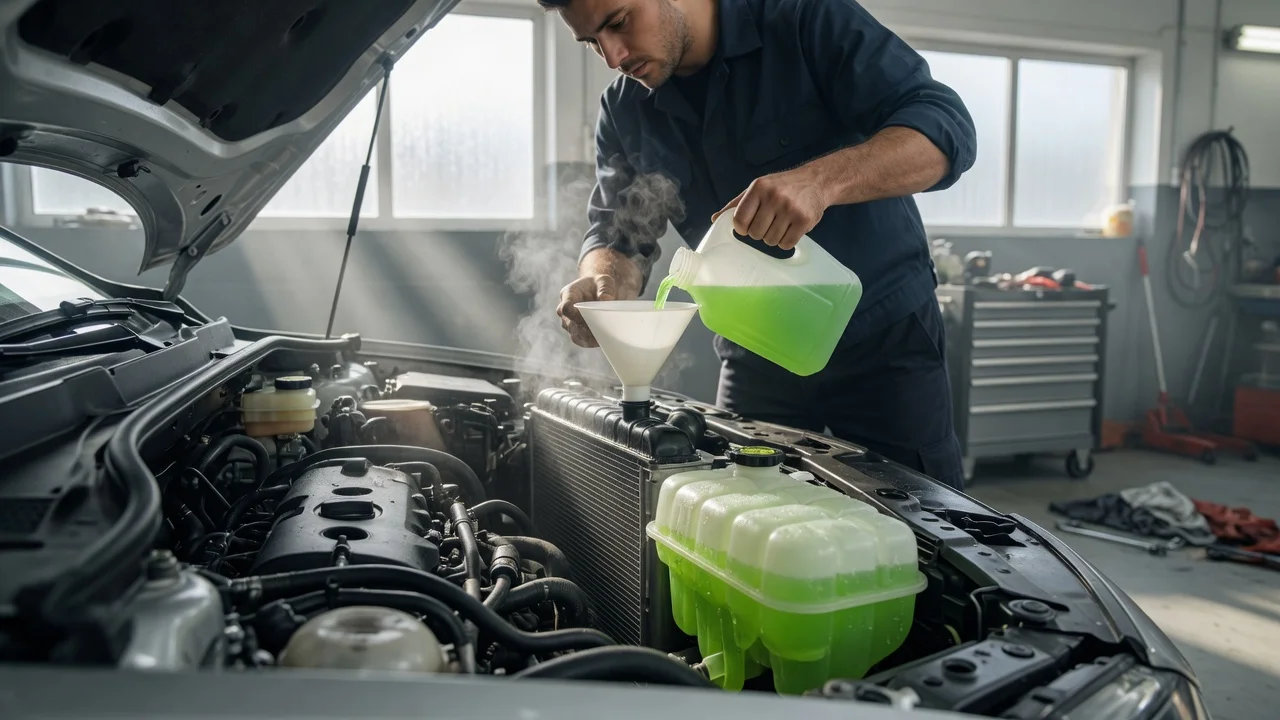
Park on level ground and let the engine cool completely. Locate the coolant reservoir. It is usually a translucent plastic tank with minimum and maximum marks. Its location varies by vehicle. Check the level against the marks. Many reservoirs are marked for a cold engine, but some vehicles differ, so confirm in the owner's manual. If the level is low, add the specified coolant to the reservoir up to the correct mark. Do not overfill. If the manual directs you to add coolant at the radiator itself, open the radiator cap only when the engine is cold, and follow the manufacturer's procedure. Some vehicles need air bled from the cooling system after coolant is added or replaced. The procedure is vehicle-specific, so check the service information if the system was drained or the level was very low. Close all caps securely and dispose of spilled coolant properly.
Coolant is toxic, and ethylene glycol based products are especially hazardous if swallowed. Keep coolant away from children and pets, wipe up spills promptly and follow local rules for disposal.
Coolant for an Overheating Car
If the temperature gauge rises into the hot zone or a warning light appears, reduce load on the engine and pull over safely as soon as you can. Continuing to drive a severely overheating engine risks serious internal damage. Switch the engine off and wait for it to cool before checking the coolant level. Some guidance suggests that, if you must keep moving briefly, turning the cabin heater to maximum can shed some engine heat. This is a stopgap, not a fix.
If the reservoir is low or empty, adding the correct coolant once the engine has cooled may bring temperatures back to normal. In an emergency, when coolant is not available, plain water is sometimes used to get a vehicle to safety. Water alone offers no freeze protection and reduces corrosion protection, so the system should be corrected with the proper coolant mix afterward.
Coolant only solves overheating caused by a low coolant level, and even then the cause of the loss still needs finding. Common causes of overheating that coolant alone will not fix include:
Coolant leaks from hoses, the radiator, the water pump, the heater core or connections. A thermostat stuck closed, which stops coolant from flowing to the radiator. A failing water pump that does not circulate coolant effectively. A cooling fan that does not run, often noticed as overheating in slow traffic or while idling. A blocked or restricted radiator, inside or out. A faulty pressure cap that does not hold system pressure. Air trapped in the system after a refill. Internal engine faults such as a failed head gasket. Possible signs include unexplained coolant loss without visible leaks, white exhaust smoke with a sweet smell, or bubbles in the reservoir. These signs point toward the possibility but do not confirm it.
If the coolant level drops again after topping up, if overheating continues with a full system, or if you notice any of the signs above, have the cooling system inspected. A technician may pressure-test the system, check the thermostat and fan operation, or test for combustion gases in the coolant. Which tests apply depends on the vehicle and the symptoms.
Replacing Coolant Over Time
Coolant additives wear out over time, so manufacturers specify a replacement interval. Intervals vary widely by vehicle, coolant type and model year, and this guide does not have figures for specific vehicles. Check the maintenance schedule in your owner's manual. Coolant that looks rusty, sludgy or contaminated, or that has an oily film, should be investigated regardless of the schedule.
What This Guide Cannot Tell You
This guide does not include vehicle-specific coolant specifications, capacities, mixing ratios, freeze-protection temperatures or service intervals, because no data for particular makes, models or engines was available. For those details, use your owner's manual, the manufacturer's service information or a qualified technician who can look up your exact vehicle.