Car Overheating Warning Signs: Lights and Temperature Gauge
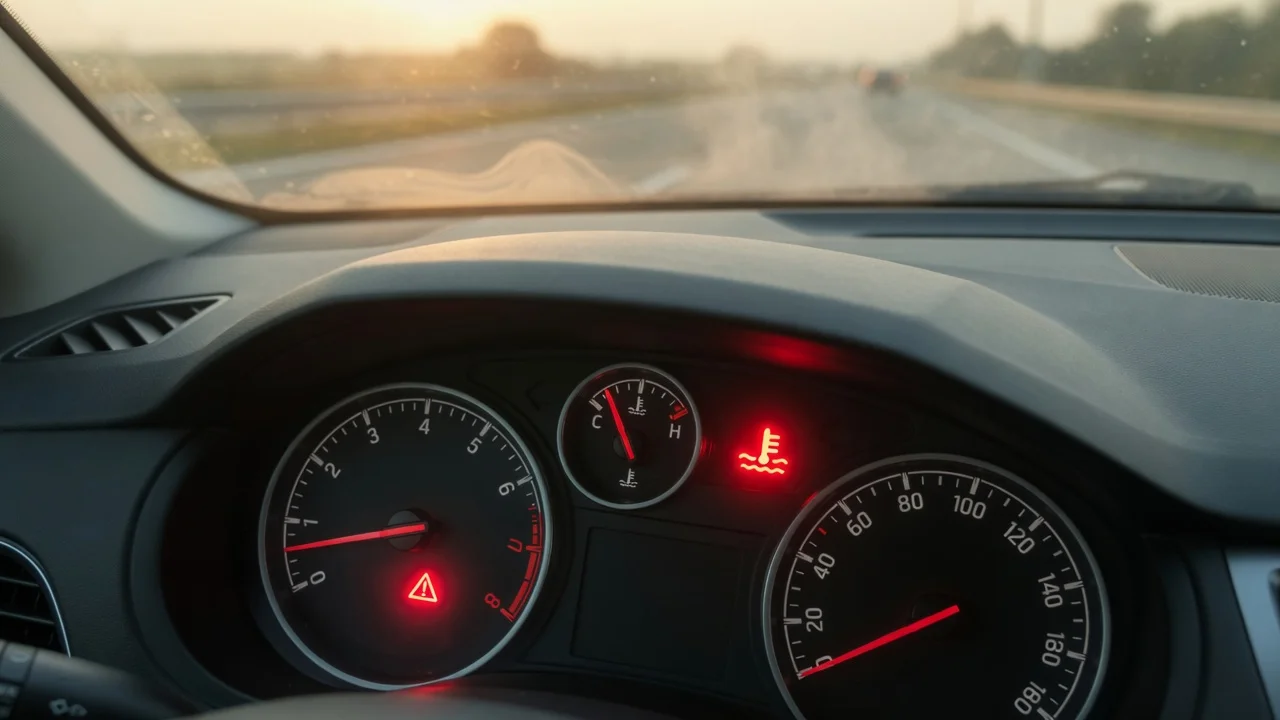
Direct answer: what the engine overheating light means
The engine overheating light is a warning that the engine coolant temperature has entered, or is approaching, an abnormally high range. Its exact meaning can vary by vehicle, because some cars use a dedicated high-temperature warning lamp while others use a warning light combined with a temperature gauge or a message in the instrument cluster. In many systems, a red coolant-temperature warning means the engine is already overheating and should be shut down safely as soon as possible; an amber or blue coolant-temperature light can instead indicate a cold engine when first started, before disappearing after warm-up. Check your owner's manual for the symbols and colors used in your particular model.
How the temperature gauge relates to the warning light
An overheating car gauge is not always a direct measurement of the metal temperature inside the engine. The gauge usually reports the reading from a coolant temperature sensor, and the displayed value depends on the engine, operating conditions and instrument-cluster calibration. A normal warmed-up reading commonly sits near the middle of the gauge, while a reading that moves steadily toward the hot end, especially under load or in traffic, is a more meaningful sign than a brief movement after a hot restart. Because normal ranges differ between models and engines, compare the gauge behavior with the vehicle's usual operating position rather than relying on an assumed universal number.
Common car overheating signs beyond the warning light
A warning light alone should never be interpreted as proof of one failed part. Overheating is a symptom that can have several underlying causes, so the surrounding observations help narrow the problem before parts are replaced.
Temperature gauge rising into the red zone or staying above its normal position
Coolant warning light illuminating, sometimes together with a loss of heater output
Steam, coolant odor or visible coolant leaking under the vehicle
Reduced engine power, unusual detonation or cooling fans running constantly
These observations, when noted together with when the overheating occurs, are more diagnostically useful than the warning light by itself.
Separating possible causes when overheating occurs
A systematic approach compares what is observed with what each likely cause would produce. Do not replace a thermostat, water pump, head gasket or sensor simply because a fault code or warning has appeared.
Observation | Possible cause | Discriminating check; Rises at idle or in traffic | Cooling fan or airflow problem | Confirm fan operation and check for blocked airflow; Rises at speed | Coolant circulation or restriction | Confirm coolant level and inspect for a stuck thermostat or restricted radiator; Low coolant warning or visible loss | Leak or consumption | Pressure-test the system and inspect external leak points; Normal driving but gauge reads high | Sensor or gauge fault | Compare sensor reading with another reliable temperature measurement; Overheating with coolant loss and white exhaust | Potential head-gasket involvement | Chemistry or cooling-system pressure test; do not treat a code as proof
A fault code for the coolant temperature circuit does not by itself demonstrate that a sensor or thermostat is faulty. The code indicates what the control module observed or could not read; the operating conditions required for that diagnostic must still be checked before interpreting the reading.
What to check first
Coolant level when the engine is cold, following the vehicle's safe-check procedure
External leaks, hose condition and the pressure cap where applicable
Cooling fan engagement and signs of blocked airflow through the radiator or condenser
Whether the gauge or light behaves consistently or only under specific driving conditions
Each result supports one explanation while leaving others unresolved. For example, a normal fan and full coolant level at idle would make a low coolant condition less likely but would not rule out a circulation restriction at higher load.
When to stop driving
If a red overheating warning is active, or if the gauge is in the hot zone with steam, coolant loss, reduced power or unusual engine behavior, the safer action is to stop, switch off the engine and allow it to cool before inspection. The specific shutdown procedure can differ between vehicles, so follow the owner's manual rather than a universal instruction.
Limits of this information
Vehicle-dependent claims are qualified by model year, engine, market and configuration rather than presented as universal. The exact warning symbol, normal gauge position, sensor location and coolant specification all vary; material uncertainty exists where the supplied evidence does not establish a model-specific value. Where a particular reading or diagnostic condition is not specified for your vehicle, that gap should be checked in the factory service information before a component is replaced.