Car Jerks After Transmission Fluid Change: Causes, Checks and Next Steps
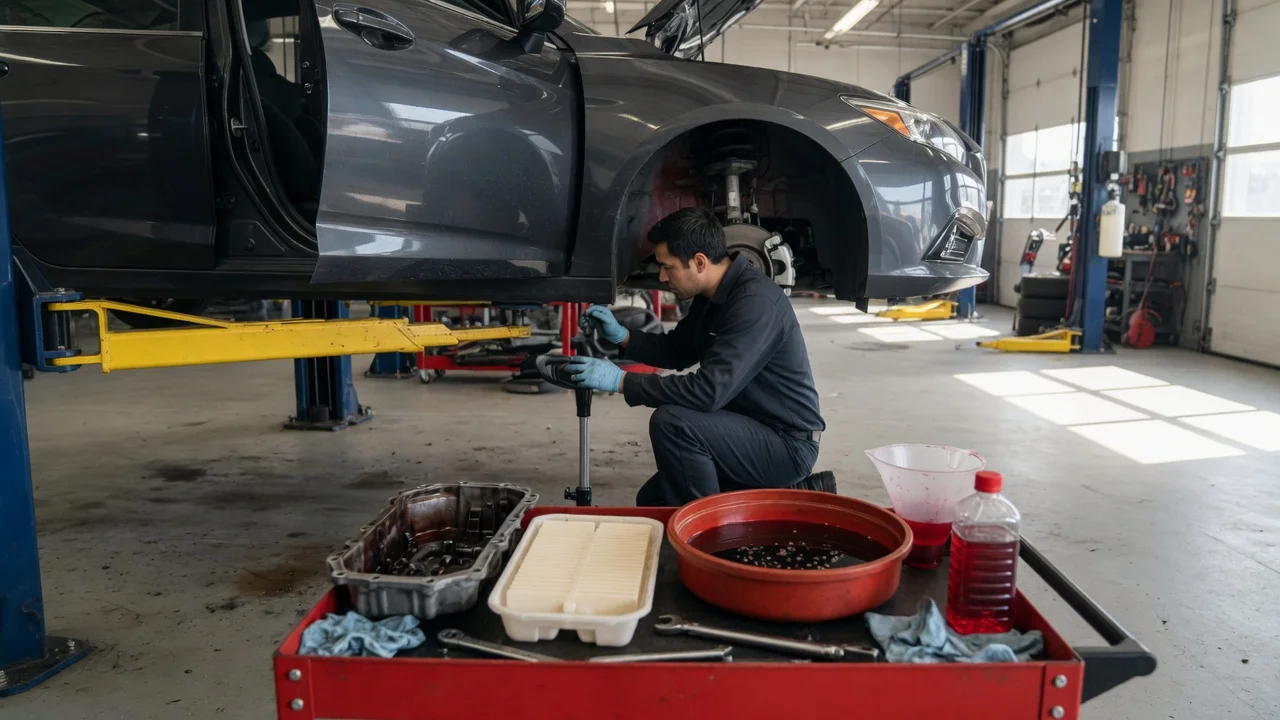
Direct answer: a jerking transmission after a fluid change is usually a fluid level, fluid type or refill procedure issue, not an automatic sign of transmission failure
If a car jerks, shudders or hesitates immediately after a transmission fluid change, the most common cause is an incorrect fluid level: either overfilled or underfilled. The second most common cause is using the wrong specification of fluid for the vehicle. A less frequent but serious cause is damage from the service procedure itself, such as a dislodged filter, a damaged pan gasket or contamination introduced during the work. The condition of the transmission before the fluid change also matters. If the fluid was extremely old, burnt or full of clutch material, fresh fluid can alter friction behavior enough to expose an already worn transmission.
Step one: check the transmission fluid level first
On most vehicles, the transmission fluid level must be checked with the engine running, the transmission at operating temperature and the shifter in Park or Neutral, depending on the manufacturer procedure. A level that is too high can cause the fluid to foam. Foamed fluid loses hydraulic pressure and can make the transmission slip, jerk or shudder. A level that is too low can cause delayed engagement, slipping and harsh shifts because the pump draws air. Check the level on flat ground using the correct dipstick procedure for the specific model year and powertrain. Some modern transmissions have no dipstick and require a fill-level plug or a scan tool to read fluid temperature during the level check.
Step two: confirm the correct fluid specification
Transmission fluids are not universally interchangeable. Using a fluid that meets the wrong specification can change friction characteristics enough to produce shudder, harsh engagement or flare between shifts. This is especially relevant for continuously variable transmissions, dual-clutch transmissions and modern stepped automatics that require a specific approved fluid. Confirm that the fluid used matches the specification listed for the exact model year, generation, engine and transmission code. A generic automatic transmission fluid can be inappropriate even if the parts store catalog lists it as compatible.
Step three: consider the refill and adaptation procedure
Many modern transmissions require a specific fill sequence. Some are filled through a level plug, not a dipstick tube. Some require the transmission to reach a defined temperature range before the final level is set. If the final level was set while the transmission was cold, the actual hot level may be incorrect. In addition, some vehicles store transmission adaptation values. After a fluid change, old adaptations can make shifting feel abrupt until the control unit relearns. A jerking sensation that is mild and improves over a few drive cycles can indicate adaptation, but a persistent or worsening jerk should not be ignored.
What if the car shakes after a transmission fluid change?
A shake or vibration after a fluid change often points to the same level and fluid-specification issues as a jerk. It can also indicate that the torque converter is not locking smoothly because of changed fluid friction or an incorrect fluid level. On front-wheel-drive vehicles, a shake under acceleration can be confused with a CV axle problem, but the timing immediately after a transmission service makes the transmission system the first suspect. If the shake occurs at idle in gear and disappears in Park or Neutral, the transmission mount or engine mount may also be involved, but the service timing should still lead you to recheck the fluid level and specification first.
What if the car will not move after a transmission fluid change?
A no-move condition after a fluid change is more serious. The direct causes are usually severe underfilling, a disconnected or dislodged internal filter, a missing fill plug allowing fluid loss, or a pan gasket failure that has dumped fluid. In some cases, the wrong fluid can cause complete loss of friction in the clutches. If the shifter moves but the car does not engage any gear, stop attempting to drive. Check for visible fluid leaks under the vehicle and recheck the level if a safe method exists. If the level is correct and the fluid specification is confirmed, the transmission may have an internal service-related fault and should be towed for diagnosis.
What if the car will not start after a transmission fluid change?
A fluid change that leaves the car unable to start is usually an electrical or range-sensor issue, not a fluid problem inside the transmission. The most common cause is a disturbed or disconnected transmission range sensor, neutral safety switch or shift linkage connector. If the vehicle only starts in Park or Neutral, confirm that the shifter cable or linkage is properly adjusted and that the transmission is actually in the selected gear. A disconnected electrical connector near the transmission can also prevent starting on some models. Check for any connector left unplugged during the service. If the engine cranks but does not start, investigate whether a sensor or ground near the transmission was disturbed.
When to stop driving and seek professional diagnosis
Stop driving if the transmission slips severely, fails to engage, produces loud metallic noise, leaks fluid or triggers a warning light with limp-mode behavior. Continued driving with an incorrect fluid level or wrong fluid can convert a correctable service error into permanent clutch or gear damage. A fault code is evidence to investigate, not proof that a specific part has failed. A professional diagnosis should include the exact fluid specification, the level-check procedure for the specific transmission, the condition of the drained fluid if retained and any stored transmission control module codes.
Summary of the most likely causes by symptom
Jerk or harsh shift: fluid level too high or too low, wrong fluid specification, adaptation period after service; Shake or vibration: foamed fluid from overfill, incorrect torque converter behavior, low fluid pressure; No movement in gear: severe underfill, dislodged filter, missing plug or fluid leak, wrong fluid; No start after service: disturbed range sensor or neutral safety switch, loose connector, misadjusted shift linkage