Car Insurance for a Driving Test: What Coverage You Need
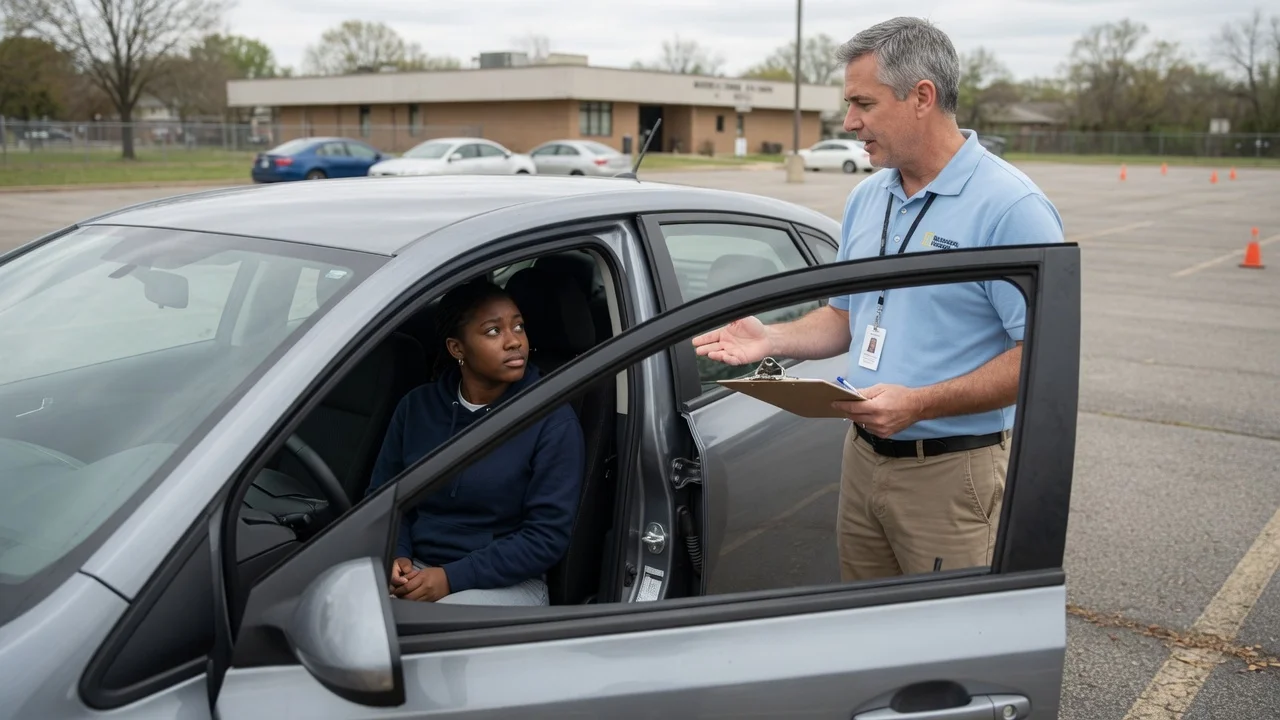
What you need on test day
You need a current motor insurance policy that is valid on the test date, names the car you will drive, and covers you as the person at the wheel. That policy must also cover injury or damage you may cause to other people, other vehicles, property, and the examiner riding with you. If you take the test in a driving-school car, the school normally already holds this cover for the candidate and the examiner. If you take it in a privately owned car, the owner’s policy must allow a learner, or another permitted driver, to use that vehicle for an official practical test.
The legal minimum, the proof a test centre will accept, and whether a private car may be used at all depend on the country and sometimes on the state or test provider. A policy that covers ordinary social driving can still exclude learners, driving tuition, or an examiner as a passenger. Those exclusions change the answer: without an endorsement or a specialist learner product, a private car may be uninsured for the test even though the owner is insured for everyday use.
How the cover works during a test
Motor insurance is a contract that pays specified losses if you cause a crash or if the test car is damaged, subject to the policy’s limits, excess, and exclusions. A practical test is a short, closely watched use of the car on public roads. The examiner is a passenger you are responsible for, and a collision during the test is treated as an ordinary insured event only if the driver, the vehicle, and the use all fall inside the policy.
Third-party, or liability, cover is the core. It pays for injury to other people, including the examiner, and for damage to other vehicles or property. Own-vehicle cover, often called collision, comprehensive, or damage to the insured car, pays to repair the car you are testing in. A driving school usually carries both on its fleet. A private owner may carry liability only; in that case damage to their own car falls on them.
Who may drive is set by the policy, not by the test booking. Some policies name specific drivers. Others cover any driver with the owner’s permission. Learners are frequently excluded unless the contract has a learner endorsement, a named-learner extra, or is written as a short-term learner product. Use class matters in the same way: social, domestic and pleasure use can exclude driving instruction or an official test. Some insurers treat a practical test as permitted use; others require a test-day or learner extension.
Policy conditions can sit alongside licensing rules. Dual controls, learner plates or equivalent markings, a supervising full-licence holder, and a current vehicle inspection may be required by both the insurer and the test authority. If a condition is broken, a claim can be refused even though a policy exists. Exact plate rules, dual-control rules, and inspection standards are set locally and are not specified in the source material for this article.
School car compared with a private car
Arrangement | Who is typically covered | What still has to be confirmed; Driving-school car | Candidate, instructor and examiner under the school’s fleet policy | That the booking includes a school vehicle and that the school confirms the policy is in force for the test; Private car | Only the people and uses listed on the owner’s policy | Named-driver or learner status, test-day validity, examiner as a passenger, and whether tuition or test use is excluded; Short-term learner policy | The named learner on a specified car for a set period | Start and end dates that include the test, the correct vehicle, and any supervising-driver conditions
A school car is the simpler route because the operator’s business is instruction and testing. Cover for the candidate and the examiner is part of that business. A private car can be used where local rules allow it, but only after the owner or broker confirms the wording. A short-term learner policy is a common way to fill a gap when the household policy will not name a learner or will not cover a test.
What to confirm before you book the car
The vehicle on the test is the vehicle named on a policy that is in force on the test date. You are an insured driver, either named or covered as a learner under the policy terms. Passenger liability includes the examiner. Use of the car for a practical test is not excluded as tuition, business, or another barred use. Any learner-plate, dual-control, supervising-driver, or inspection conditions in the policy will be met. You know what proof the test centre requires, if it requires any.
Only the insurer, broker, or driving school can confirm a given car and driver. Premiums, excesses, and certificate formats are not documented here and vary by product. Whether a centre checks insurance electronically, asks for a certificate, or proceeds on the school’s assurance is also a local operational detail, not a universal rule. If that confirmation is missing, treat cover as unverified and do not assume the household policy is enough.