Car Differential Lock: What It Is and When to Use It
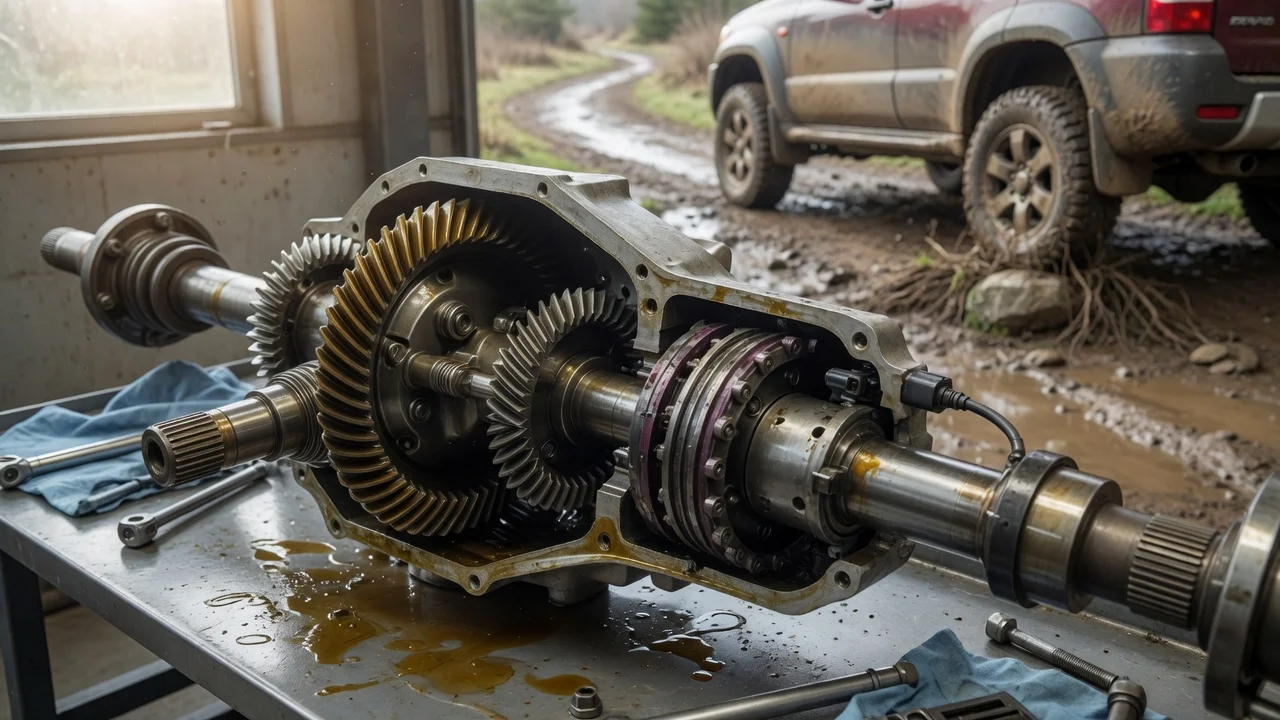
What a Differential Lock Is
A differential lock is a mechanism that forces the two wheels on an axle to rotate at the same speed, temporarily disabling the differential's normal speed-differentiation function. It is available on many four-wheel-drive vehicles, pickups, and some performance cars. The lock is primarily an aid for low-traction surfaces such as mud, sand, snow, or loose rock. It is not a permanent driving mode and is generally intended for use at low speed and only when traction is compromised.
How It Works
In normal driving, a differential allows the left and right wheels to spin at different speeds during cornering. This prevents tire scrub and driveline stress, but it also means power follows the path of least resistance. If one wheel is on ice or lifted in the air, that wheel spins freely while the wheel with grip receives little or no torque. Engaging a differential lock mechanically joins the two axle shafts. Once locked, both wheels receive torque and turn at the same rate, so the wheel with traction can move the vehicle even when the opposite wheel has none.
Locks can be driver-operated, such as an electronic or air-actuated locker controlled by a switch, or automatic, such as a mechanical locking differential that engages when wheel-speed difference exceeds a threshold. The practical effect is the same: the axle behaves like a solid connection between the wheels until the lock is released.
When to Use a Differential Lock
A differential lock should be used when one wheel on an axle is likely to lose traction and forward progress would otherwise be halted. Common scenarios include crossing deep ruts, climbing rocky or uneven terrain, driving through deep mud or sand, and starting on a slippery incline. On vehicles with selectable lockers, the lock is normally engaged before entering the difficult section, not after wheel spin has already begun.
A differential lock should not be engaged on dry, high-grip pavement. With both wheels forced to rotate at the same speed, cornering becomes difficult and can cause tire scuffing, driveline binding, and premature wear or damage to axles, universal joints, or the differential itself. Most manufacturers specify a maximum speed for locked operation and require that the lock be switched off before returning to firm, high-traction surfaces.
Strengths and Limitations
The main strength of a differential lock is predictable traction. On low-grip surfaces, it can help a vehicle continue moving where an open differential would leave one wheel spinning. It also improves control during slow technical driving by reducing the chance of sudden wheel-speed changes. For drivers who regularly travel unsealed roads, a rear differential lock in particular is often considered a useful addition.
The trade-off is reduced maneuverability and added driveline stress when the lock is active. Steering response becomes heavier and the turning radius effectively widens because both wheels travel the same distance. Automatic lockers can engage abruptly during normal driving, producing a clunk or a change in handling feel that some drivers find intrusive. Selectable lockers avoid this in their open mode but require the driver to remember to engage and disengage them at the right time.
A differential lock suits drivers who face occasional or regular low-traction terrain and need maximum forward progress. It provides less benefit for primarily on-road use, where the added complexity and the need for correct operation may outweigh the advantage. Performance data for acceleration or lap times is not the relevant measure here; the value is in controlled movement over surfaces where an open differential cannot maintain drive.
Operating Steps
Stop or slow to a walking pace before engaging a selectable lock; many systems require the vehicle to be in neutral or moving below a set speed. Move the driveline into the appropriate range, usually low range if available, before switching the lock on. Engage the rear differential lock first when available; add a front lock only if additional traction is needed and the terrain allows it. Drive at low speed and avoid sudden steering inputs while the lock is engaged. Keep the throttle smooth to reduce driveline shock. Disengage the lock as soon as the vehicle is back on ground where the wheels can turn independently without losing drive. Confirm the lock has released by driving gently in a straight line and checking that the indicator light, if present, has turned off.
Not all four-wheel-drive vehicles have a locking differential or a lockable center differential. A vehicle with a part-time four-wheel-drive system may have no differential lock at all, while some all-wheel-drive cars use an electronically controlled coupling instead of a physical lock. Check the owner's manual for the exact engagement procedure, speed limits, and fluid or maintenance intervals for the locking mechanism. If a lock does not disengage or the indicator stays on, stop using it and have the system inspected before continuing to drive.