Capacitor for amplifier car audio
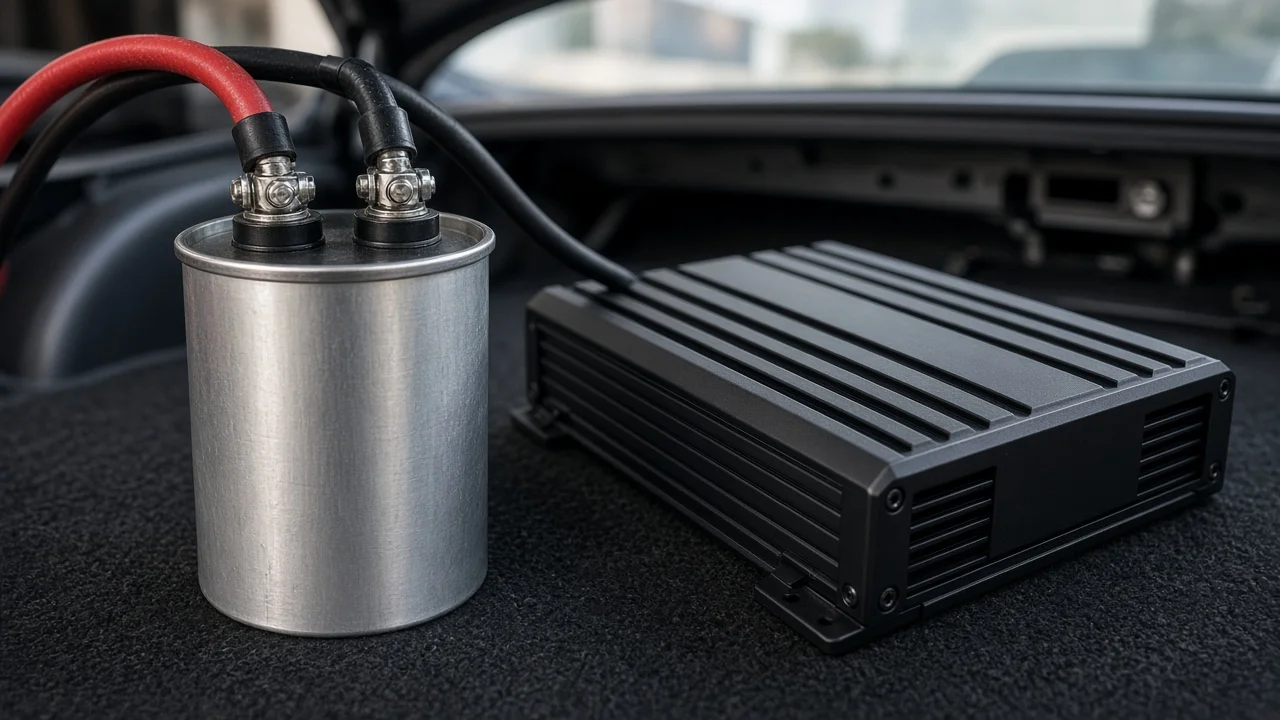
A stiffening capacitor, often called a power cap, is a short-term energy reservoir installed near a demanding car audio amplifier. When heavy bass notes draw current faster than the vehicle's electrical system can supply it, voltage sags and headlights may dim. This component buffers those transient demands, supporting stable amplifier performance. For hobbyists considering a capacitor for amplifier car audio, understanding what it does—and what it cannot fix—helps avoid unnecessary upgrades and focus effort on the true cause of power delivery problems.
Essential answer
A car audio amplifier capacitor is an inline storage device connected to the power cable feeding the amplifier. Its core job is to supply rapid bursts of current during musical peaks, then recharge between those peaks. Inside, it uses charged plates and a dielectric to store electrical energy within its capacitance rating. This differs from a battery, which stores far more total energy but releases it more slowly. The capacitor therefore complements the alternator and battery during brief transient demands rather than replacing them as the main source of power.
This device is most relevant when the electrical foundation is already healthy but the amplifier draws instantaneous current beyond what the wiring can comfortably deliver. It is not a cure for a weak alternator, undersized power wire, poor ground connection, or an aging battery. A sagging voltage reading during sustained loud playback usually points to those deeper issues. Before adding a car audio amplifier capacitor, owners should inspect cable gauge, termination quality, and charging system health, because the capacitor only smooths short-term spikes in an otherwise adequate circuit.