C0055 and C0057 ABS Codes on Trucks and Vans
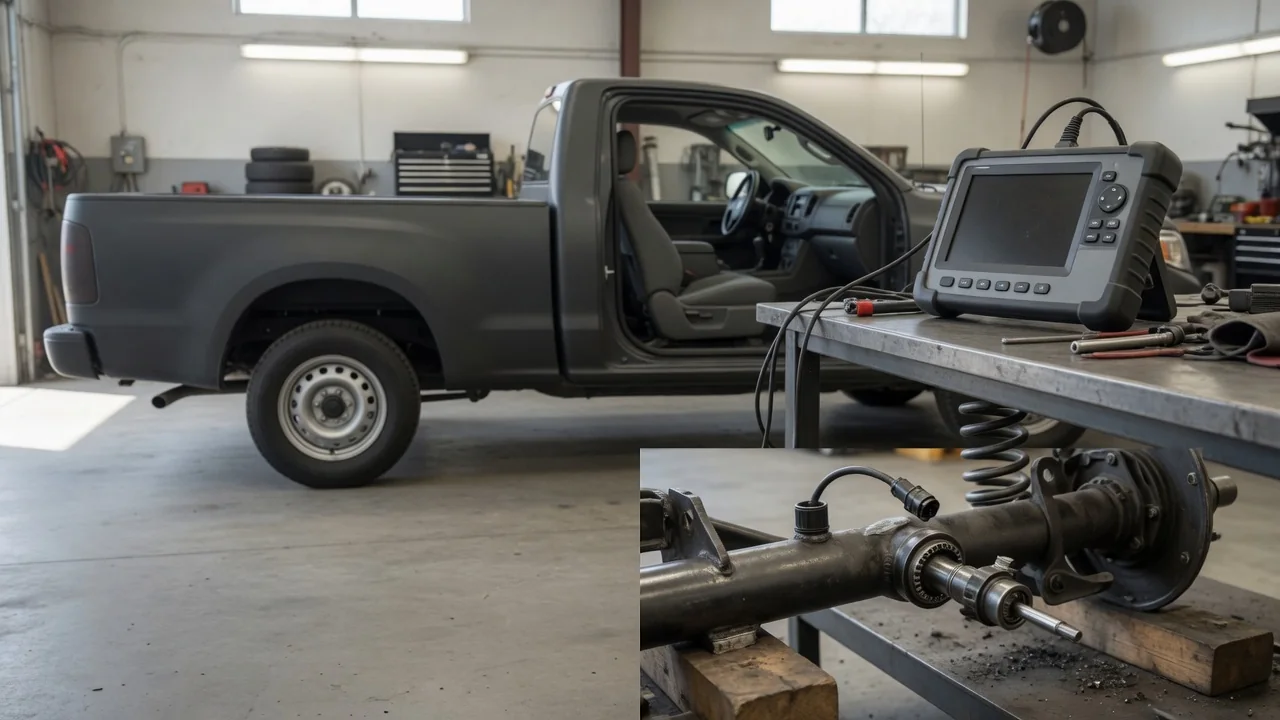
C0055 and C0057 ABS codes on trucks and vans often point toward a rear wheel speed signal problem, especially on single-channel ABS layouts that share a rear axle speed sensor. A C0055 code or C0057 code is manufacturer-dependent evidence for the ABS module to interpret, not proof that a sensor has failed. Confirm the year, make, model, and brake system before treating either code as a universal rear-sensor diagnosis.
Verify What C0055 and C0057 Mean for the Vehicle
Before interpreting C0055 or C0057, collect the truck or van year, make, model, brake system configuration, and the module that stored the fault. These identifiers decide which service definition applies, because the same alphanumeric string can describe different circuit, signal, or performance conditions on different platforms. Manufacturer-dependent wording must be confirmed in that vehicle's service information. Neither the C0055 code nor the C0057 code, by itself, establishes a universal rear wheel speed sensor failure across all trucks and vans.
Record the complete stored code, including any suffix or failure subtype the scanner reports, together with the tool's plain-language description. That extra detail often separates an intermittent signal dropout from a continuous open, short, or implausible rear wheel speed signal, and it keeps later testing aligned with the actual complaint. If C0054 appears with C0055 or C0057, look up C0054 on its own in the same vehicle-specific information. Treat it as related only when that documentation ties it to the same rear speed circuit or ABS channel.
Understand the Rear Speed Signal on Single-Channel ABS
On some trucks and vans, single-channel ABS uses one shared rear speed input to control the rear antilock channel rather than separate left and right rear sensors. In that arrangement, the ABS module watches a rear axle speed sensor or a comparable combined rear signal and compares it with front-wheel data when deciding whether to modulate rear brake pressure. A fault labeled as a rear wheel speed signal therefore may describe that shared input, not a dedicated sensor at one rear wheel. Assuming an individual wheel sensor exists can send diagnosis toward the wrong harness, connector, or mounting point.
Sensor location, signal source, and circuit layout still have to be confirmed for the specific truck or van. Some platforms place the pickup at the differential, others at a transmission or transfer output that the ABS module treats as rear speed, and still others use two rear sensors even when a C0055 or C0057 code appears. Until the verified code definition and brake system design say the rear speed path is involved, treat rear-sensor discussion as conditional. Live speed data from an ABS-capable scan tool is useful later only after that layout is known.
Recognize Symptoms and Decide Whether to Stop Driving
An illuminated ABS warning light is a common reason these codes are found, and some vehicles also disable antilock assistance at the rear or across the system when the module cannot trust the rear speed input. Display behavior is not identical on every truck or van, so the absence of a particular message does not rule the codes out, and a lamp alone does not describe how hard the brakes still work. A warning light or a stored C0055 or C0057 code cannot establish the condition of the base hydraulic braking system, which may still provide ordinary stopping force.
Stop safely and arrange professional assistance if braking feel is reduced, the pedal is abnormal, brake fluid is visibly leaking, or a red brake warning is on. Those signs concern foundation braking and fluid integrity, not merely antilock logic, and they take priority over code interpretation. For the ABS complaint itself, note whether the warning appears at startup or during ordinary driving already experienced. Do not try to reproduce a braking fault, lock a wheel, or force antilock cycling just to see whether C0055 or C0057 returns.
Identify Possible Sources of a Rear Speed Signal Fault
Once vehicle-specific information confirms that C0055 or C0057 concerns the rear speed sensor circuit, possible sources include a failed pickup, damaged wiring, and connector corrosion that interrupts or distorts the rear wheel speed signal. Those items remain possibilities, not a ranked parts list, until circuit tests isolate the path. A circuit or signal code does not prove the sensor itself needs replacement. Open, shorted, or high-resistance wiring, a poor ground, or a contaminated connector can produce the same ABS module complaint as a defective rear axle speed sensor.
On systems that read a tone ring, reluctor, or similar target, a cracked, missing, or heavily contaminated target, or a shift in the air gap between the sensor and that target, can cause signal dropout even when the electrical harness looks intact. Power and ground supplies to the sensor or to the ABS module, and the module's own ability to process live speed data, belong in the discussion only when the vehicle's diagnostic procedure includes them. Replacing parts before those checks can leave the original C0055 or C0057 condition unchanged.
Collect Useful Information Without Hazardous Checks
Save the full scan report, each code's status as current or history, and any freeze-frame or event data the ABS module offers before clearing anything. That snapshot preserves whether C0055, C0057, or an accompanying C0054 was active when the warning appeared and what related PIDs the tool captured. Note recent axle, brake, tire, or wiring work as diagnostic context, such as a hub, drum, or harness disturbance near the rear speed path. Timing of that work is useful background; it is not proof that the last job caused the code.
Limit owner observations to warning messages, symptoms already felt during normal driving, and visible damage that can be seen from a safe standing position, such as a torn loom or a hanging connector at the rear of the vehicle. Do not crawl under an unsupported truck or van, lift or spin wheels, probe brake electronics, or perform a road test intended to trigger ABS. Those actions can create injury or additional electrical damage and they are not required to document a C0055 code or C0057 code for a technician.
Know What Professional Testing Should Establish
A technician needs an ABS-capable scan tool and the correct service procedure for that truck or van to evaluate the reporting module and rear speed data. Generic code readers often show C0055 or C0057 without live speed data, bidirectional tests, or the failure subtype the module uses. Professional testing typically compares commanded versus reported rear speed, checks sensor-circuit integrity for opens and shorts, and reviews power and ground only as the published steps specify. Universal voltage or resistance numbers do not belong in that work because those values are manufacturer and circuit specific.
When circuit findings do not explain the signal fault, inspection of the speed target and the mechanical relationship at the sensor mounting may be required on applicable designs, always with the vehicle properly supported by a shop. After a repair, verification should use the same module checks, live speed data, and a controlled professional assessment of antilock operation rather than a casual drive. Clearing C0055 or C0057 alone does not confirm a fix, because an intermittent rear wheel speed signal can stay silent until the enabling conditions return.