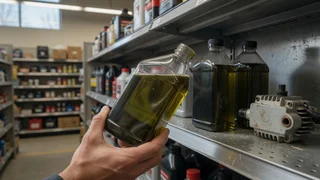
Buy 2-cycle engine oil
Buy the 2-cycle oil type and fuel-to-oil ratio that your engine's owner's manual specifies. Then pick a bottle size that matches how much fuel you mix at one time. Two conditions change the answer. Water-cooled outboard motors generally need a different oil class than air-cooled equipment such as chainsaws, string trimmers and leaf blowers. Engines with separate oil injection take oil in a reservoir instead of premixed in the fuel. If your manual names a specific certification or ratio, follow it over any general guidance.
Match the oil to the engine type
A 2-cycle (two-stroke) engine burns its lubricating oil along with the fuel, so the oil has to be formulated for that job. Ordinary 4-stroke motor oil is not a substitute. Bottles usually show a performance certification on the label. The certification tells you which kind of engine the oil is intended for.
Label marking | Typical intended use; JASO FC, JASO FD, ISO-L-EGC, ISO-L-EGD | Air-cooled two-stroke engines, such as handheld outdoor power equipment and many small motorcycles and scooters; API TC | An older air-cooled two-stroke classification that still appears on some bottles; NMMA TC-W3 | Water-cooled outboard and other marine two-stroke engines
Some equipment and engine makers recommend their own branded oil. Some tie warranty terms to a stated specification. Check your manual or warranty terms if you are unsure. This article cannot confirm the requirements for a particular model, model year or market.
Confirm the mix ratio before choosing a bottle
The mix ratio is the number of parts fuel to one part oil. Common ratios include 50:1, 40:1 and 32:1, but the correct one depends on the engine. Some oils are sold for a single ratio. Others list several ratios on the label. The amounts below are simple arithmetic based on a US gallon of 128 fluid ounces.
Ratio Oil per 1 US gallon of fuel; 50:1 about 2.6 fl oz; 40:1 about 3.2 fl oz; 32:1 about 4.0 fl oz; 25:1 about 5.1 fl oz
Small single-mix bottles are usually sized to treat a set amount of fuel at one ratio. Before buying one, confirm that both the ratio and the fuel volume printed on the bottle match what you mix.
Small bottles versus gallon jugs
Small or pre-measured bottles: convenient for one or two pieces of handheld equipment and occasional mixing, with less measuring and less leftover oil to store. Larger bottles with a measuring chamber: useful if you mix fuel regularly and want to measure different amounts. Gallon containers: better suited to people who run several machines, mix large fuel batches, or use an oil-injected engine or outboard that draws oil from a reservoir. You will need a way to measure accurately and somewhere to store the container sealed.
Buying by the gallon only makes sense if you will use that much oil. Check the label for any storage guidance. Keep containers closed and away from heat.
Buying at a home-improvement store or nearby
Home-improvement chains, hardware stores, auto parts stores, outdoor power equipment dealers and marine shops commonly carry two-stroke oil. Selection and sizes vary by location. This article does not have current stock, product lists or prices for Lowe's or any other retailer. Use the store's own inventory lookup or call ahead to confirm what is on the shelf.
Look for the certification your manual requires, such as JASO FD for air-cooled equipment or TC-W3 for an outboard. Check that the ratio on the bottle matches your engine. Match the bottle size to the fuel volume you actually mix. If you buy a small pre-measured bottle, confirm whether it is meant for 1 gallon, 2.5 gallons or another fuel amount.
What this guide does not cover
No prices, test results, brand comparisons or store availability were available for this article, so none are given here. Ratio and oil requirements for a specific engine also depend on the maker, model, year and market. For those details, your owner's manual or an authorized dealer is the reliable source.