Broken Driveshaft: What to Do and When to Stop Driving
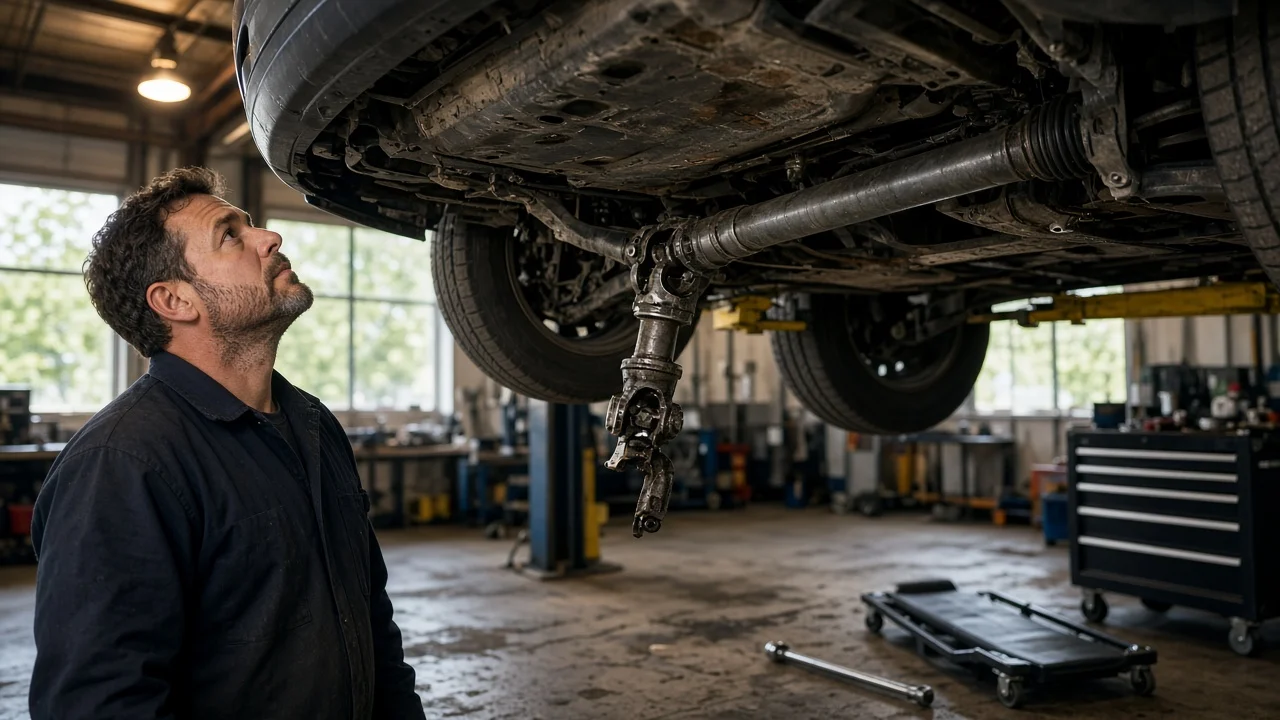
When a driveshaft breaks on the road, most drivers describe the same sequence: a loud bang or clunk under the vehicle, sometimes a rattling or scraping noise, then the engine revs while the vehicle coasts and loses drive. The direct answer is to stop as soon as you can do so safely and not try to limp home. This guide explains why, how your vehicle configuration changes the picture, and what to do while you wait for a tow and repair.
Stop driving as soon as it is safe
If you suspect a broken driveshaft while moving, turn on the hazard lights, ease off the accelerator and steer to a safe spot away from traffic. Do not keep driving even if the vehicle still moves under power, which can happen on some four-wheel drive and all-wheel drive layouts. A loose or dangling shaft can whip around under the floor and damage brake lines, fuel lines, wiring, the exhaust and the floor pan. If one end of the shaft drops, especially the front end, it can dig into the pavement and jolt or even lift the vehicle, which can cause a loss of control.
Once you have stopped, do not rely on Park. On an automatic transmission the parking pawl locks the transmission output, so when the shaft between the transmission and the axle is disconnected, Park no longer holds the wheels on a rear-drive vehicle. Leaving a manual transmission in gear has the same limitation. Set the parking brake firmly before you take your foot off the brake pedal, chock the wheels if you are on any slope, and arrange a tow rather than a roadside fix.
How a driveshaft works and why it breaks
On rear-wheel drive, four-wheel drive and many all-wheel drive vehicles, the driveshaft, also called a propeller shaft, is a tube that carries torque from the transmission or transfer case to a differential. Universal joints or constant-velocity joints at the ends let the shaft operate at an angle as the suspension moves, and a slip yoke or plunging joint lets its length change. Longer vehicles often use a two-piece shaft supported in the middle by a center support bearing mounted to the body.
A broken driveshaft is rarely a tube snapping cleanly in half. More often a worn universal joint comes apart, the rubber in a center support bearing tears, flange bolts work loose, or a joint seizes and breaks. These failures usually develop over time, which is why many owners notice earlier warning signs: a vibration that grows with speed, a clunk when shifting into Drive or Reverse, a rhythmic squeak at low speed, or a shudder when pulling away from a stop. Operating conditions such as heavy towing, frequent off-road use, impact from road debris, or a lift or lowering kit that changes the joint angles can speed up wear.
What changes the answer for your vehicle
On a rear-wheel drive vehicle, a break anywhere between the transmission and the rear axle means a complete loss of drive along with the Park limitation described above. There is no safe way to continue driving.
Four-wheel drive and all-wheel drive vehicles have front and rear shafts, and the vehicle may still move under power through the remaining one. That does not make it safe to drive: the broken shaft is still loose, and depending on the design, running with one shaft disconnected can strain the transfer case, center differential or coupling. Whether Park still holds depends on the layout and on which shaft failed, so use the parking brake regardless. Some manufacturers publish specific towing or limited-operation procedures after a shaft is removed; follow only the instructions written for your exact model, drivetrain and transfer case.
On front-wheel drive vehicles, the parts people often call driveshafts are the CV axles, or half shafts, running from the transaxle to each front wheel. A broken CV axle usually makes a loud clunk or grinding noise, and with an ordinary open differential the vehicle often will not move at all because power goes to the broken side. The advice is the same: stop and have it towed.
What to do after the vehicle is stopped
Look from outside the vehicle, but do not crawl underneath on a road shoulder or rely on a jack for support. Note whether a shaft is hanging down or lying on the road, whether fluid is leaking from the transmission or differential, and whether anything else looks damaged. Write down what happened: your speed, what you heard, and any vibration or noise in the days before. This, along with your service history, helps a mechanic narrow down the cause.
Tell the tow operator that the driveshaft is broken. A flatbed is the safest option. If a wheel-lift tow is the only choice, the manufacturer's towing guidance for your vehicle configuration determines whether the driven wheels must be off the ground or the shaft must be removed first; a dangling shaft must never be dragged. Avoid tying the shaft up with wire or straps and driving on, because a secured shaft can still come loose and the cause of the failure is still unknown.
At the shop, expect an inspection of the shaft, joints, yokes and center bearing, the transmission or transfer case output and seal, the differential pinion flange, and nearby brake lines, fuel lines and exhaust. Repair may be as limited as a universal joint or center bearing replacement or as extensive as a new shaft; a bent or dented tube generally needs replacement or professional repair and balancing. Ask what caused the failure and confirm that fasteners are tightened to manufacturer specifications, otherwise new parts can fail the same way.
Catching problems before the next failure
After a repair, pay attention to any new vibration, clunk or squeak rather than waiting for it to go away. Some universal joints have grease fittings and need lubrication at intervals listed in the maintenance schedule, while many are sealed for life; your owner's manual or service information tells you which applies. Asking for a driveline check when the vehicle is on a lift for other service, such as a tire rotation or oil change, is a simple way to spot worn joints, torn boots or loose bolts early, especially if you tow, drive off-road or have modified the suspension.
Limitations and next step
Symptoms alone cannot confirm a broken driveshaft. A bang followed by loss of drive can also come from a transmission failure, a broken axle shaft inside the rear axle, damaged differential gears or, on a manual, a failed clutch. Drivetrain layouts also vary between models and even between trim levels of the same model, so general guidance cannot replace the procedures for your specific vehicle. The next step is a professional inspection on a lift, and the vehicle should not be driven until the cause has been found and repaired.