Broken CV Axle: What to Do and When to Stop Driving
Direct answer
If a CV axle has broken, the vehicle should generally not be driven. A broken axle can separate or bind while the wheels are turning, which may cause sudden loss of drive, damage to nearby suspension or brake parts, or loss of control. Continuing to drive is usually unsafe until the axle has been inspected and replaced.
The meaning of "cv axle broke" can vary. The outer constant velocity joint may click or clunk while the shaft is still connected, or the shaft or joint may have physically separated. A noisy joint is a warning sign, while a visibly separated or badly binding axle is a more immediate stop-driving condition.
What a CV axle does
A CV axle, or constant velocity axle, transfers torque from the transmission or differential to a drive wheel while allowing the wheel to move up and down with the suspension and turn for steering. Constant velocity joints at the inner and outer ends let the shaft keep rotating smoothly as those angles change.
On a front-wheel-drive car, each front axle typically has an inner joint near the transaxle and an outer joint at the wheel. All-wheel-drive and some rear-wheel-drive vehicles use similar axle assemblies. The outer joint is protected by a rubber boot, and the inner joint may use a boot or housing depending on the design.
Signs and possible causes
A failing outer CV joint often produces a rhythmic clicking or popping sound during sharp turns, especially under acceleration. A worn inner joint may cause vibration or shudder during acceleration. A torn boot is a common early cause because it lets grease escape and allows dirt and water into the joint.
A broken axle can also appear after impact damage, severe corrosion, a failed joint, or excessive driveline stress. If the shaft has separated, the vehicle may not move when a gear is selected, or it may move briefly with a loud clunk and then lose drive. These observations do not always identify the exact failed part, so the axle, joints, and nearby components should be inspected together.
What to check
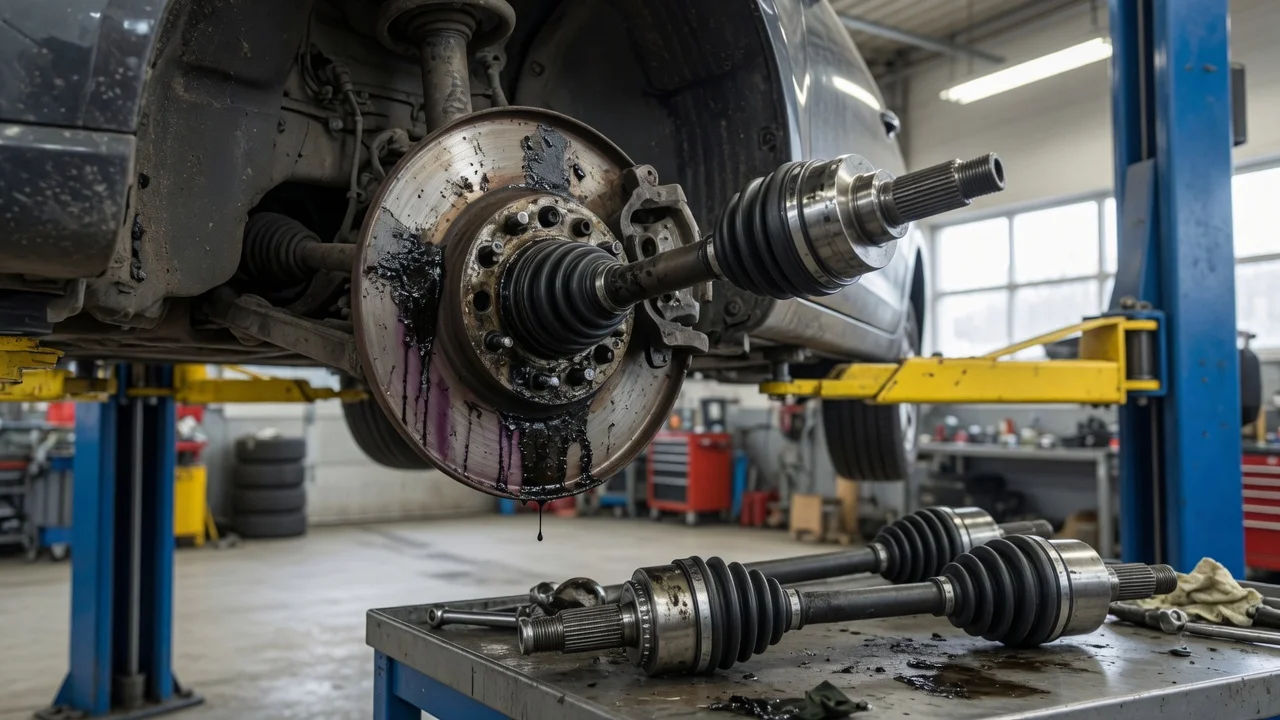
Begin with a safe visual inspection. Look for a torn or displaced boot, heavy grease spray near the joint, a separated shaft, or an axle that is no longer seated in the transmission or wheel hub. Compare both sides if possible. Do not rely only on sound, because brake, wheel bearing, and suspension problems can make noises that resemble CV joint wear.
A road test may help distinguish causes, but it should only be done if the vehicle still moves safely and the axle is not visibly separated or binding. A click that changes with steering angle and load points toward the outer joint. A vibration that changes mainly with acceleration points more toward the inner joint or another driveline component. A vehicle that will not move after a loud mechanical failure should not be driven or forced into gear.
When to stop driving
Stop driving and have the vehicle towed if the axle is visibly broken or separated, if drive is lost, if the axle is striking the chassis or suspension, or if the wheel is no longer being located correctly. A loose or separated axle can damage the brake hose, wheel speed sensor wiring, transmission seal, steering parts, and suspension links.
A clicking joint that has not separated may allow a short careful drive to a repair shop, but this is not a guarantee. The safest course is to have the vehicle inspected as soon as the noise appears. Delaying replacement can turn a worn joint into a separated axle and a more expensive or dangerous failure.