Brake Caliper Repair: Rebuild Kits, Procedure and Cost Factors
Answer upfront
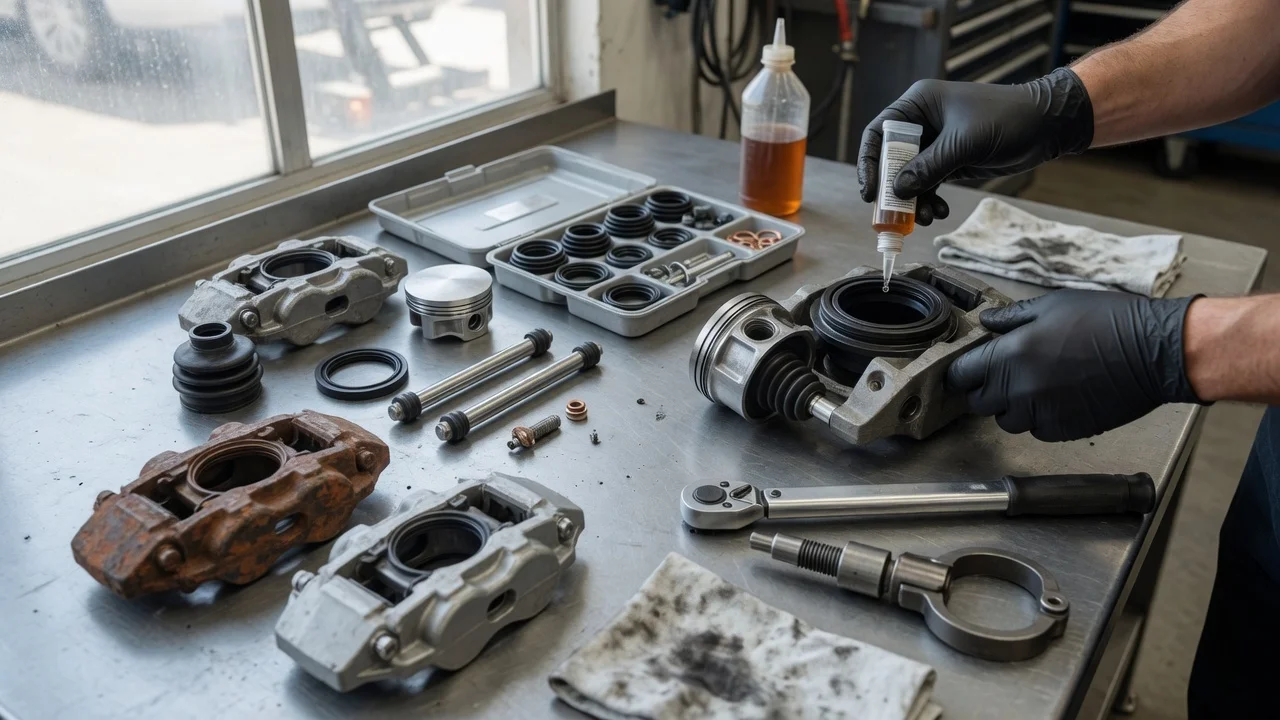
Brake caliper repair usually means replacing the rubber seals, boots and hardware that wear or damage over time. It is worth doing only when the caliper body, piston bore and slide surfaces are still in good condition. If the caliper is heavily corroded, cracked, leaking from the casting or has a scored bore, replace the caliper instead. Conditions that materially change the answer are rust exposure, the caliper design and whether the piston itself is pitted or chrome-damaged.
Symptoms that point to a caliper problem
A sticking caliper can cause the vehicle to pull to one side, produce dragging or overheating at one wheel, or create uneven pad wear. A leaking caliper may appear as wetness at the piston boot or bleeder area and can reduce pedal firmness. These symptoms do not by themselves prove the caliper needs rebuilding. Discriminating checks are more useful than replacing parts on suspicion.
Check pad wear side to side on the same axle. A large difference often indicates a slide or piston problem, not necessarily a failed caliper. Check whether slide pins move freely before condemning the caliper. Inspect the piston boot for torn or displaced rubber. Look for brake fluid wetness at the piston, bleeder screw or hose fitting. Lift the wheel and turn it by hand to confirm whether drag is actually present.
If drag continues after the slides are cleaned and lubricated, or if the piston will not retract smoothly during a brake job, stop normal testing and inspect the piston and bore directly. Continued operation with a dragging brake can overheat the rotor, fluid and nearby components.
What a brake caliper repair kit contains
A typical caliper rebuild kit includes the square-cut piston seal, a dust boot, and sometimes replacement bleeder caps, guide pin boots or small hardware. Kits are sold by caliper type and piston size, so they must match the exact model year, market, trim and brake package. Some kits cover only one caliper while others cover an axle. A reseal kit does not repair scoring or corrosion.
When evaluating a kit choice, verify that the piston diameter matches your caliper and that the boot style suits the caliper body. A kit alone is not the right repair if the piston is pitted. In that case a caliper kit with a new piston, or a remanufactured caliper, may be required.
Procedure when the caliper is rebuildable
Secure the vehicle on a suitable lift or jack stands and remove the wheel. Remove the caliper and suspend it so the flexible hose is not stretched or twisted. Drain residual brake fluid into a suitable container and avoid contact with painted surfaces. Clean the caliper body external surfaces before separating internal parts.
The next steps differ by caliper design. On many single-piston calipers, compressed air can help move the piston out, but the piston can be ejected suddenly. Place a block of wood or a shop rag in front of the piston before applying air. On multi-piston or fixed calipers, follow the service procedure for that caliper rather than forcing pistons apart.
Remove the old piston boot and square-cut seal without gouging the seal groove. Inspect the piston for pitting, chrome damage or scoring; replace it if any is found. Inspect the bore and seal grooves for corrosion or damage. Clean the bore with brake cleaner and dry it completely. Lubricate the new seal and boot only with clean brake fluid or the lubricant specified for the kit. Install the seal and boot in the correct orientation. Press the piston into the bore squarely, using hand pressure or the specified tool.
Refit the caliper, pads and hardware, then bleed the brake system according to the vehicle service instructions. The completion check is a firm pedal, no fluid leaks, and no residual drag after the wheel is reinstalled and turned by hand. If the piston does not seat smoothly, the bore has visible damage, or the bleeder cannot be sealed, stop and replace the caliper or use a qualified remanufacturing path.
Stop points for qualified assistance
Brake work is safety-critical. If any torque value, lifting point, fluid specification or bleed sequence cannot be confirmed against the applicable service instructions, stop before proceeding. If the caliper is a complex fixed multi-piston design, retained by unusual fasteners, or forming part of an electronic brake system, qualified assistance is the safer next step.
Brake caliper repair cost factors
A caliper repair cost is not one fixed figure. The main variables are whether you use a seal kit, a kit with new pistons, a remanufactured caliper or a new caliper; whether one or both sides are done; and whether the brake fluid and related hardware are replaced at the same time. The job also changes when a brake bleed is required or when the caliper is difficult to access.
Caliper type: fixed multi-piston calipers and performance or electronic brake calipers can cost more than a basic single-piston sliding caliper. Repair part: a basic seal-and-boot kit is usually the lowest part cost, while a new caliper or caliper with pistons is higher. Vehicle fitment: model year, trim, market and brake package can change the compatible part and its price. Labor scope: removing, rebuilding, reinstalling, lubricating slides and bleeding the system add time. Condition: a scored bore or damaged piston can make a rebuild treatment unsuitable and move the repair toward replacement.
Brake system work must be handled as a safety-critical repair. Do not use a general price estimate, torque guess or fluid specification as a substitute for the applicable vehicle service information.
Deciding between rebuild and replacement
A caliper is a rebuild candidate when the metal body and bore are sound and the issue is limited to seals, boots or slide hardware. Replacement is the more suitable choice when the casting is cracked, the bleeder or inlet threads are damaged, the piston is pitted, or the bore is scored beyond cleaning. For many daily-use vehicles, a remanufactured or new caliper can provide a predictable result with less time spent inspecting and cleaning. For an uncommon or costly caliper, a quality rebuild kit matched to the exact caliper may be worth the labor.
Evidence gaps and limits
This article does not give a single price because pricing depends on the vehicle and the chosen repair path. It does not state which specific kit fits a particular vehicle, because caliper kits are matched by caliper type and piston diameter. Source-grade torque values, fluid specifications, lifting points and bleed sequences were not supplied here and must be taken from the vehicle service instructions before beginning the job.