Where to Connect a Brake Booster Vacuum Hose on a Carbureted Engine
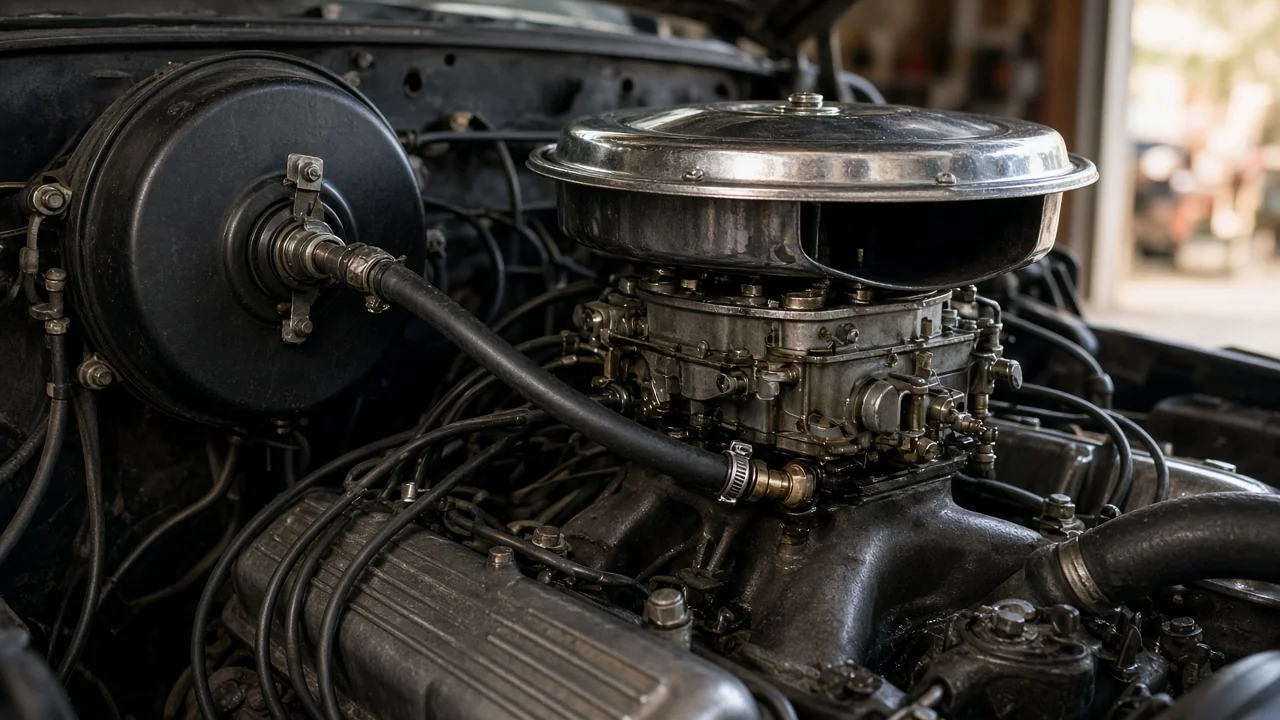
A vacuum brake booster only helps you stop if it gets steady, strong vacuum from the engine. A carbureted engine has several vacuum fittings on the carburetor and intake manifold, and they do not all behave the same way. Picking the wrong one can leave you with a hard pedal at idle or a lean, rough-running engine. This guide explains which source to use, why it matters and how to confirm the connection works.
Connect it to full manifold vacuum
The brake booster hose belongs on a source of full manifold vacuum. That means a port below the carburetor's throttle plates that is open to the intake manifold at all times. On most carbureted engines this is a large dedicated fitting on the intake manifold plenum, often near the rear of the carburetor pad. It can also be a large fitting on the carburetor base plate or on a carb spacer that opens below the throttle blades. Many four-barrel carburetors have a larger nipple on the base sized for booster or PCV use. The small nipples higher on the carburetor body are often ported vacuum and are not suitable.
The hose runs from that fitting to a one-way check valve, usually seated in a rubber grommet on the booster shell. Use the largest suitable port available. Do not tee into a small line shared with the distributor advance, PCV valve or other accessories. A booster moves a meaningful volume of air each time the brakes are applied and released, and a small or shared port can starve it of vacuum or upset the idle mixture.
How a vacuum booster uses engine vacuum
Inside the booster, a large diaphragm separates two chambers. With the brakes released, both sides hold vacuum. When you press the pedal, a valve lets atmospheric air into the rear chamber. The pressure difference pushes the diaphragm forward and adds force to the master cylinder pushrod. That extra force lets moderate foot pressure create enough brake fluid pressure to clamp each caliper and press the brake pads against the brake rotors, or to apply the drum shoes.
The difference between manifold and ported vacuum explains why the port choice matters. Manifold vacuum is highest at idle and during deceleration, which is exactly when you are most likely to be braking. Ported vacuum is taken above the closed throttle plates, so it reads close to zero at idle and only rises once the throttle opens. A booster on a ported source would give little or no assist as you come to a stop. The check valve keeps stored vacuum in the booster when manifold vacuum drops under heavy throttle or after the engine stops. That stored vacuum provides a few assisted applications in reserve.
What changes the answer
Port locations differ between manifolds and carburetors, so the general rule matters more than any one fitting. Aftermarket intake manifolds may have threaded ports that need a hose fitting installed. Some factory setups route the booster line to a fitting on a manifold runner or a vacuum tree. Carburetor spacers with a full manifold vacuum port are common in engine swaps. If you cannot tell whether a port is ported or manifold vacuum, check it with a vacuum gauge at idle. Manifold vacuum shows a steady, strong reading, while ported vacuum shows little or none until the throttle opens.
Engine condition and modifications also affect the result. A camshaft with long duration and overlap often produces low, unsteady idle vacuum, and a standard booster may not deliver enough assist on that supply. Higher altitude also reduces available vacuum. In those cases owners commonly add a vacuum reservoir, fit an electric or belt-driven vacuum pump, or switch to a hydraulic-assist system. The booster should also suit the master cylinder and the disc or drum brake arrangement. A good vacuum connection cannot make up for mismatched components or questionable vehicle fitment.
What the owner can do
Start with the check valve. Its arrow or marking should point toward the engine, so air can flow out of the booster toward the manifold but not back in. With the valve removed, you should be able to blow through it from the booster side but not from the engine side. Replace a valve that passes air both ways, sits loose in its grommet or is cracked. Fit a reinforced vacuum-rated hose that will not collapse under vacuum, and match its inside diameter to the check valve and manifold fitting. Many applications use roughly 11/32 or 3/8 inch hose. Clamp both ends and route the hose away from exhaust heat and moving parts.
Then test the system. With the engine off, pump the brake pedal several times until it feels firm, hold steady pressure and start the engine. The pedal should sink slightly as vacuum builds, which shows the booster is providing assist. Next, run the engine for a minute, shut it off and wait. If you still get two or three assisted pedal applications, the check valve and booster are holding vacuum. A hiss under the dash, an idle that changes when you press the pedal or a hard pedal at idle points to a vacuum leak, a failed diaphragm, the wrong port or a collapsed hose.
After moving the booster line, cap any manifold port left unused. An open port leans out the mixture and can cause a rough idle or stalling, and it is easy to overlook.
Limitations and when to get help
These checks confirm whether vacuum reaches the booster. They do not prove the whole braking system is sound. A hard pedal can also come from a failing booster. A soft or sinking pedal usually points to hydraulic problems, such as air in the brake fluid, a leaking caliper or a worn master cylinder. Worn friction material, or pads and rotors past their wear limits, is a separate problem that booster vacuum cannot fix. Use the service information for your specific vehicle, engine and manifold to confirm the correct port and parts.
Stop driving the vehicle and have a qualified brake technician inspect it if the pedal is hard, sinks toward the floor, the vehicle pulls to one side or it does not stop as it should. Braking faults can worsen suddenly, and a correctly routed hose is only one part of a safe system.