Recognize brake actuator symptoms
The short answer
A failing brake actuator usually shows up as a brake-related warning light or message, often with a stored fault code. Depending on which actuator is involved, you may also notice ABS or stability control that stops working or works when it should not, a pump that runs more often or longer than usual, a change in brake pedal feel, or a parking brake that will not apply or release. None of these signs is unique to the actuator. Wheel speed sensors, wiring, low brake fluid, low battery voltage and ordinary mechanical brake problems can produce the same symptoms, so the symptoms point you toward the actuator but do not prove it has failed.
Which brake actuator do you mean?
"Brake actuator" is not one standard part. Manufacturers use the name for different components, and the likely symptoms depend on which one is meant. Check the service information for your exact model year, market and configuration to see what the term refers to on your vehicle.
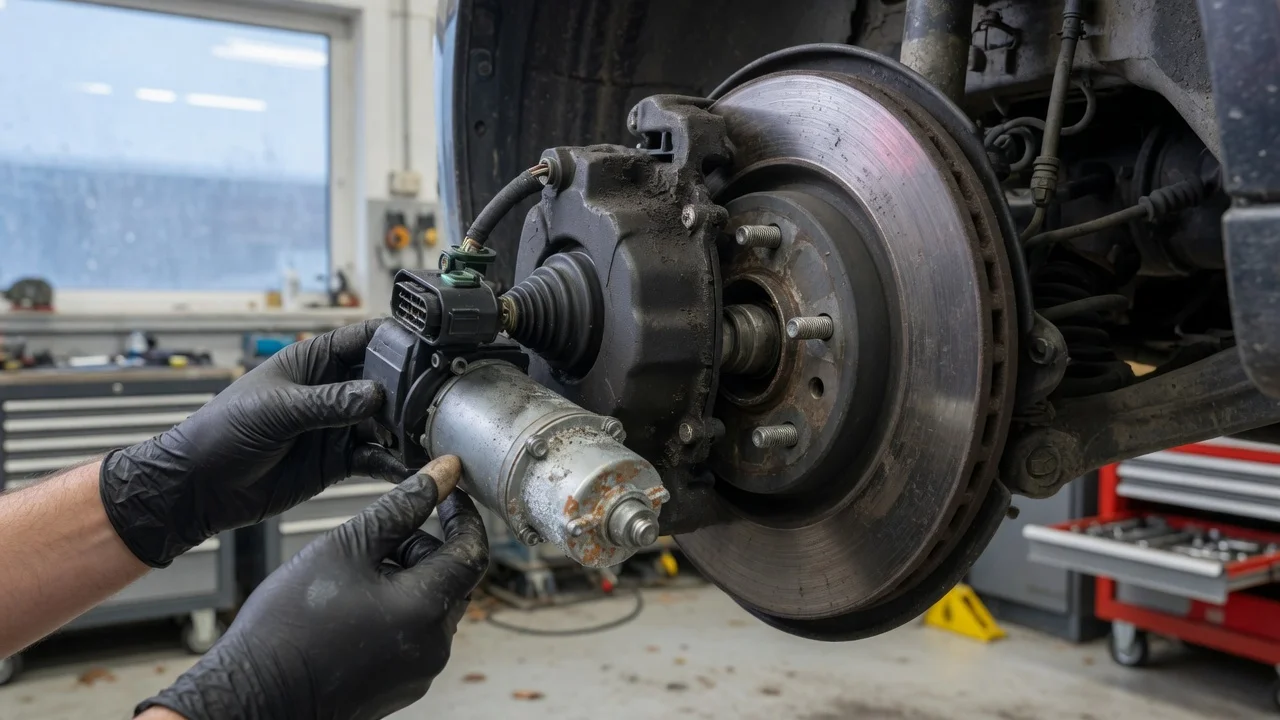
ABS or stability control hydraulic unit: in many passenger vehicles, this is the assembly that controls brake pressure at each wheel. It typically combines solenoid valves, a pump motor and, often, an attached electronic control module. ABS means anti-lock braking system. ESC means electronic stability control, which some brands call by other names. Electrohydraulic brake actuator: some vehicles, including certain hybrids and electrified models, use a brake actuator that also generates or stores brake pressure. It may include a pump and an accumulator, which is a pressure reservoir. Its symptoms can include pump noise and pedal-feel changes that a conventional system would not show. Electronic parking brake actuator: an EPB (electronic parking brake) uses electric motors, usually mounted on the rear calipers or driven through a central unit, to apply and release the parking brake. Air brake chamber: on heavy trucks and buses with air brakes, "brake actuator" can mean the air chamber at each wheel. That is a separate system and is not covered in this guide.
Symptoms associated with an ABS or stability control actuator
ABS, traction control or stability control warning lights stay on or come on while driving, sometimes together. The red brake warning light comes on. Some vehicles use it alongside the ABS light when electronic brake-force distribution is affected. ABS does not engage during hard braking on a slippery surface, so the wheels lock. ABS activates when it should not, such as at low speed or on dry pavement, so the pedal pulses or chatters during normal stops. The vehicle pulls to one side under braking, or one wheel seems to brake more or less than the others. The pump motor makes unusual noise: buzzing, whirring or grinding that is louder, longer or more frequent than normal. On electrohydraulic systems, a pump that runs repeatedly at rest is a notable sign. The pedal feels different: harder, softer, or higher or lower than usual. This symptom also has many causes outside the actuator. The module stores fault codes, or a scan tool cannot communicate with the ABS or stability control module at all.
Symptoms associated with an electronic parking brake actuator
A parking brake warning light or a "service parking brake" style message appears. The parking brake will not apply, will not release, or works on only one side. The parking brake applies or releases slowly, with straining, grinding or clicking from one rear wheel. The vehicle drags or the brakes stay warm on one side after the parking brake has been released. The parking brake does not release automatically when you drive off, on vehicles with that feature.
What else can cause the same symptoms
Several common faults can look like an actuator failure. Rule these out before deciding the actuator is the problem.
Observation | Possible causes besides the actuator | Check that helps tell them apart; ABS or stability warning light on | Wheel speed sensor or tone ring fault, damaged sensor wiring, blown fuse, low system voltage, module or communication fault | Read the codes from the ABS or stability module, then compare live wheel speed readings from all four wheels while driving; ABS activates at low speed or on dry roads | Dirty, damaged or misaligned wheel speed sensor; damaged or corroded tone ring; incorrect tire size or mismatched tires; wheel bearing play | Watch live wheel speed data for a wheel that drops out or reads erratically, and inspect the sensor, tone ring and tires; Vehicle pulls under braking | Sticking caliper or slide pins, collapsed brake hose, contaminated pads, suspension or tire problems | Inspect the base brakes and check for uneven pad wear or heat at one wheel before suspecting the actuator; Soft or sinking pedal | Low fluid, a leak, air in the system, master cylinder fault | Check fluid level and look for leaks. Air trapped in an ABS unit may need a scan-tool bleed procedure; Pump runs often or continuously | Low fluid, a pressure switch or sensor fault, internal leakage in the actuator or accumulator | Check fluid level and read codes and pressure data where the system provides them; Parking brake fails on one side | Seized caliper or cable, worn pads, wiring or connector fault to that motor, low voltage | Check codes from the parking brake system, inspect the wiring at the wheel, and inspect the caliper mechanically; No communication with the brake module | Fuse, power or ground supply, network wiring, connector, or a scan tool that does not support that module | Confirm power, ground and fuses, and confirm the tool can access that module on your vehicle
Checking the symptoms in a sensible order
The goal is to separate what you can observe from what might be causing it. Start with checks that are quick and rule out common causes, then narrow toward the actuator.
1) Record the conditions. Note which lights or messages appear, when they appear (at startup, at a certain speed, over bumps, in wet weather, after a jump start) and whether they come and go. Intermittent faults often depend on these details. 2) Check brake fluid level and condition, and look for leaks. Low fluid can trigger warnings and affect pedal feel on its own. 3) Check battery and charging system voltage. Low or unstable voltage can set brake system codes, and some parking brake and ABS faults appear after a weak battery or a jump start. 4) Read codes with a scan tool that can access the brake modules. Many basic code readers only read engine and emissions codes through the OBD-II port (on-board diagnostics, second generation), so they may show no ABS, stability or EPB codes even when codes are stored. 5) Look up each code using the manufacturer's definition for your vehicle. The same code number can mean different things on different makes, and the definition, together with its setting conditions, tells you what the module actually detected. 6) Review live data. Wheel speed readings from all four wheels, plus pressure, pump or motor current data where the tool provides it, help show whether the actuator or a sensor feeding it is the problem. 7) Inspect fuses, connectors and wiring for the module, the pump motor, the wheel speed sensors or the parking brake motors. Corroded or loose connections are a common cause. 8) Run the manufacturer's functional tests where your tool supports them. Bi-directional tests can command the ABS pump, individual valves or the parking brake motors so you can see whether each responds. 9) Check the base brakes mechanically: pads, rotors, calipers, slide pins, hoses and parking brake components. This is especially important for pulling, dragging or one-sided problems.
What each result tells you
A code that names a wheel speed sensor circuit, with one wheel showing missing or erratic live data, points to that sensor, its wiring or its tone ring rather than the actuator. A code that names an internal valve, the pump motor or the module itself suggests an actuator or module fault. Before concluding that, confirm power, ground, connectors and voltage, because supply problems can set similar codes. A pump or valve that responds correctly to a commanded test makes a complete mechanical failure of that part less likely. It does not rule out an intermittent fault. A parking brake motor that runs when commanded but does not clamp properly points toward the caliper, pads or mechanism rather than the motor's electrical side. Codes that return immediately after clearing indicate an active fault. Codes that return only under certain conditions need those conditions recreated during testing. A fault code alone does not prove the actuator needs replacement. A code reports what the module detected, such as a circuit out of range or a slow response, and wiring, voltage or sensor faults can produce the same codes.
When to stop driving and get help
On many vehicles, an ABS or stability light on its own means the anti-lock and stability functions may be disabled while normal braking still works. This varies by system. Stop driving and have the vehicle inspected promptly if the red brake warning light is on, the pedal is soft or sinking, braking distance has increased, the vehicle pulls strongly, or a parking brake will not release or releases only partly. Electrohydraulic systems that store pressure, and parking brakes that need a service mode before the rear brakes are worked on, can be hazardous to work on without the correct procedure. Repairs to the hydraulic unit may also require a scan-tool bleed procedure.
Limits of this guide
This guide describes general patterns. It does not provide code definitions, test values, pressure or current specifications, component locations, or the applicable models for any particular vehicle. These vary by manufacturer, model year, market and brake system design. To interpret readings and decide on repairs, use the service information and diagnostic procedures for your exact vehicle.