Bose Car Subwoofer: Factory Sub Replacement and Upgrade
What You Need to Know Before Replacing a Bose Subwoofer
A Bose car subwoofer is not a generic drop-in component. Bose audio systems in vehicles are typically engineered as a closed set, with the amplifier, speaker impedance, enclosure volume, and digital signal processing tuned together. The essential answer is that replacing or upgrading a Bose subwoofer requires confirming the factory configuration first: the driver size, enclosure location, voice coil impedance, and whether the amplifier sends a filtered low-frequency signal. In many Bose-equipped cars, the subwoofer is driven by a dedicated low-impedance amplifier channel, often rated near 1 ohm or 2 ohms. Using a standard 4-ohm aftermarket subwoofer on that channel can reduce output substantially or trigger amplifier protection.
Factory Bose Subwoofer Locations and Common Sizes
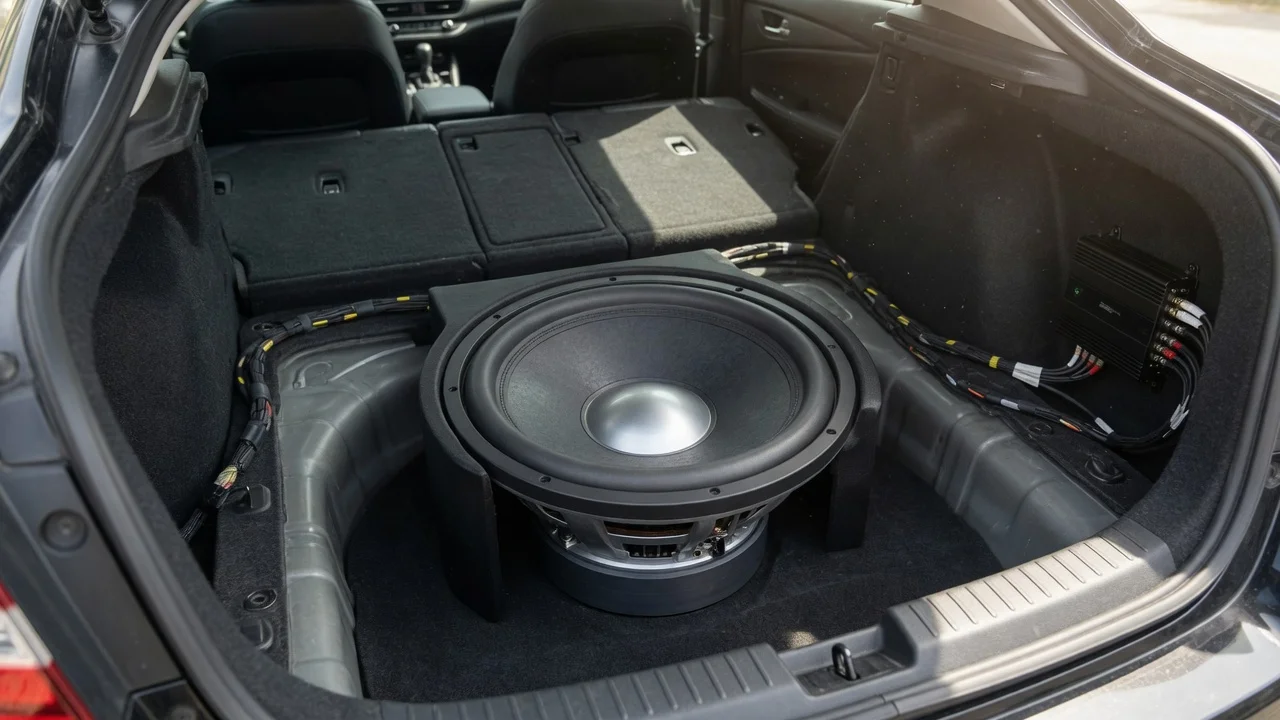
Bose places subwoofers in several locations depending on the vehicle platform. Common factory positions include a rear parcel shelf, a rear quarter-panel enclosure, a spare-wheel well, under a front seat, or inside a door. Driver sizes vary widely. Many sedans and coupes use a shallow 8-inch or 10-inch driver in a small sealed enclosure. Some SUVs and trucks use a 5.25-inch or 6-inch low-profile driver mounted in a compact plastic box. Before ordering a replacement, measure the cutout diameter, mounting depth, and bolt circle of the existing driver. The enclosure is often tuned to the original driver's parameters, so changing the driver size or type can alter low-end response and may require modifying the enclosure.
Impedance and Amplifier Matching
The most important electrical check is impedance. Bose factory subwoofers frequently use dual voice coils or a single very low impedance coil. Documented examples include 1-ohm and 2-ohm drivers, although specific values vary by model year and vehicle generation. If you install a 4-ohm subwoofer where the amplifier expects 1 ohm, the amplifier will deliver less power and the system may sound weak. If you wire two voice coils incorrectly, you can present a load that is too low and risk damaging the amplifier. Measure the factory driver with a multimeter to confirm DC resistance as a close guide to nominal impedance. Match the replacement driver to the same load, or plan to bypass the factory subwoofer amplifier entirely.
Shallow-Mount and Enclosure Constraints
Factory Bose subwoofers are usually shallow because the enclosure fits into a tight cavity. A standard aftermarket subwoofer with a deep motor structure may not fit. Look for shallow-mount subwoofers that specify a mounting depth less than or equal to the factory driver's depth, plus a small clearance margin. The enclosure material is often rigid plastic or fiberboard and may be sealed. A replacement driver should have a compliance and resonant frequency suited to small sealed enclosures. If the factory enclosure is ported, confirm the port tuning because a different driver can interact poorly with the port and produce weak or boomy bass.
Signal Path and Wiring
On many Bose systems, the subwoofer channel receives an already low-pass filtered signal from a dedicated amplifier or from a Bose digital amplifier module. The factory subwoofer may connect through a short harness with two or four wires depending on voice coil count. When swapping the driver, keep the factory connector if possible or use a matching adapter. If you plan to use an aftermarket amplifier, you will need a line output converter or a digital signal processor to sum and flatten the signal, because the factory head unit or amplifier may apply equalization that cannot be disabled without a separate interface. In some vehicles, the factory subwoofer signal is only present when the factory amplifier detects the correct load, so a load resistor may be required if the factory amplifier is retained.
Upgrade Paths
There are three practical upgrade paths. The first is a direct replacement of the factory driver with an aftermarket driver that matches the enclosure depth, cutout, bolt circle, and impedance. This preserves the factory amplifier and integration but limits power handling to what the factory amplifier provides. The second path is to reuse the factory enclosure and install a more capable shallow-mount driver, then power it with an aftermarket amplifier fed from a line output converter or DSP. The third path is a full replacement of the enclosure and driver, usually with a larger box or a powered subwoofer that includes its own amplifier. The third path is often necessary if the factory enclosure is too small for meaningful low-frequency extension or if the factory driver is not a standard size.
Checks Before Buying
Measure the factory subwoofer cutout diameter and mounting depth. Measure the DC resistance across each voice coil. Note whether the enclosure is sealed or ported. Confirm the subwoofer location and the available clearance behind the mounting surface. Check whether the factory amplifier sends a filtered low-frequency signal or requires a load to stay active.
Material Gaps and Uncertainty
Specific impedance, enclosure volume, and amplifier output ratings are not universal across Bose car audio systems. They vary by automaker, model year, generation, trim level, and market. Without the vehicle's exact year, model, and audio package, any stated specification is only an example. For a supported replacement decision, inspect the factory driver and enclosure in the specific vehicle rather than relying on a general Bose subwoofer description.