BMW Steering Angle Sensor Reset and Calibration: A Practical Guide
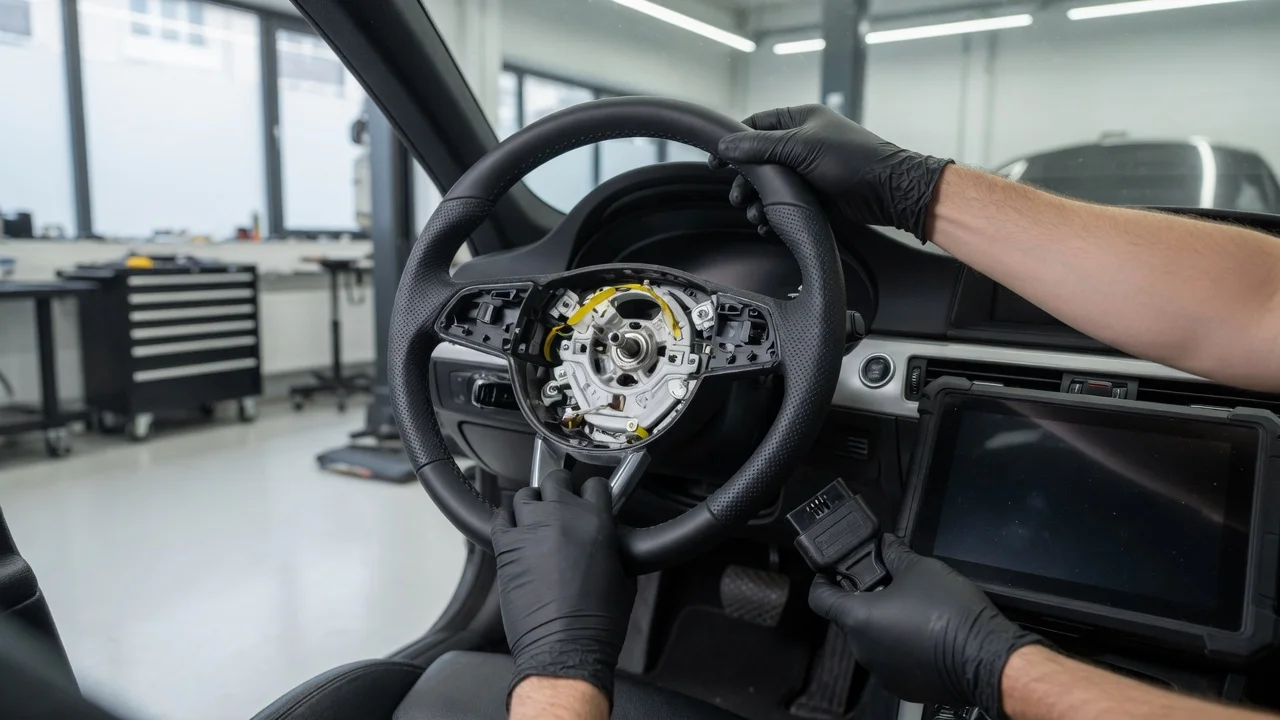
What the Steering Angle Sensor Reset Actually Involves
A BMW steering angle sensor reset is the process of clearing the stored steering center position and, when required, relearning the sensor's calibration so the stability control and steering systems agree on where straight ahead is. On many BMWs the reset is a software function rather than a physical adjustment. The exact procedure depends on the chassis generation and the diagnostic tool available, but the goal is the same: to remove a false steering angle fault or to teach the vehicle a new center position after alignment, suspension work, or steering component replacement.
When a Reset or Calibration Is Needed
The most common trigger is a steering angle sensor fault code, often accompanied by a DSC, ABS, or traction warning light. A reset is also needed after a wheel alignment changes the straight-ahead steering position, after replacing the steering angle sensor, clock spring, steering rack, tie rods, or steering column components, and sometimes after a battery disconnect on vehicles where the stored center value is lost. It is not a routine maintenance item; it is a correction for a mismatch between the sensor's stored zero point and the vehicle's actual straight-ahead position.
Model-Specific Differences Matter
The method varies significantly by platform. On an E39, E46, E53, or E60, the steering angle sensor calibration is usually performed with a diagnostic interface such as INPA, DIS, or a capable handheld tool. On later F-chassis cars like the F10 or F30, the function is often called "steering angle sensor adjustment" or "calibration" in ISTA and may run as a service function that requires driving the vehicle briefly. The BMW 1 Series spans multiple generations, so an E87 or E82 uses the older E-series procedure while an F20 or F40 uses the newer F-series or G-series procedure.
Basic Mechanical Checks Before Any Software Procedure
A software reset will not fix a mechanical problem. Before calibrating, confirm that tire pressures are equal side to side, the steering wheel is centered when the front wheels point straight ahead, the alignment is within specification, and the steering angle sensor is correctly installed and not damaged. On vehicles where the sensor reads an implausible angle only while driving, inspect the steering column coupling and wheel speed sensors as well. If the sensor itself is faulty, coding or resetting will not provide a lasting repair.
Generic Reset Procedure for Many BMWs
A commonly documented procedure for vehicles with a basic steering angle sensor reset function starts with the ignition on and the engine off, or the engine running depending on the tool instruction. The front wheels must be pointed straight ahead. Using a diagnostic tool, select the chassis, then the DSC or ABS control unit, and then the steering angle sensor calibration or reset service function. Follow the on-screen prompts, which may include turning the steering wheel from lock to lock and returning it to center. After the function completes, clear fault codes and perform a short test drive so the system can verify the sensor signal.
INPA and ISTA Steering Angle Sensor Calibration
INPA is a factory-level diagnostic software commonly used for E-series BMWs. The calibration is typically found under the chassis or DSC section as "Lenkwinkelsensor abgleichen" or a similar steering angle sensor adjustment function. ISTA is the newer factory diagnostic platform used for F-series and later cars. In ISTA the function is usually under vehicle management, service functions, chassis, and then steering angle sensor adjustment. ISTA often instructs the technician to drive the vehicle slowly during or immediately after the calibration. When using either tool, follow the exact on-screen sequence because module communication and required conditions differ between chassis.
Steering Angle Sensor Coding vs. Calibration
Coding and calibration are separate operations. Coding writes configuration data to a module, such as variant settings or replacement sensor identity. Calibration teaches or resets the sensor's zero position. When a new steering angle sensor is installed, it may require both: coding to match the vehicle configuration and calibration to establish the center value. Do not assume one operation covers the other. A sensor that is coded but not calibrated can still set a steering angle plausibility fault.
Resetting After an Alignment
After an alignment, the steering wheel may be centered but the sensor's stored zero point may no longer match the new straight-ahead position. The correct sequence is to perform the alignment first, confirm the wheel is centered, and then run the steering angle sensor reset or calibration with the wheels straight. Some alignment shops reset the sensor as part of the service; others do not. If a DSC light remains after a professional alignment, the sensor likely needs a separate software reset.
Specific Notes: E39, E60, E90, F10, and Z4
The E39 steering angle sensor calibration is well documented through INPA or equivalent E-series software and usually does not require driving during the function itself. The E60 uses a similar diagnostic path but may also show steering angle data under the DSC module. The E90 commonly needs the reset after steering rack or column work and responds to the same E-series procedure. The F10 uses ISTA and may require a brief drive to complete the adjustment. The BMW Z4 is generation-dependent: the E85 and E89 follow the E-series method, while later Z4 models follow the newer ISTA procedure. Always confirm the chassis code before choosing a procedure.
What to Do If the Reset Fails or the Light Returns
If the calibration rejects or the fault returns immediately, check that the steering angle sensor is receiving power and ground, that the CAN or LIN communication to the DSC module is intact, and that the sensor mounting is not loose or rotated. A sensor that repeatedly loses its zero point after the ignition is cycled may have an internal fault. In those cases, replacement rather than repeated resetting is the appropriate repair. Also verify that the battery voltage is stable during the procedure because low voltage can interrupt module communication and leave the calibration incomplete.
Tools and Access Requirements
A basic OBD2 scanner usually cannot perform a BMW steering angle sensor reset. The function typically requires a BMW-capable diagnostic tool such as INPA, ISTA, a factory scan tool, or a higher-level aftermarket tool that supports BMW service functions. Some tools can read the steering angle live data but cannot write the calibration. Before purchasing or borrowing a tool, confirm that it lists steering angle sensor adjustment or calibration for the specific chassis, not just generic OBD2 access.