BMW Parking Brake Actuator Repair: Fault Assessment and Repair Options
Confirm the fault before repair
Start with a fault scan, not with parts replacement. Read the electronic parking brake control unit and record every stored fault code, freeze-frame data, and mileage entry. Intermittent parking brake warnings can come from a weak battery, low system voltage during cranking, a damaged wheel-speed signal, a wiring connector issue, or a genuine actuator fault. A confirmed actuator defect usually returns immediately after clearing codes and may be accompanied by a measured open circuit, short circuit, implausible position signal, or a failure to reach the commanded position.
Compare live data with the commanded state. Request apply and release while watching actuator current draw and position feedback. A healthy actuator moves to its target position within the expected time and current range. A seized mechanism may draw high current briefly before the control unit aborts the operation. A motor with worn brushes or an open winding may show no meaningful movement, low or zero current, or a position signal that does not change. Noise alone is not proof of failure: a short groan during operation can be normal.
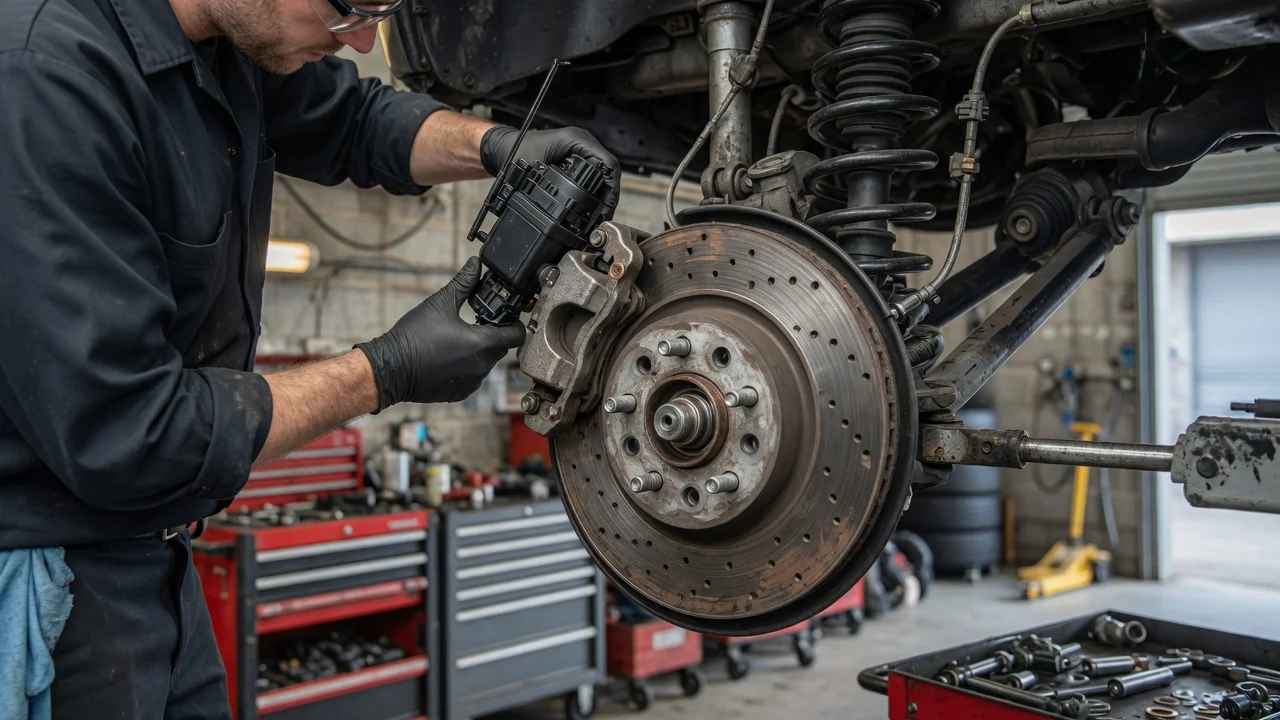
Confirm the complaint on the affected wheel before ordering parts. The actuator works with the caliper, brake pads, and brake rotors. If the parking brake works electrically but the vehicle still rolls, the fault may be mechanical at the caliper or related to friction material, not the actuator. If one wheel releases but the other stays applied, check the affected side sensor, connector, and wiring before condemning the actuator.
Define the repair scope
Identify the exact system and configuration. BMW uses different parking brake designs depending on model, market, and production date. Some vehicles use an electric motor on each rear caliper, while others use a central actuator operating cables. Replacement parts, calibration routines, and service procedures differ between systems. Vehicle fitment must be checked from the VIN or the original part number, not from appearance alone.
Assess the extent of the damage before choosing a repair. Water ingress into the actuator housing can corrode the motor or electronics and may also damage the connector terminals. If moisture reached the unit, inspect the connector seal and wiring for green corrosion or swollen insulation. A damaged caliper, worn friction material, or a scored rotor should be addressed with the actuator repair so the system does not fail again shortly after reassembly.
Do not assume every model can be repaired the same way. Some actuator motors are serviceable only as a complete unit, while others are available separately. If the failure follows water damage or wiring damage, replacing only the motor may leave the original cause unresolved. Confirm whether the control unit requires coding, programming, or a repair-shop service function after actuator replacement before you begin.
Compare repair options
Adjustment is only appropriate when the system is within specification but not correctly adapted. Some parking brake systems require a service position, pad replacement routine, or basic setting after brake pad replacement. If the fault is only a stored implausible position after recent brake work, performing the correct adaptation may resolve it without replacing the actuator. Adjustment does not repair a seized motor, broken gear, damaged connector, or internal electrical fault.
Component repair can work when the damage is isolated and repairable. Cleaning corroded connector terminals, replacing a damaged seal, or repairing an identified wiring break may restore function if the actuator internals are still sound. This option leaves the original actuator in place, so it is only suitable when testing has shown the motor and position sensor are good. If the fault is intermittent and the cause has not been reproduced, cleaning alone may create a false sense of repair.
Replacement is the usual repair for a confirmed actuator defect. Use a part that matches the vehicle by VIN or original part number, and follow the manufacturer procedure for installation, connector fitting, and sealing. After installation, the system usually requires a service function to move the actuator into the correct position and carry out a basic setting. Skipping this step can leave the parking brake partially applied, cause incorrect pad clearance, or set new fault codes.
Specialist service is appropriate when the diagnosis is unclear, the vehicle has multiple stored faults, or the required scan tool and service information are not available. A brake specialist can separate an actuator problem from a control unit, wheel-speed sensor, or body electrical fault. Braking faults can be safety-critical, and a vehicle with an unreliable parking brake should not be parked on a slope or left in gear as a substitute until the system is repaired.
Requirements and limits
Use vehicle-specific service information and wear limits. The required torque values, seal positions, connector routing, and adaptation routines come from the manufacturer procedure for the exact model. Where a new actuator or caliper is fitted, follow the stated torque sequence and use the correct brake fluid specification. Check brake pad and rotor thickness against the published wear limits while the wheel is removed; parts below the limit must be replaced rather than refitted.
A diagnostic tool with two-way control and the ability to perform service functions is essential for most actuator replacements. Generic code clearing is not enough: the electronic parking brake normally needs to be placed in service mode before removing the caliper and adapted after reassembly. Without the correct tool, manual attempts to wind back the actuator can damage the internal mechanism or leave incorrect clearance.
Work safely. Secure the vehicle on level ground, chock the wheels, and support it on rated stands. The parking brake must be treated as inoperative until the repair is verified. Brake fluid can damage paint and is a safety hazard; use the correct procedure if the hydraulic system must be opened. If the parking brake fault affects holding on gradients, stop using the vehicle for parking on slopes and have it transported if necessary.
Some repairs exceed the scope of driveway work. Control unit programming, coding to the vehicle, and calibration may require manufacturer or specialist diagnostic access. If a scan shows communication faults with several modules, low network voltage, or a control unit that does not respond, the repair should go to a specialist rather than being treated as a simple actuator replacement.
Verify the outcome
Perform the required adaptation before judging the repair. After any actuator or caliper work, run the manufacturer service function for pad fitting or basic setting, then clear fault memory and reread the system. Check that the parking brake applies and releases evenly on both rear wheels and that no position, current, or plausibility faults return.
Complete functional checks with the wheels in the air and then on the ground. Verify that the brake holds against drive away or wheel rotation, releases completely without drag, and illuminates the correct warning state. Road test gently and confirm there is no pull, brake noise, or warning light. Record the work performed, the parts used, fault codes before and after, and the mileage for future diagnosis.
If a fault returns or the parking brake still does not hold, stop and reassess rather than repeating the same replacement. Persistent symptoms suggest the original cause was not the actuator or that a related component, connector, or control unit fault remains. In that case, obtain a specialist diagnosis before further use of the vehicle.