BMW N55 Wastegate Actuator: Identification
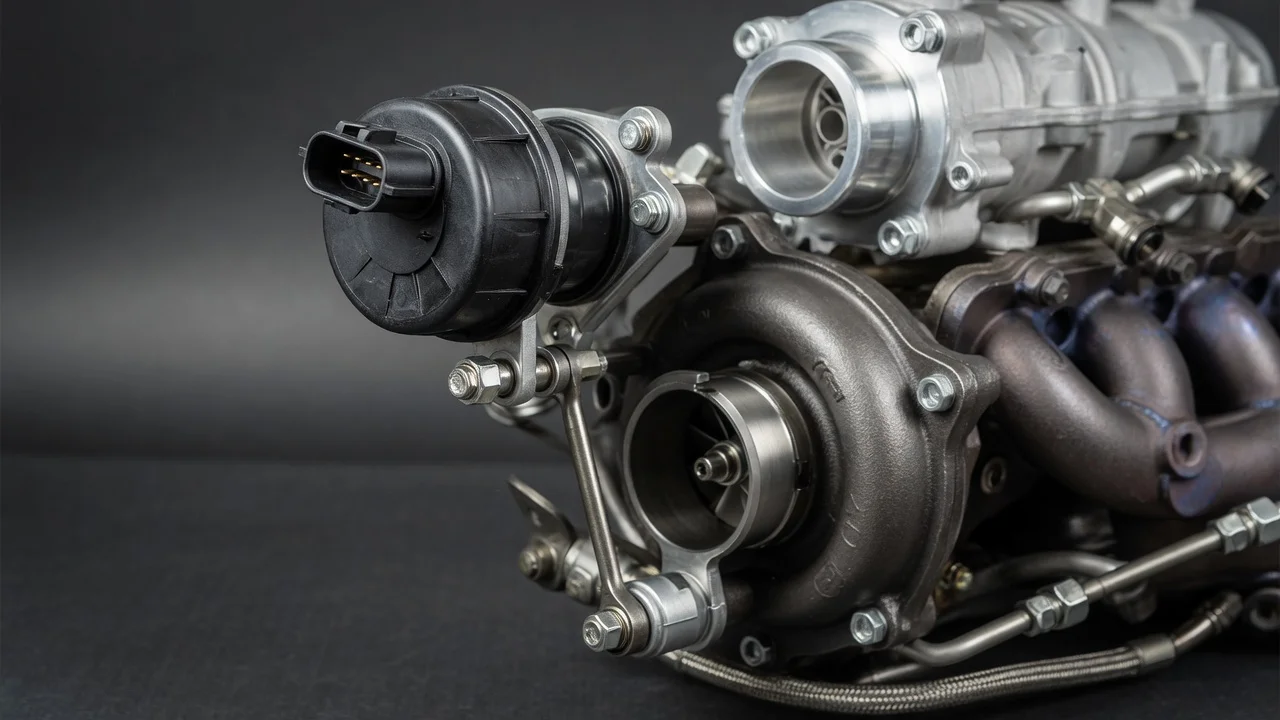
The wastegate actuator on a BMW N55 is the small canister attached to the turbocharger that moves the wastegate flap and so controls how much exhaust gas drives the turbine. Identify it correctly before you chase a boost fault or order parts, because the N55 is easily confused with other BMW six-cylinder engines that use different turbo layouts. This guide covers where the actuator sits, how it works, what varies between vehicles and what an owner can safely check.
Where the N55 wastegate actuator is and how to recognize it
The N55 is a 3.0-liter inline-six with a single twin-scroll turbocharger. The turbo sits on the exhaust side of the engine, and the wastegate actuator is mounted on the turbocharger assembly. Look for a round diaphragm housing with a small hose connection and a rod running from it to a lever on the turbine housing. That lever turns the wastegate flap inside the exhaust housing. Heat shields and surrounding components hide much of this area, so the actuator and its linkage are often easiest to see from underneath the vehicle with the undertray removed.
On the N55 the actuator is generally vacuum-operated. The engine control unit regulates the vacuum reaching it through an electro-pneumatic pressure converter, often called the boost control solenoid. Whether the actuator can be bought separately or only as part of the turbocharger depends on the parts catalog for your exact vehicle, so confirm availability by VIN before planning a repair.
How the wastegate actuator controls boost
Exhaust gas spins the turbine, which drives the compressor that pressurizes intake air. The wastegate is a bypass around the turbine. When the flap is closed, exhaust flows through the turbine and boost builds; when it opens, part of the exhaust bypasses the turbine, limiting its speed and therefore boost pressure. The engine control unit compares measured boost with its target and adjusts the converter signal. That changes the vacuum acting on the actuator diaphragm against an internal spring, and the balance between the two positions the rod and the flap.
Because the system is a chain, a fault anywhere in it can produce similar symptoms: vacuum supply, hoses, the pressure converter, the actuator diaphragm, the rod, or the flap and its pivot. A metallic rattle from the turbo area, for example, is commonly traced to wear in the flap pivot or linkage rather than to the actuator canister itself. Finding the actuator is the starting point for diagnosis, not the diagnosis.
Engine variants and conditions that change the answer
Confirm the engine code on the engine or through the VIN rather than relying on the model badge, since the same badge has covered different engines across generations. The earlier N54 uses two turbochargers with two wastegates, the S55 in M models is a separate twin-turbo engine, and the B58 that succeeded the N55 in many models uses a different turbocharger and wastegate control. Parts, locations and test procedures for those engines do not transfer directly to the N55.
The vehicle configuration and service history also matter. Engine tuning changes boost targets and can alter how hard the wastegate system works. Aftermarket parts such as adjustable actuator rods, modified vacuum lines or a non-original replacement turbocharger may look and behave differently from factory parts. Operating conditions such as frequent short trips, heavy towing or sustained high load expose the turbo area to repeated heat cycling, which affects hoses and linkage wear. Ask for records of any previous turbo or boost-related work before drawing conclusions.
What the owner can check
Work only with the engine off and fully cooled, and support the vehicle securely before going underneath. With the undertray removed, locate the actuator and inspect it visually. Check that the vacuum hose is attached and not cracked, collapsed or heat-damaged, that the rod is connected to the lever with its retaining clip in place, and that there is no obvious heat damage or oil contamination around the actuator. If you have a hand vacuum pump, applying vacuum to the actuator port should move the rod, and the diaphragm should hold vacuum; one that leaks down points to an actuator problem.
Read stored fault codes with a scan tool that supports BMW engine control units. If the tool shows live data, compare target and actual boost pressure during a safe, legal test drive. Note when symptoms appear: rattle at cold start, idle or on lift-off, reduced power under load, or a reduced-power mode with a warning light. A cracked or detached hose is usually a simple fix. A seized rod, a failed diaphragm or a worn flap pivot is more involved and may require turbocharger removal.
Limitations and next step
A visual inspection identifies the actuator but cannot prove it works correctly under load and heat. Underboost and overboost symptoms overlap with boost leaks in the charge piping, vacuum supply faults, sensor problems and converter failures. There is no universal replacement interval for the wastegate actuator; it is normally inspected when symptoms or fault codes appear, not on a fixed maintenance schedule. Rod adjustment, fastener torque and any calibration steps must follow the manufacturer specifications for your exact engine and vehicle.
Get professional help if boost-related codes return after basic checks, if diagnosis requires removing the turbocharger, or if you see smoke, oil leaks or heat damage around the turbo. Bring the VIN, confirmed engine code, service history, stored codes and your notes on when symptoms occur. That information lets a qualified technician separate an actuator fault from linkage wear or a problem elsewhere in the boost control system.