BMW N54 Wastegate Actuator: Identification and Function
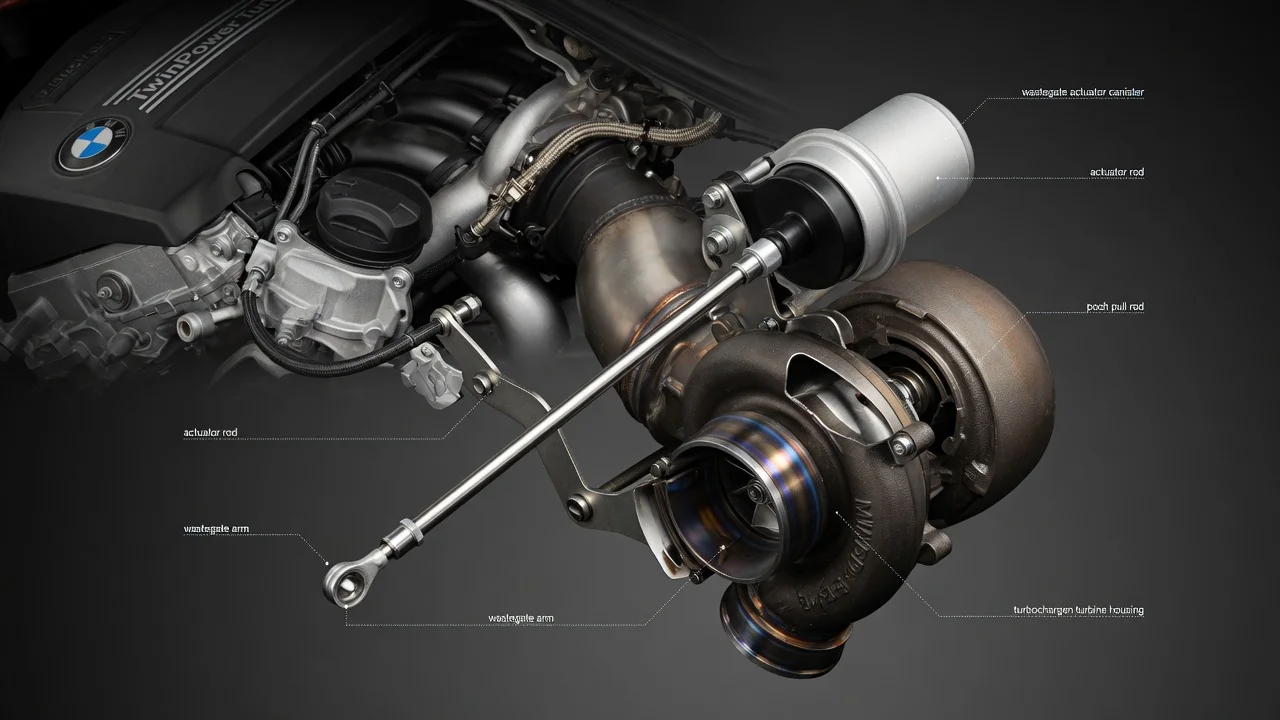
The N54 is BMW's 3.0-liter twin-turbocharged inline-six, and each of its two turbochargers has its own wastegate actuator. These small vacuum canisters control how much exhaust gas bypasses the turbine, so they directly shape boost. This guide explains how to identify the actuators and what they do. It also covers which faults look like an actuator problem but are not, and what an owner can reasonably check before booking an inspection.
What the N54 wastegate actuator is
On the N54, the wastegate actuator is the round diaphragm canister mounted on each turbocharger. A short rod links it to the wastegate arm on the turbine housing. There are two of them. One is on the front turbo, which serves cylinders one to three, and the other is on the rear turbo, which serves cylinders four to six. Both sit low on the exhaust side of the engine, so they are easiest to see from underneath the car with the undertray removed. Each actuator has a vacuum port with a hose running back to the boost control solenoids.
The actuator's job is to move the internal wastegate flap. When the flap is open, exhaust gas bypasses the turbine wheel, the turbo spins more slowly, and boost is limited. When the flap closes, more gas drives the turbine and boost rises. The actuator does not decide how much boost to make; the engine control unit does. The actuator is simply the mechanism that moves the flap in response to the vacuum signal it receives.
How the boost control system works
The N54 uses vacuum, not boost pressure, to operate its wastegates. An engine-driven vacuum pump supplies the vacuum. The engine control unit modulates it through electronically controlled solenoid valves before it reaches the actuators. Inside each actuator, a spring holds the wastegate open at rest. When vacuum is applied, it pulls the diaphragm against the spring and draws the flap closed. More vacuum means a more closed wastegate and more boost. Less vacuum lets the spring reopen the flap and release boost.
Because the wastegates are held open by default, a loss of vacuum anywhere in the chain usually causes underboost rather than overboost. A split hose, a leaking diaphragm or a solenoid that does not pass vacuum all leave the spring in charge. The flap then stays open and the turbo cannot reach its target pressure. The control unit compares measured boost with its target. When the gap is large or persistent, it can set fault codes and reduce engine power.
What changes the diagnosis
Not every boost or noise complaint on an N54 is an actuator fault. The most common source of confusion is wastegate rattle, a metallic noise at idle, under light load or when lifting off the throttle. It usually comes from wear between the wastegate flap shaft and its bushing inside the turbine housing, not from the actuator canister. Adjusting the actuator rod can sometimes quiet the noise, but it does not repair the worn parts and can change boost behavior. Underboost can also come from charge pipe or intercooler leaks, failing solenoids, vacuum pump problems or worn turbochargers. All of these can produce symptoms similar to a failed actuator.
Vehicle configuration matters as well. The N54 was fitted to several BMW models over a number of years, and parts, software and service history differ between cars. A car with an aftermarket tune, upgraded turbochargers or modified boost control may use different actuators or control logic, so stock expectations may not apply. Do not apply diagnostic advice from the later N55 engine to the N54, because the N55 uses a single twin-scroll turbocharger. Operating conditions such as cold starts, sustained high load and repeated heat cycling also affect how wear and leaks show up.
What the owner can check
Start with any stored fault codes and the conditions under which symptoms appear. Note whether the problem is a loss of power, a boost-related warning, a rattle or a combination of these. Also note whether it happens cold or warm, at full throttle or at light load. That record is more useful to a technician than a general description. It also helps separate a control problem from mechanical wear. Wastegate actuators are generally inspected when symptoms appear rather than replaced on a fixed maintenance schedule.
With the engine off and cool, many owners can do a basic visual inspection. Trace the vacuum hoses from the solenoids to both actuators. Look for cracks, hardened sections, loose connections or heat damage near hot exhaust parts. A hand vacuum pump connected to an actuator port can show whether the rod moves smoothly and whether the diaphragm holds vacuum without slowly leaking down. Compare the front and rear actuators, because a clear difference between them points to the weaker one. Do not force the wastegate arm or change the rod length without the manufacturer specifications for your vehicle.
A cracked or loose hose is often a simple repair. An actuator that will not hold vacuum or moves unevenly needs replacement or further diagnosis. Before ordering parts, check how replacement parts are supplied for your exact car, because that affects repair scope and cost. Reaching the turbochargers on this engine is labor-intensive, especially at the rear.
Limitations and when to get help
A vacuum test and a visual check can confirm an obvious leak or a failed actuator. They cannot measure wastegate bushing wear, verify boost under load or confirm that the control unit is commanding the correct vacuum. Answering those questions requires data logging of target and actual boost, solenoid testing and sometimes a smoke test of the intake and vacuum systems. How the results should be read depends on the exact model, software and any modifications.
Before buying parts, review the service history for previous turbo, solenoid or vacuum pump work and check for any service campaigns that apply to your vehicle. If symptoms continue after the vacuum side checks out, or if the car repeatedly enters reduced power mode, have a technician familiar with the N54 confirm the cause. Turbo work on this engine is expensive, so an accurate diagnosis usually saves more money than replacing the cheapest suspect part first.