BMW Electronic Parking Brake Service Mode Without a Scanner
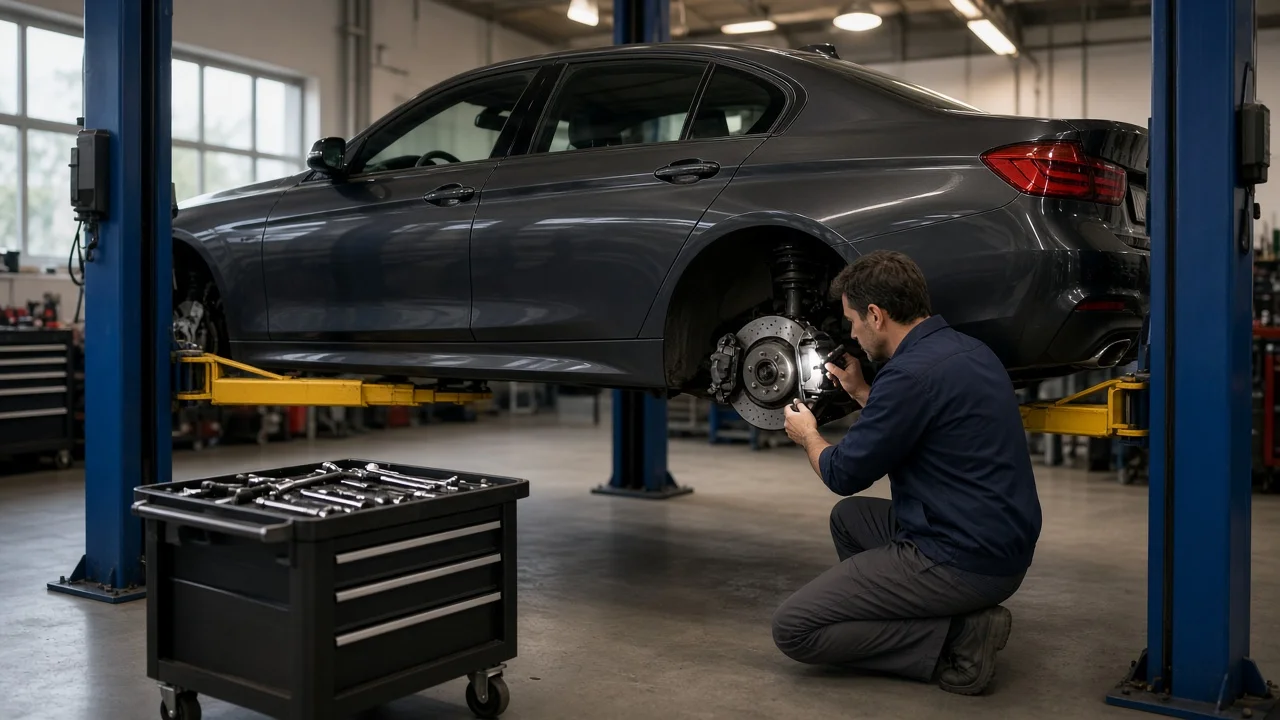
Replacing rear brake pads on most modern BMWs means getting past the electronic parking brake first. A motor-driven mechanism holds the rear caliper pistons, so you can't simply press them back the way you could on older hydraulic-only calipers. A diagnostic tool normally puts the system into service mode, and many owners ask whether the job can be done without one. This guide explains what that mode does, which systems allow alternatives, and where the workarounds stop being safe.
What service mode has to accomplish
Service mode is also called workshop or maintenance mode. It commands the parking brake motors to fully retract their spindles, then locks out the system so it won't apply while a caliper is open. Without that retraction, the piston can't be pushed back far enough to make room for thicker new brake pads. Forcing it can strip the internal gearing or spindle. Once the new friction material is installed, the system has to leave service mode. The motors then drive forward, find the pad contact point and recalibrate clamping force.
Before choosing a method, define the job. You might be replacing only pads, pads and brake rotors, or a complete caliper. You need level ground, wheel chocks and proper vehicle support. You also need the procedure and wear limits for your specific vehicle. Minimum rotor thickness is often stamped on the rotor itself, and pad limits are given in the service information. Measure against those figures rather than judging wear by eye.
Identify which parking brake system your BMW uses
BMW has used two broad designs. Some earlier models, such as the E70-generation X5, use a central electromechanical actuator that pulls cables to small drum-style shoes inside the rear rotor hat. On these cars the parking brake does not clamp the rear disc pads, so pad replacement normally doesn't involve service mode. The cable system has its own adjustment and release arrangements, which are covered separately in the service information.
Most later models use motor-on-caliper units. A small motor and gearbox bolt to the back of each rear caliper and drive the piston directly, and these are the systems that need retraction before pad work. Fitment details vary by chassis, engine, brake package and model year. Confirm the exact system from the vehicle's build data or by looking at the rear calipers. An electrical connector and motor housing on the caliper body indicate a motor-on-caliper design.
Methods that avoid a dedicated scan tool
Some BMW models let you release and re-apply the parking brake with a sequence using the ignition, brake pedal and parking brake switch. Owners sometimes call this a manual service mode. Whether your car supports such a sequence, and what it actually does, depends on the model and software. Often the sequence only performs a normal release and doesn't fully retract the spindle, which is not enough room for new pads. Use only a procedure documented for your vehicle, and confirm full retraction before you compress the piston.
A second approach is mechanical. With the ignition off and the battery handled as the service information requires, you unplug the motor unit and unbolt it from the caliper. You then turn the exposed spindle by hand with the correct bit until the piston can retract. This avoids the electronics entirely, but the risks are yours. Turning the wrong way, using an impact tool or over-retracting can damage the spindle, and the motor seal must be clean and properly seated when you reassemble. Some people instead power the motor directly from a 12-volt source to reverse it. That bypasses the control module's current limits and position tracking and can damage the motor, so it is the riskiest option.
Whichever method you use, these calipers are typically pushed straight back once the spindle is retracted rather than wound in. Check the service information for your caliper, because some designs differ. Watch the brake fluid level in the reservoir as the pistons return, since a recently topped-up system can overflow.
Trade-offs between the approaches
The main difference between methods is what the control module knows afterward. A scan tool retracts the motors under the module's control, so the module tracks their position, runs a proper calibration and can clear stored faults. A switch sequence, where supported, also keeps the module involved. Manual spindle turning and direct power both happen without the module's knowledge. The first application afterward may set fault codes or a warning light, and clearing them may require a scan tool even if the brake works.
Be wary of claims that one method works on every BMW or carries no risk. Forum posts and product labels rarely say which chassis, software level or caliper supplier was involved. Trust a method when it comes with a procedure for your exact model, a clear way to confirm full retraction, and a reliable way to reactivate and test the system.
Limitations, risks and hidden costs
Skipping the scanner saves the cost of a tool, not the cost of the job. You still need new pads, possibly rotors, wear sensors where fitted, brake cleaner and suitable lubricant for slide pins and pad contact points. You also need torque values for the caliper carrier and motor bolts. If a warning light stays on after reassembly, you may end up visiting a shop or buying a tool that supports BMW parking brake functions anyway, which can cancel the savings.
Some tasks are beyond any no-scanner method. It can't confirm that the module has recorded the new pad position, read the cause of an existing parking brake fault, or run checks the factory procedure requires after certain repairs. If the parking brake already showed a fault, a motor doesn't respond or a caliper is seized, treat the job as a diagnosis rather than a pad swap.
When to stop and seek professional service
Stop driving the vehicle and have it inspected if any of these occur: the parking brake won't hold on a slope, a brake warning stays on after the job, the pedal feels soft or sinks, or one wheel drags and runs hot after driving. These symptoms can point to incomplete calibration, air in the hydraulic system, a sticking caliper or a damaged actuator. The parking brake is a safety system. A car that rolls away and a rear brake that won't release are both serious failures.
Practical checklist before you start
Confirm vehicle fitment: the chassis code, the model year and whether the rear calipers carry parking brake motors. Get the procedure, torque values and wear limits for your specific vehicle, and measure the current pads and rotors against them. Decide in advance how you will retract the spindles, how you will confirm full retraction and how you will reactivate the system afterward.
Have all parts and supplies ready, including any required wear sensor. Support the car safely and chock the front wheels, because the rear parking brake won't hold while it is retracted. After reassembly, pump the pedal to seat the pistons before moving the car. Reactivate the parking brake according to the procedure, check for warning messages, confirm that it holds and releases, and test the brakes at low speed. If you can't complete any step with confidence, a scan tool or a brake specialist is the safer choice.