BMW E90 Brake Booster Check Valve: Choosing the Correct Part
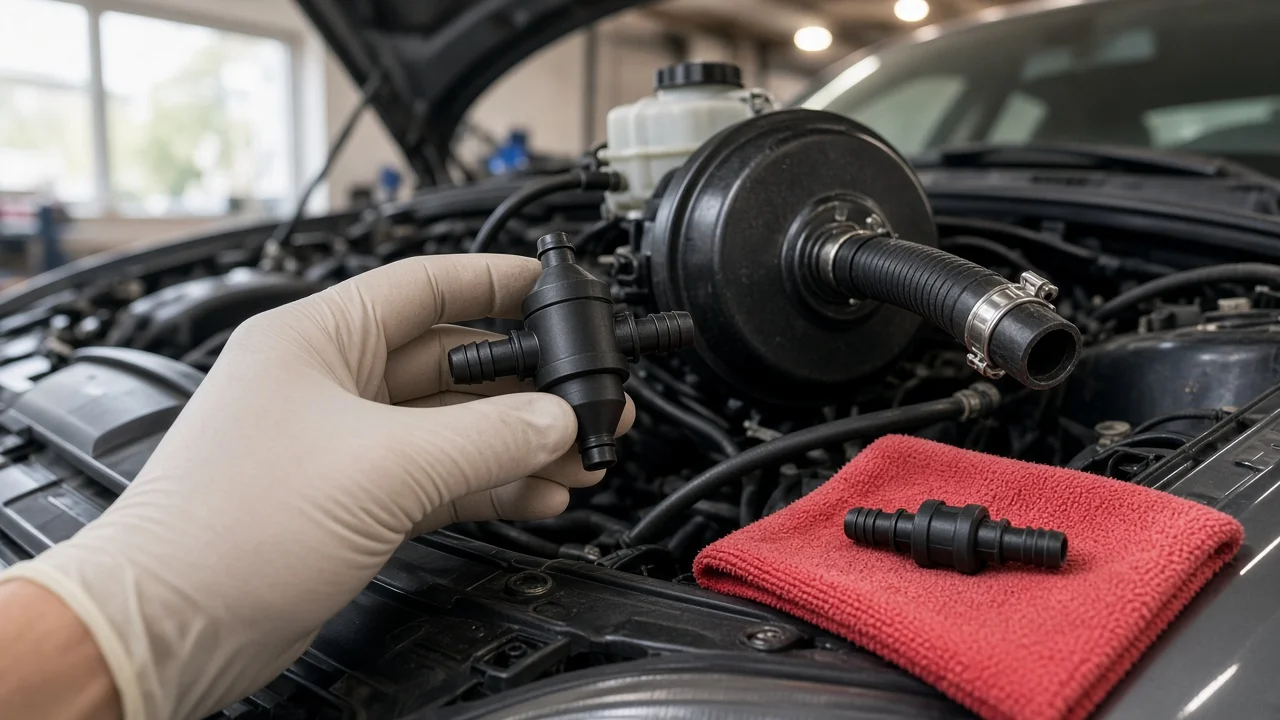
The brake booster check valve on a BMW E90 is a small one-way valve in the vacuum line that keeps power assist available in the booster. When it sticks, cracks or leaks, the pedal can feel hard, especially on the first stop after the car has been parked. Choosing a replacement is mostly about fitment: matching your engine, hose layout and connector style. It also means confirming that the valve has failed, rather than the booster, vacuum pump or hose.
Define the job the check valve must do
Brake assist on the E90 depends on vacuum stored in the booster. Most engines in this chassis use an engine-driven vacuum pump instead of relying only on intake manifold vacuum. The check valve sits between that vacuum supply and the booster. It lets air be drawn out of the booster and stops air from flowing back in when the engine shuts off or when the supply side loses vacuum. A healthy valve lets the booster hold vacuum long enough to give one or more assisted pedal applications after the engine stops.
Before buying, confirm the fault. Common signs of a failing valve are a firm pedal on the first press after the car has sat, a hiss near the booster or vacuum line, and assist that disappears quickly with the engine off. A simple check: with the engine off, pump the pedal until it firms up, hold light pressure and start the engine. The pedal should drop slightly as assist returns. When the valve is removed, air should pass from the booster side toward the pump side and be blocked in the reverse direction. If assist is weak or missing with the engine running, suspect the pump, hose or booster as well as the valve.
Check compatibility with your E90
Fitment on this platform varies more than the small size of the part suggests. Engine code matters most, because four-cylinder, six-cylinder, turbocharged, diesel and M3 versions route their vacuum lines differently. Model year, production date and steering side can also change the hose assembly. On some cars the check valve is a separate inline piece. On others it is built into a preformed vacuum hose or the fitting at the booster, so the replacement may only be sold as part of the line. The sedan, wagon, coupe and convertible (E90, E91, E92 and E93) share a lot of hardware, but a listing for one body style does not automatically fit the others.
Use your VIN with a BMW parts catalog or a dealer parts counter to get the correct part number. Then match listings to that number rather than to a generic description. Compare the old part physically as well: hose inner diameter, quick-connect or barbed ends, elbow angles, the grommet that seals the line into the booster shell, and the flow-direction arrow on the valve body. A valve installed backwards prevents the booster from building vacuum, so note the orientation before you remove the old one.
Features that affect the choice
Genuine BMW parts and parts from original-equipment suppliers match the factory connector geometry, so they are the safest reference. Aftermarket valves differ in housing material, internal valve design and connector tolerances. What matters is a tight seal at every joint, a valve that closes reliably in the blocked direction, and materials that tolerate under-hood heat and oil mist. Labels such as heavy-duty or upgraded mean little on their own. A cross-reference to the factory part number and clear fitment by engine code are more useful evidence.
Decide whether to replace only the valve or the whole hose assembly. On an older E90, the plastic lines and rubber elbows around the valve can become brittle, and a new valve fitted into a cracked hose solves nothing. A kit that includes the hose and booster grommet costs more but removes several likely leak points at once. Universal inline valves must be cut into the line and clamped. They can work where the factory part is a simple inline type, but they are a poor substitute where BMW uses molded quick-connect fittings.
Limitations and ownership costs
A check valve only controls the direction of airflow. It cannot fix a torn booster diaphragm, a weak or leaking vacuum pump, a failing master cylinder or a vacuum leak elsewhere in the line. It also does nothing about worn brake pads, glazed friction material, worn brake rotors, a sticking caliper or old brake fluid. A pedal that feels soft or sinks, rather than hard, usually points to a hydraulic problem that needs a different diagnosis. Checking pads and rotors against BMW wear limits is a separate job.
Replacing the valve is usually straightforward, but access near the booster can be tight and old quick-connect clips break easily, so plan for a new grommet and clips. Oil seepage at the vacuum pump seal, common on some engines, is a separate repair worth noting while you are working in the area. After replacement, check assist with the engine off and running, listen for leaks, and test drive carefully at low speed. A hard pedal increases stopping distance. If assist still fades or the pedal stays hard, stop driving the car and have the booster and vacuum pump tested by a professional.
Build a practical shortlist
Start with the factory part number from your VIN, then collect two or three candidates that list that number or a confirmed cross-reference. Compare each one on: stated vehicle fitment by engine code and production range, whether it is the valve alone or a full hose assembly, connector style and hose diameter, whether a grommet or clips are included, a clear flow-direction marking, and the seller's return terms if the part does not fit.
Rule out any listing that gives only a broad 3 Series range without engine details, or whose photos do not match your original part. Among the remaining options, the genuine or original-equipment version is the reference choice. A cheaper e90 brake booster check valve is reasonable only when its connectors, dimensions and orientation match the factory part exactly.