BMW E36 Brake Warning Light: Meaning and Checks
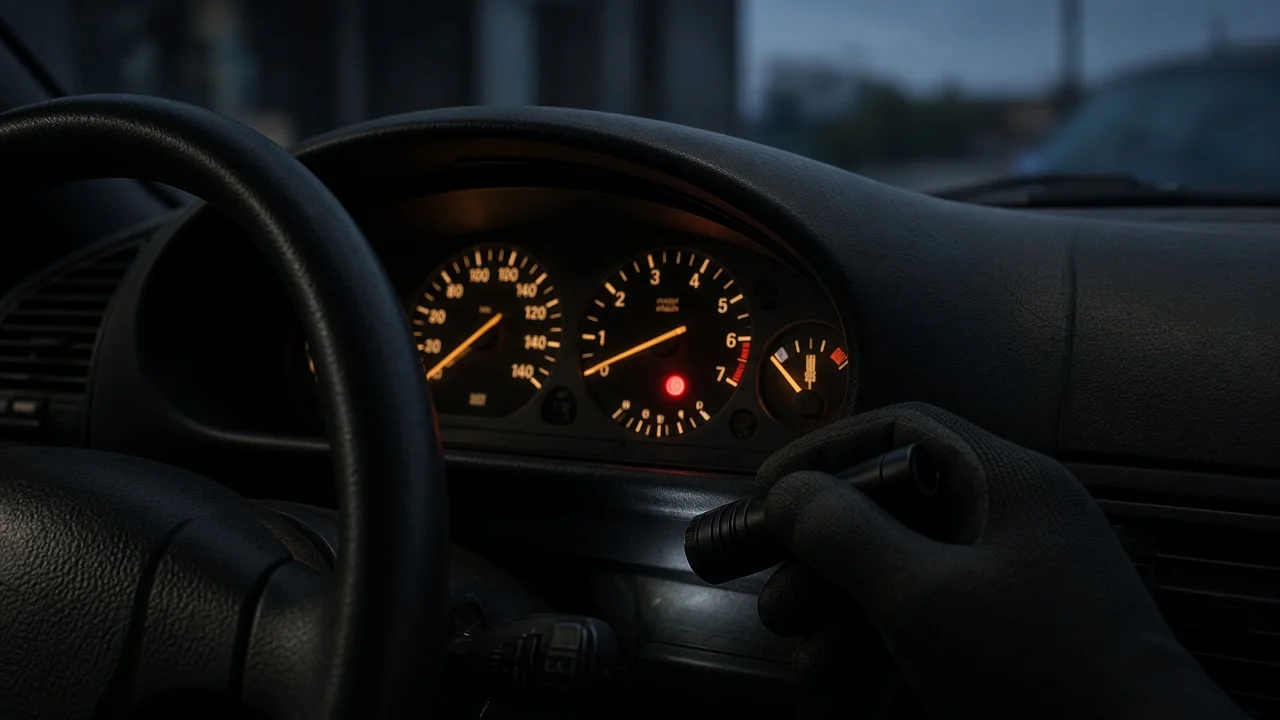
On a BMW E36 3 Series, the red brake warning light usually reports one of two conditions: the parking brake is applied, or the fluid in the brake reservoir has dropped below the level sensor's threshold. Separate amber lamps cover brake pad wear and ABS faults. Before you diagnose anything, work out which light is on and when it appears. That points you to the right part of the system and helps you decide whether the car should be driven at all.
Establish the symptoms
First, identify the exact lamp. Depending on market and cluster, the red brake symbol is either a circle with an exclamation mark or the word BRAKE. The pad wear lamp is an amber circle with dashed arcs on each side, and the ABS lamp is amber and labelled ABS. All of them should light briefly at key-on as a bulb check and then go out once the engine is running. Next, note when the warning appears. Is it on constantly? Does it show only during hard braking, cornering or on hills? Does it flicker over bumps, or appear only when the car is cold? A light that comes and goes with vehicle movement often means the fluid level is sitting close to the minimum mark and sloshing past the float.
Record any related signs. Note whether the pedal feels soft, sinks under steady pressure or travels further than before. Note any pull to one side, grinding, or a burning smell after driving. Look for wet residue on a wheel, the inside of a tire or under the car. On manual-transmission E36 models the clutch hydraulics draw from the same reservoir as the brakes, so a changed clutch pedal feel is also relevant. Finally, list recent work: pad or rotor replacement, bleeding, parking brake shoe adjustment, or anything done near the instrument cluster or under the hand brake lever.
Distinguish plausible causes
Parking brake engagement or a faulty switch is the simplest explanation. The switch sits at the base of the hand brake lever. If the lever does not return fully, or the switch is loose or misaligned, the light stays on. Two observations support this cause: the light changes when you move the lever, and the fluid level is normal. If the light ignores the lever completely, this cause becomes much less likely.
Low fluid from normal wear is the next candidate. As friction material wears away, the caliper pistons move outward, and the fluid level in the reservoir drops slowly to match. A level near the minimum mark, thin pads, a normal pedal and no wet spots all point this way. A leak is the more serious alternative. Signs include a level that falls noticeably between checks, residue at a caliper, hose, line fitting or the master cylinder, a soft or sinking pedal, and on manual cars a misbehaving clutch. Any visible fluid loss weakens the normal-wear explanation.
An electrical fault is also possible. The level sensor uses a float in the reservoir, wired through a connector at the cap, and the float, contacts or wiring can fail. Suspect this when the fluid is at the maximum mark, the lever is fully down, and the light stays on anyway. The amber pad wear lamp is a separate circuit. Its sensors trigger when the pads approach their limit or when a sensor wire is damaged. If the ABS lamp is lit together with the red brake light, treat it as a braking system fault rather than a simple warning.
Checks in a useful order
Start with checks that need no tools. Make sure the parking brake lever is fully released, then lift it slightly and lower it again while watching the light. With the car parked on level ground and the engine off, read the reservoir level against its minimum and maximum marks. The reservoir sits on top of the master cylinder at the rear of the engine bay. Read the level through the translucent body if you can. If you have to open the cap, wipe the area clean first so no dirt falls in. Look around each wheel, along the visible brake lines and under the master cylinder for wet or crusted residue. Where the wheel design allows, look through the spokes at the pads and brake rotors.
Next, with the car stationary, press the pedal firmly and hold steady pressure for several seconds. It should stay high and firm and should not keep sinking. If it sinks or feels spongy, stop here and do not drive the car.
Some checks need tools, specifications or experience. Measuring pad thickness and rotor thickness against BMW wear limits requires removing the wheels; the minimum rotor thickness is often marked on the rotor itself. Testing the parking brake switch or fluid level sensor calls for a multimeter and the wiring diagram. Reading ABS faults on an E36 needs a scan tool compatible with that model's diagnostic connector. Leak repairs, caliper work, line replacement and bleeding a system with ABS belong with a qualified technician unless you have the correct procedure and equipment.
Interpret the findings
Read the results this way: • If the light goes out with the lever fully down, you have confirmed a parking brake circuit or adjustment issue. Still check the fluid level, because a correctly working switch does not prove the hydraulics are healthy. • If the fluid is near the minimum mark, the pads are visibly thin and there is no leak, normal wear is the likely explanation. Confirm it by measuring the pads and rotors. Topping up to the maximum mark hides the warning, and when new pads push the pistons back the reservoir may overflow. Replacing worn pads is the real fix. • If the fluid is low but the pads still have plenty of friction material, the fluid went somewhere else. Find the leak before the car is driven.
If the level is correct and the lever is down but the light stays on, you have narrowed the problem to the float, connector or wiring. That is less urgent than a hydraulic fault, but it still needs repair, because a failed sensor will not warn you of a real fluid loss. For the amber lamp, measure the pads. If they are near their limit, replace the pads together with the wear sensor, which is designed to be replaced once it has triggered. If the pads are healthy, inspect the sensor and its wiring for damage. In every case, the light alone does not justify replacing a master cylinder or calipers. That decision needs evidence such as an external leak, a failed pedal hold test, or a technician's inspection.
Urgency and next action
Stop using the car and arrange transport to a repair shop if you see any of these: • a pedal that is soft, sinks or reaches the floor; • visible fluid leaking from any part of the system; • a fluid level that drops again after topping up; • a strong pull to one side, or metal-on-metal grinding; • the red light coming on while driving with the parking brake fully released; • the red and ABS lights on together; No distance can be considered safe while any of these conditions is present. A light that responds only to the hand brake lever, with correct fluid level and a firm pedal, is lower risk. Still correct it soon, so the warning remains meaningful.
Give the technician or parts supplier enough information to get vehicle fitment right and avoid repeat diagnosis. Include the model year, body style, engine, whether the car has ABS or traction control, and the VIN. Describe which light is on and the conditions when it appears, the fluid level you observed, the dates and amounts of any top-ups, any wet spots found, and recent brake work. If you are ordering parts, have pads, rotors and wear sensors matched to the specific car rather than to the E36 range in general, and use the brake fluid type specified for that vehicle.