BMW Coolant Flush: Drain, Refill and Bleeding Requirements
Essential answer
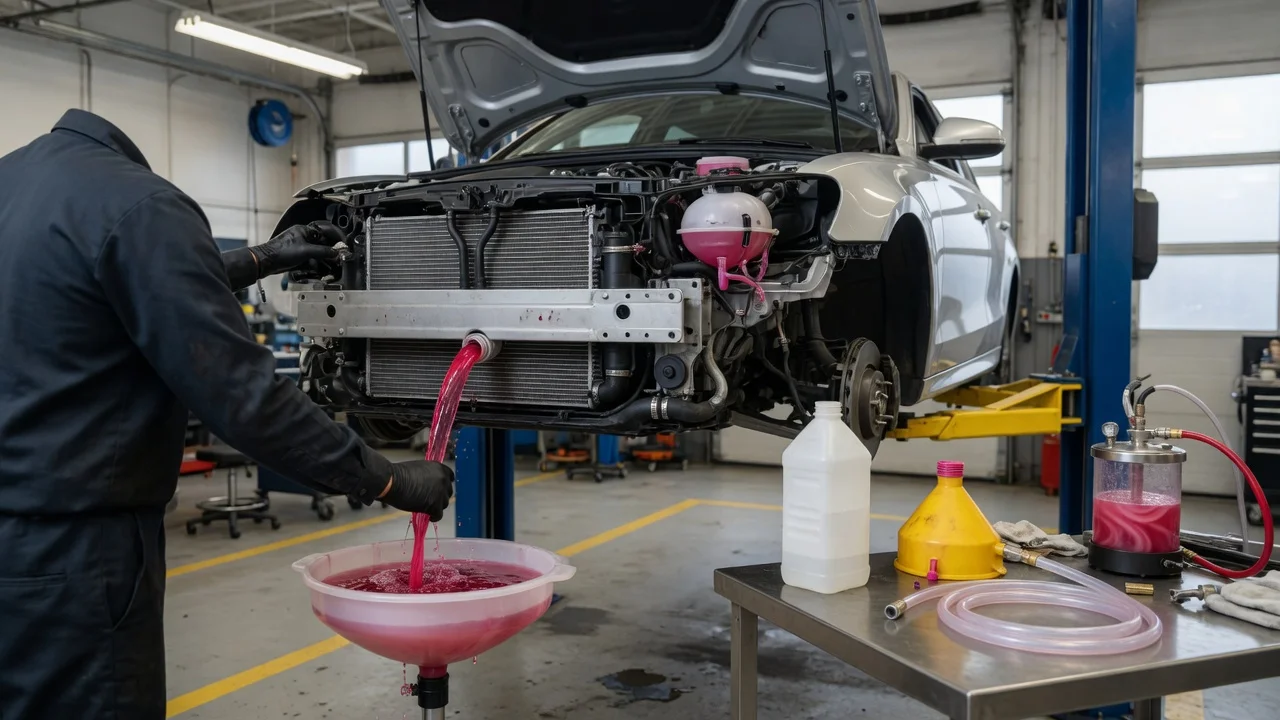
A BMW coolant flush is a controlled drain of the engine cooling system, a refill with BMW-approved coolant mixed as specified for that car, and a bleed until trapped air is gone from the radiator, heater core, and engine. Drain, refill and bleeding are one job: leaving air in the circuit can cause overheating, a weak heater, or a false temperature reading even when the system looks full at the expansion tank.
The exact drain points, fill volume, coolant specification, and bleed method depend on model year, generation, engine family, and whether the water pump is mechanical or electric. Those details are not the same across the BMW range, so the workshop procedure for the specific vehicle is the source of record for capacity, mix ratio, and bleed steps. Opening a hot cooling system, mixing incompatible coolant chemistries, or skipping the bleed are the main ways the job fails.
What a flush covers on a BMW
In ordinary ownership language, a coolant flush means removing used coolant and replacing it with fresh approved fluid, then restoring a sealed, air-free system. A true chemical flush of scale or oil contamination is a separate, less common service and is only appropriate when the system is contaminated; it is not the default maintenance drain-and-fill.
BMW cooling systems typically fill and check at a translucent expansion tank, not at a traditional radiator cap. Used coolant may sit in the radiator, engine block, heater core, and associated hoses. A drain that only empties the radiator or the tank therefore leaves a large share of old fluid in the circuit. How much remains after a single drain is model-dependent; a second drain after a short run, or a documented fill-and-circulate sequence, is sometimes required to get a high replacement fraction.
Drain requirements
Work only on a cold or fully cooled engine. Residual pressure in a hot system can spray coolant and cause burns, and a hot drain also makes it harder to judge the later cold fill level.
Typical drain access, when present, includes a radiator or lower-hose outlet and, on some engines, a block drain. Not every BMW engine has an easy block drain, and some cars require undertray removal to reach the lowest point. Catch the old fluid completely: coolant is toxic to pets and wildlife and must be stored and disposed of as hazardous waste under local rules.
Confirm the engine is cold and the ignition is off before opening the expansion tank. Identify the lowest drain point the workshop procedure lists for that engine; do not assume a radiator petcock is present. Drain into a clean, dedicated container so the old fluid can be inspected for oil, rust, or gel before refill. Inspect hoses, clamps, the tank, and the cap or tank seal while the system is empty; a flush does not fix a leaking joint. If the old coolant is milky, oily, or heavily sludged, stop a simple refill and treat the system as contaminated until the cause is identified.
A visual check of the drained fluid is part of the job. Light colour change with age is common. Oil in the coolant, heavy rust, or a mayonnaise-like emulsion points to a different fault, such as a leaking oil cooler, head-gasket issue, or neglected fluid, and a plain refill will not correct it.
Refill requirements
Refill with a coolant that meets the BMW specification listed for that model year and market. BMW has used more than one approved chemistry over time; colour is a weak identifier and is not a substitute for the specification on the tank, owner’s literature, or parts catalogue. Mixing incompatible coolants can form gel, reduce corrosion protection, and clog the heater core or radiator.
Use the mix the procedure calls for, commonly a premixed approved product or a concentrate diluted with distilled or demineralised water. Tap water introduces minerals that can deposit in the system. Do not invent a mix ratio from a generic chart when the vehicle literature specifies a ready-mix or a stated percentage.
Fill slowly at the expansion tank so air can leave as liquid enters. On many BMWs the tank is the only fill point; forcing fluid in quickly traps pockets in the heater core and cylinder head. Fill to the cold mark on the tank, then complete the bleed before judging the final level. Capacity figures vary widely by engine and heater circuit and are not listed here because they were not supplied for a specific model.
Match the coolant to the vehicle’s approved specification, not only to colour or a universal label. Keep the old and new chemistries separate unless the procedure explicitly allows a conversion flush. Fill at the expansion tank with the engine cold, to the cold level mark. Leave headroom in the tank for thermal expansion; overfilling can push fluid out of the overflow as the engine warms. Record the product used so the next service does not mix a different chemistry.
Bleeding requirements
Bleeding is mandatory after a drain-and-refill. Air left in a BMW cooling circuit often collects at the heater core or around the cylinder head. Symptoms include a fluctuating temperature gauge, a cabin heater that stays cool, a low tank after a short drive, or an overheat with a tank that still looks partly full.
The bleed method follows the hardware. Older engines with a mechanical water pump often bleed by running the engine to operating temperature with the heater on full heat, the tank cap off or loosely fitted as the procedure allows, and any dedicated bleed screw opened until a solid stream appears. Later engines with an electric water pump commonly use a key-on, engine-off sequence: ignition on, climate control set to maximum heat and blower, then a wait while the pump cycles and pushes air back to the tank. Some models add a scan-tool or hidden-menu bleed routine. Using a mechanical-pump idle bleed on an electric-pump car, or the reverse, will not fully purge the circuit.
Keep the tank topped to the cold mark during the bleed so the pump cannot ingest air. After the first heat cycle, allow a full cool-down and recheck the cold level; a drop is normal as remaining pockets collapse. Repeat the bleed and top-up until the cold level is stable and the heater delivers hot air promptly. If the level keeps falling, look for an external leak before adding more fluid as a habit.
Use the bleed sequence written for that engine: electric-pump cycle, mechanical-pump heat-up, bleed screw, or scan-tool routine as specified. Set the heater to maximum heat so the heater core is in the flow path. Watch the tank for collapsing bubbles and a settling level; a violent boil or rapid emptying is a stop condition, not a normal bleed. After cool-down, confirm the cold mark, then road-test and recheck. Do not drive with a known air lock. An air pocket at the sensor or head can allow damage before the gauge catches up.
What changes the procedure
Engine family is the largest qualifier. Naturally aspirated six-cylinder engines, turbocharged petrol engines, diesels, and later modular engines do not share drain plugs, pump type, or bleed logic. All-wheel-drive packaging, auxiliary heaters, and dual-zone climate systems can add circuits that stay full unless the procedure includes them.
Market and model year also matter. Coolant approval, service interval language, and tank markings have changed over BMW generations. A “lifetime fill” note in some literature is a factory interval claim, not proof that the fluid is chemically unchanged forever. Independent of marketing language, the practical need to drain, refill and bleed still applies whenever the system is opened, the fluid is contaminated, or the level and condition no longer meet the inspection standard for that car.
Specific drain volumes, torque figures, bleed-screw locations, and minute-by-minute electric-pump timings are not given here because they were not supplied for a named model, year, or powertrain. Those values belong in the vehicle’s workshop procedure. If the car is under warranty or a service plan, using a non-approved coolant or an incomplete bleed can also affect later claims, which is a dealer-policy matter rather than a universal technical rule.
Next action
Identify the exact model, model year, engine code, and whether the water pump is electric or mechanical. With that, obtain the matching coolant specification, drain points, and bleed sequence, then perform a cold drain, an approved refill, and a complete bleed with a cold recheck. If any of those three documents is missing, treat the job as incomplete rather than substituting a generic flush procedure from another brand or generation.