Best DSP Settings for Car Audio: A Practical Baseline
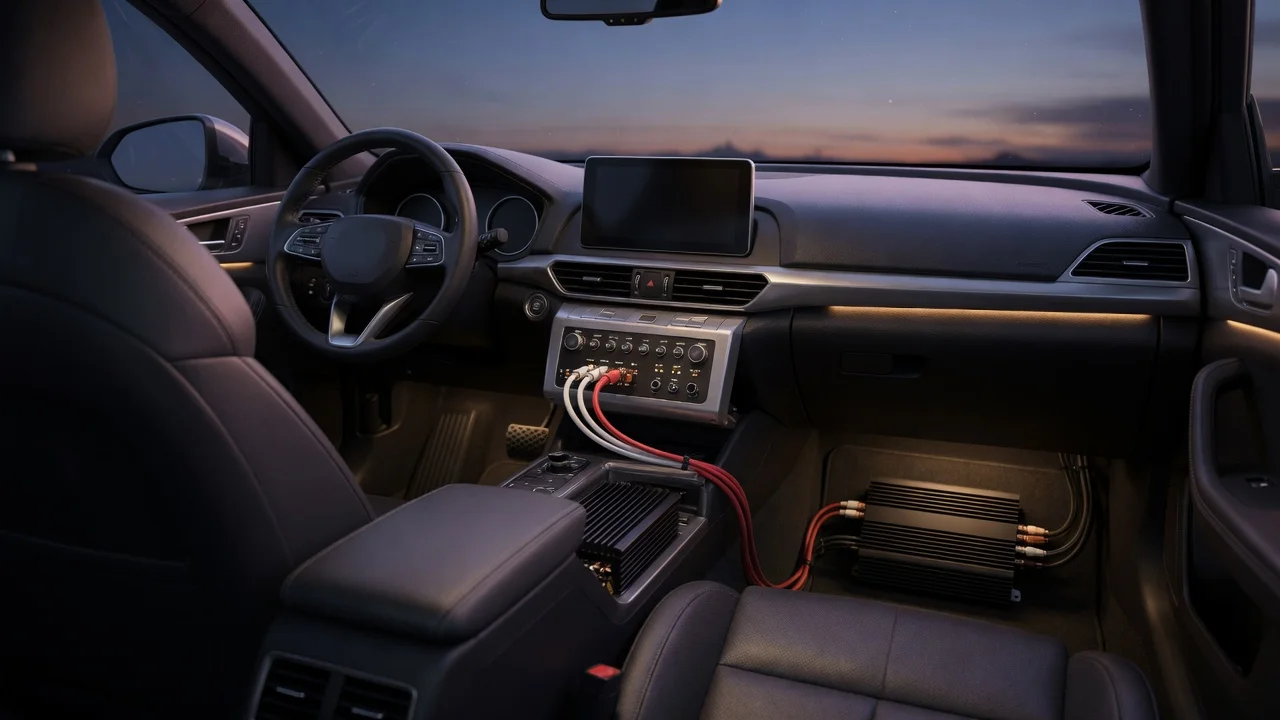
What a Car Audio DSP Should Do First
A digital signal processor corrects problems created by speaker placement, cabin reflections and uneven driver distances. The best DSP settings for car audio are therefore not one universal curve. They are a repeatable order of operations: set crossovers, align arrival times, flatten the response, then shape the bass. Each step depends on the vehicle, the speaker locations and the listener position.
Start with a Safe Crossover Baseline
Crossovers protect drivers from frequencies they cannot reproduce cleanly. As a baseline, try a high-pass filter for door woofers around 80 Hz with a 24 dB per octave slope, and a matching low-pass filter for a subwoofer at the same point. For component tweeters, a high-pass filter near 3,500 Hz is often usable, but the exact point should follow the manufacturer's rated range for the specific tweeter and midrange.
Slope matters as much as frequency. A shallow 12 dB per octave slope creates more overlap between drivers; a steeper 24 dB per octave slope reduces overlap but can sound abrupt if the drivers do not blend well. Treat 80 Hz as a starting value, not a fixed rule.
Time Alignment Before Heavy Equalization
Time alignment delays the nearest speakers so sound from each side reaches the listening position together. In a typical left-hand-drive car tuned for the driver, the left door woofer and left tweeter usually receive the most delay, while the right-side speakers receive less. The exact values come from measured path-length differences or an automatic setup routine in the DSP software.
Set alignment before making large equalizer changes. If the arrival times are wrong, boosting or cutting frequencies can mask the real problem and create a setting that only works for one song.
Use Subtractive Equalization First
The most practical car audio DSP equalizer strategy is to cut peaks rather than boost dips. Car cabins create strong resonances, often between 100 Hz and 250 Hz, that make some notes boom and others disappear. Identify the worst peaks and reduce them by 3 dB to 6 dB with a narrow or medium Q factor. Then listen again before adding any broad low-frequency lift.
Avoid copying a generic smile curve. A car audio equalizer curve that looks good on a screen may overdrive small amplifiers or push midbass drivers into distortion.
Bass Settings for a Controlled Low End
For most music, a modest subwoofer boost around 40 Hz to 50 Hz works better than boosting the crossover region. A common starting point is a 2 dB to 3 dB boost with a low Q, centered near 45 Hz. If the system lacks a subwoofer, do not force deep bass from door speakers; instead raise the high-pass filter or reduce the boost below the speaker's usable range.
Bass boost in a car audio DSP is not the same as subwoofer level. Broad bass boost affects the transition between the subwoofer and midbass drivers and can create muddiness. Adjust subwoofer level separately, then use a narrow equalizer band only if a specific low-frequency region needs correction.
What This List Includes and Excludes
This list covers the core settings that most directly affect staging, clarity and low-frequency control: crossovers, time alignment, equalizer approach and bass shaping. It is a practical baseline rather than an exhaustive inventory of every DSP parameter. Options such as all-pass filters, per-channel limiter behavior, input mixing and advanced OEM integration features are omitted because they depend on specific hardware and installation goals rather than general car audio tuning.
Known Gaps and Vehicle-Dependent Limits
Exact crossover points, delay values and equalizer cuts require measurement in the specific vehicle. Make, model, model year, trim and factory audio package change speaker locations, signal routing and available DSP channels. The values here are starting points, not verified specifications for a particular car.
Without a measurement microphone or known speaker response data, a user should not claim that a curve is flat or that all resonances are corrected. A good DSP setting is one that is stable across different recordings and does not rely on heavy boosts that a speaker or amplifier cannot sustain.