Best 2-Cycle Oil: How to Choose the Right Two-Stroke Oil for Your Engine
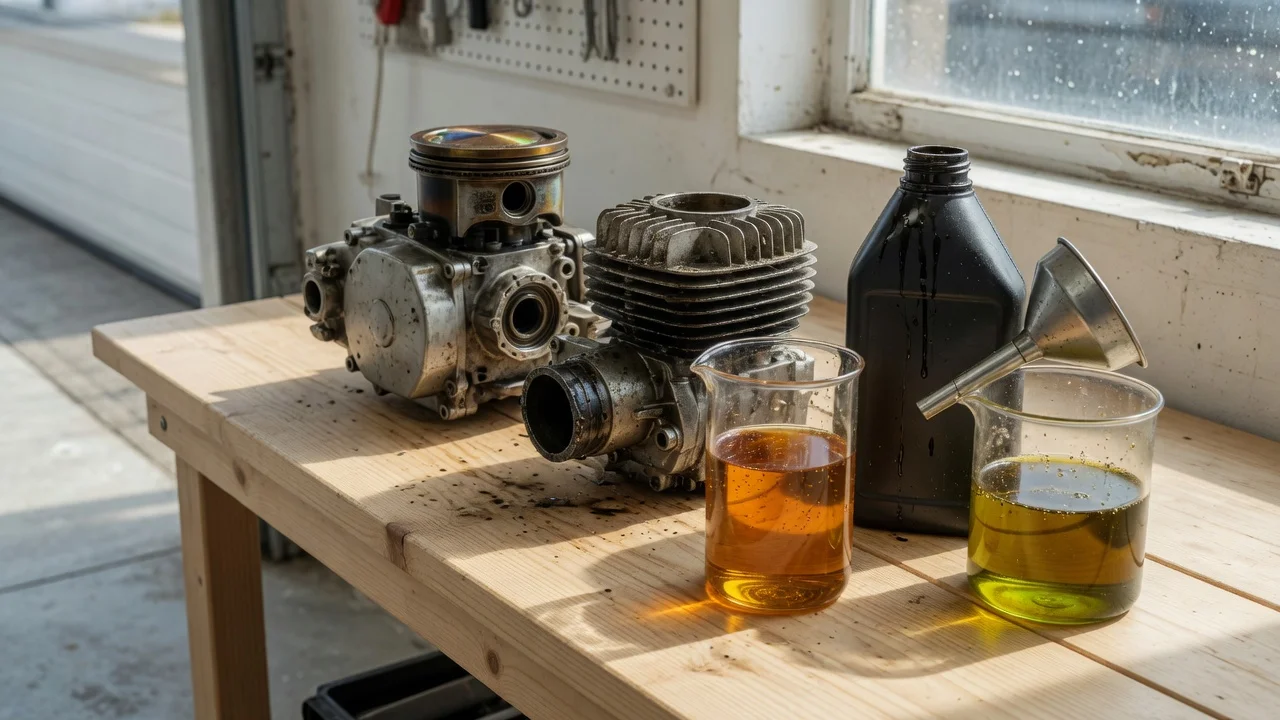
There is no single best 2-cycle oil for every engine. The best choice is the oil that meets the performance standard your engine maker specifies and suits how the engine is cooled and used. A premium synthetic built for a high-revving chainsaw is the wrong pick for a water-cooled outboard, and an outboard oil is generally the wrong pick for an air-cooled trimmer. This guide sorts the main types of two-stroke oil by what they are designed for, so you can identify the right one for your equipment.
What 2-Cycle Oil Is and Why the Choice Matters
"2-cycle oil" and "2-stroke oil" mean the same thing. Both refer to oil made for two-stroke engines. These engines have no separate oil sump. Instead, the oil is either premixed into the fuel or metered into the intake by an oil-injection system. The oil lubricates the piston, cylinder, bearings and crankshaft as the fuel-oil mixture passes through the engine, and then it is burned along with the fuel.
Because the oil is burned, a good two-stroke oil needs to do more than lubricate. It must mix cleanly with gasoline, protect the engine at high temperatures, and burn without leaving heavy carbon deposits on the piston, rings, spark plug and exhaust port. Some formulations are also designed to reduce visible exhaust smoke.
Two-cycle oil is not interchangeable with four-stroke engine oil, such as ordinary car motor oil. Four-stroke oil is designed to circulate and be reused in a sump, not to be mixed with fuel and burned. Do not substitute one for the other.
How This List Is Organized
This is a selection of the main categories of two-stroke oil, grouped by engine type and certification. It is not a ranked buyer's guide. No independent, like-for-like test data comparing specific brands was available for this article, so no product is placed above another, and no performance figures are given for individual brands. The entries are ordered from the most widely used category, handheld air-cooled outdoor power equipment, to more specialized applications.
Every recommendation below depends on one rule: your engine's owner's manual takes priority. The manual lists the oil standard, the fuel-to-oil mixing ratio and any brand-specific or warranty requirements for that model.
Understanding the Certification Labels
Most two-stroke oil containers list one or more performance standards. These labels are the most reliable way to compare oils, because they show what the oil has been formulated or tested to do.
Standard | Who issues or uses it | Typical application; JASO FD | Japanese Automotive Standards Organization | Air-cooled two-stroke engines; the highest JASO tier, adding detergency requirements above FC; JASO FC | Japanese Automotive Standards Organization | Air-cooled two-stroke engines; low-smoke grade; JASO FB | Japanese Automotive Standards Organization | Air-cooled two-stroke engines; a lower tier now largely superseded by FC and FD; ISO-L-EGD | International Organization for Standardization | Air-cooled two-stroke engines; based on the JASO tests with added detergency requirements; ISO-L-EGC | International Organization for Standardization | Air-cooled two-stroke engines; roughly parallels JASO FC; API TC | American Petroleum Institute (legacy category) | Older general-purpose air-cooled two-stroke designation; NMMA TC-W3 | National Marine Manufacturers Association | Water-cooled two-stroke engines, mainly outboards and personal watercraft
In simple terms, JASO and ISO labels relate to air-cooled engines, while TC-W3 relates to water-cooled marine engines. Within the air-cooled standards, JASO FD and ISO-L-EGD are the higher tiers. Check which standard your manual calls for rather than assuming that the highest tier is always required.
The Main Types of 2-Cycle Oil
1) JASO FD or ISO-L-EGD Oil for Handheld Outdoor Power Equipment
This is the category most people need when they search for the best 2-cycle oil. It covers chainsaws, string trimmers, leaf blowers, hedge trimmers, edgers and similar air-cooled tools. These engines run at high speeds and high temperatures, and they rely on airflow alone for cooling. That makes them sensitive to oil quality and carbon buildup.
Oils certified to JASO FD or ISO-L-EGD are designed for these conditions. The detergency requirement helps keep deposits from accumulating on the piston and in the exhaust port, which can otherwise cause power loss over time. If your manual calls for a JASO FC or higher oil, an FD-rated oil also satisfies that requirement, because it is the higher JASO tier.
2) Equipment-Maker Branded Oils
Major outdoor power equipment manufacturers, including Stihl, Husqvarna and Echo, sell two-stroke oil under their own brands. These oils are formulated with the maker's engines in mind. Some equipment warranties name a specific brand or grade of oil, or require that a certain standard be met.
For engines still under warranty, the maker's own oil is often the simplest choice because it removes any doubt about compliance. Read the warranty terms for your specific model to confirm what is required. Do not rely on general claims about which brands are accepted.
3) Full-Synthetic Two-Stroke Oil
Full-synthetic two-stroke oils use synthetic base stocks instead of conventional mineral oil. They are generally marketed as offering cleaner burning, lower smoke and better protection under heavy load or high temperatures. Many are sold with JASO FD or ISO-L-EGD certification and are popular for professional chainsaw and trimmer use, as well as for performance motorcycles.
Synthetic oils typically cost more than mineral or semi-synthetic oils. Whether the added cost is worthwhile depends on how hard and how often the engine is run. Verify the certification on the label rather than relying on the word "synthetic" alone, because the base oil type does not by itself guarantee that any particular standard has been met.
4) Semi-Synthetic and Mineral Two-Stroke Oil
Semi-synthetic oils blend synthetic and mineral base stocks. Mineral oils use conventional petroleum base stocks. Both types are widely available and less expensive than full synthetics, and many carry JASO FC or FD certification.
For occasional homeowner use of a trimmer or blower, a correctly certified semi-synthetic or mineral oil can meet the engine's requirements. The certification on the container matters more than the base oil type.
5) NMMA TC-W3 Oil for Water-Cooled Outboards and Personal Watercraft
Two-stroke outboard motors and many two-stroke personal watercraft are water-cooled. As a result, they run at lower temperatures than air-cooled handheld engines. NMMA TC-W3 oil is formulated for these engines and is the standard most two-stroke outboard makers specify.
TC-W3 oil is generally not intended for high-temperature air-cooled engines such as chainsaws and trimmers. Air-cooled oils are likewise not a substitute where a marine manufacturer specifies TC-W3. Outboard brands also sell their own TC-W3 oils. As with other equipment, check the outboard manual for the required grade, and for injection-equipped models, confirm any oil requirements specific to that system.
6) Two-Stroke Oil for Dirt Bikes and Motorcycles
Two-stroke dirt bikes, scooters and motorcycles are usually air-cooled or liquid-cooled. They often run at sustained high engine speeds. Oils sold for these machines commonly carry JASO FC or FD ratings, and many are full synthetics aimed at racing or high-load riding.
Requirements vary widely by make, model, model year and whether the bike uses premix or oil injection. Some manufacturers specify both a standard and a mixing ratio that depends on riding conditions. Use the motorcycle manufacturer's specification for your exact model, and do not assume that an oil designed for outdoor power equipment or outboards is suitable.
7) Injector-Suitable Oils for Oil-Injection Systems
Some two-stroke engines, including certain outboards, snowmobiles and motorcycles, meter oil from a separate tank rather than using premixed fuel. These systems need an oil that flows reliably through the pump and lines, particularly in cold conditions. Many two-stroke oils are labeled as suitable for both premix and injection, but not all of them are. If your engine uses oil injection, choose an oil whose label confirms it is suitable for injection systems and that meets the manufacturer's standard.
8) Pre-Mixed Fuel Cans
Several equipment makers and fuel brands sell canned fuel that comes already blended with two-stroke oil at a stated ratio. These products are often ethanol-free. They remove the risk of mixing errors and store longer than freshly mixed pump fuel. They are a practical choice for people who use small equipment only occasionally.
The main trade-off is cost per unit of fuel. Before buying, check that the can's stated ratio matches what your engine requires.
How to Choose the Best Option for Your Engine
Find the oil standard in your owner's manual, such as JASO FD, ISO-L-EGD or NMMA TC-W3, and buy an oil that lists that standard on its label. Match the oil to the cooling type: JASO or ISO grades for air-cooled engines, and TC-W3 for water-cooled marine engines, unless the manufacturer states otherwise. Use the mixing ratio printed in the manual for your specific model. Common figures such as 50:1, 40:1 and 32:1 appear on many labels, but the correct ratio depends on the engine, and some oils are marketed for a single ratio. If the engine is under warranty, check whether the warranty names a specific oil brand or standard. If the engine uses oil injection, confirm that the oil is labeled as suitable for injection systems. Choose synthetic oil for heavy, frequent or professional use if the added cost suits you. For light use, a correctly certified semi-synthetic or mineral oil can meet the specification.
Limits of This Guide
This guide does not rank individual brands, because no independent comparative test results were available to support a fair ranking. It also does not state certifications, mixing ratios or performance figures for specific products, since these vary by product line and can change between formulations. Always confirm a product's current certification on its label, and confirm the oil requirements for your machine in the manufacturer's documentation for your exact make, model and model year.