Bent Inner Tie Rod: How to Identify Damage
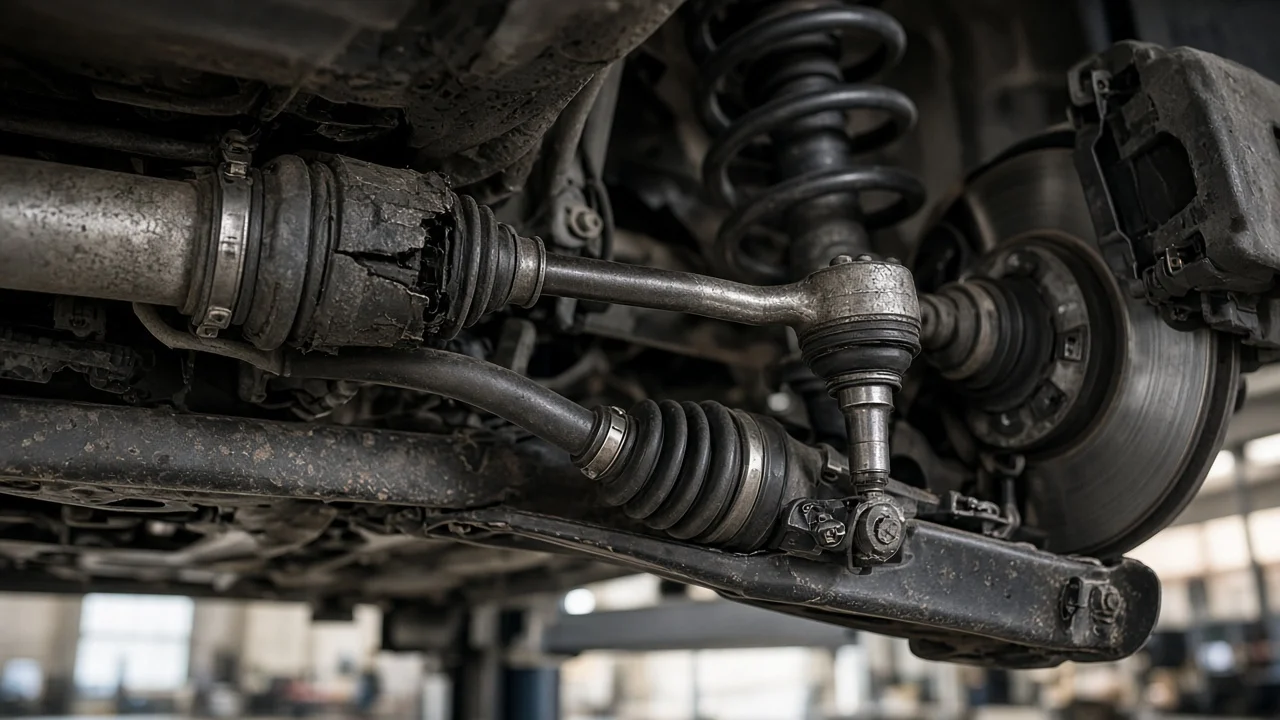
A bent inner tie rod usually shows up after a specific event: a curb strike, a deep pothole, sliding into something in snow, or lifting the vehicle from the wrong point. The signs overlap with ordinary alignment drift and worn joints. It helps to know what a bent rod changes in the steering geometry and how to tell it apart from other damage before you decide on repairs.
How to Tell an Inner Tie Rod Is Bent
In most cases a bent inner tie rod shows up as a group of symptoms that appear right after an impact, not gradually. The steering wheel sits off-center when you drive straight. The vehicle may pull, or it may feel different turning one direction than the other. One front tire starts wearing quickly on its inner or outer edge, often with a feathered texture you can feel by sweeping a hand across the tread. With the front wheels pointed straight, the damaged side may look visibly toed in or out compared with the other side. The clearest physical evidence is a rod that is not straight when you sight along it, or one whose angle or shape does not match the rod on the opposite side.
Two qualifications matter. First, a bent rod is not the same as a worn one. Bending usually leaves the ball socket tight, while looseness, clunking and wandering point to joint play from wear. Second, an impact strong enough to bend a tie rod can also bend the steering knuckle, a control arm or the rack, or move mounting points. Finding a bent rod confirms damage, but it does not prove the rod is the only damaged part.
How the Inner Tie Rod Affects Steering
On a rack-and-pinion system, the inner tie rod threads onto the end of the steering rack and pivots on a ball socket hidden under the rubber bellows boot. The outer tie rod end threads onto the inner rod and connects to the steering knuckle. Together they form a link of set length. The threaded adjustment between them is how a technician sets toe during a wheel alignment.
When the rod bends, the straight-line distance between the rack and the knuckle changes. That pushes or pulls the wheel to a different toe angle. The rack is still centered, so either the steering wheel ends up rotated to compensate or the vehicle drifts. A tire running with excess toe is dragged slightly sideways as it rolls, which causes the fast edge wear. A bend can also change how the rod swings as the suspension moves up and down, so some vehicles start to steer themselves slightly over bumps.
What Changes the Diagnosis
The steering layout changes where you look. Most modern cars and crossovers use a rack with an inner tie rod at each end. Some older vehicles use a center-take-off rack, where both rods bolt to the middle of the rack. Many older trucks and vans use a parallelogram linkage with a center link, idler arm and pitman arm, and the part called an inner tie rod end on those vehicles is a different component. Solid front axle trucks often have one long tie rod spanning both knuckles plus a drag link. A bend in that rod changes toe on both wheels at once and is often visible as a slight bow.
Operating conditions can mimic or hide a bend. Changes in ride height from a lift kit, lowering springs, sagging springs or a heavy load alter toe on many suspensions, so an off-center wheel alone does not prove damage. A previous alignment may also have been adjusted unevenly to mask a bent part, which makes thread comparisons less reliable. Wear in the inner socket can exist alongside a bend. The impact may also have damaged a rack bushing or subframe mount, which can affect steering feel in a similar way.
What You Can Check Yourself
Start with safe vehicle support. Park on level ground, set the parking brake, chock the rear wheels, and raise the front only at the lift points listed in the owner's manual or service information. Rest the vehicle on rated jack stands before reaching underneath, and never rely on the jack alone. Do not lift, support or tie down the vehicle by a tie rod or any other steering part, because that is one of the ways rods get bent in the first place. Leave the wheels pointed straight ahead.
Then compare the two sides. Sight along each tie rod for a kink or curve, and check whether the rods sit at a similar angle to the rack and the knuckles. Look at how much thread is exposed at each outer tie rod end and where the jam nuts sit. A large difference between sides suggests uneven adjustment or a damaged part. Inspect the boots for tears or crushing, check both front tires for edge wear, and note whether the steering wheel is centered on a straight, level road. To check joint play, have a helper rock the steering wheel back and forth slightly with the wheels on the ground. Grip the boot over the inner socket and feel for a clunk or free movement before the rod moves.
If you confirm a bend, the standard repair is replacement, not straightening. Heating or bending a steering link can weaken it in ways you cannot see. Many owners replace the outer tie rod end at the same time if it is worn or was also struck. Tighten every fastener to the fastener specification in the service information for your vehicle, and get a wheel alignment right afterward. Counting threads during removal only gets the toe close enough to drive carefully to the shop. If the steering feels loose, unpredictable or noticeably different from before the impact, avoid driving the vehicle and have it towed.
Limits and the Next Step
A home inspection has real limits. A slight bend can be invisible, and toe cannot be measured accurately by eye. Nobody can tell from appearance alone how long a damaged steering part will hold. Exact procedures, fastener values and alignment settings vary by vehicle, so rely on the manufacturer's service information instead of general figures.
The most useful next step is a professional inspection and wheel alignment with printed before-and-after readings. Ask the shop to check the knuckle, control arms, rack and subframe for further impact damage in any of these cases: toe will not come within specification, the adjustment needed differs greatly from side to side, or the steering wheel stays off-center after a new tie rod is installed. Many newer vehicles also need a steering angle sensor reset or driver assistance calibration after alignment work, which is another reason to use a properly equipped shop.