What a battery discharge warning means
The short answer
A battery discharge warning is a dashboard or infotainment message telling you that the vehicle's 12-volt battery is losing charge faster than it is being replenished. Most often it appears when electrical equipment such as lights, the audio system, climate fan or phone charging is used while the engine is off or idling for a long time. It can also appear when the battery's state of charge has fallen low for another reason, such as an ageing battery, repeated short trips or a fault in the charging system.
Two qualifications change how seriously you should take it. First, the exact wording, the conditions that trigger it and what the car does in response vary by manufacturer, model and model year, so the owner's manual for your specific vehicle is the authority on what your message means. Second, the warning concerns the low-voltage 12-volt battery. In hybrids and electric vehicles, that is the auxiliary battery that powers the control electronics, not the high-voltage traction battery that drives the car.
Discharge warning versus charging system warning
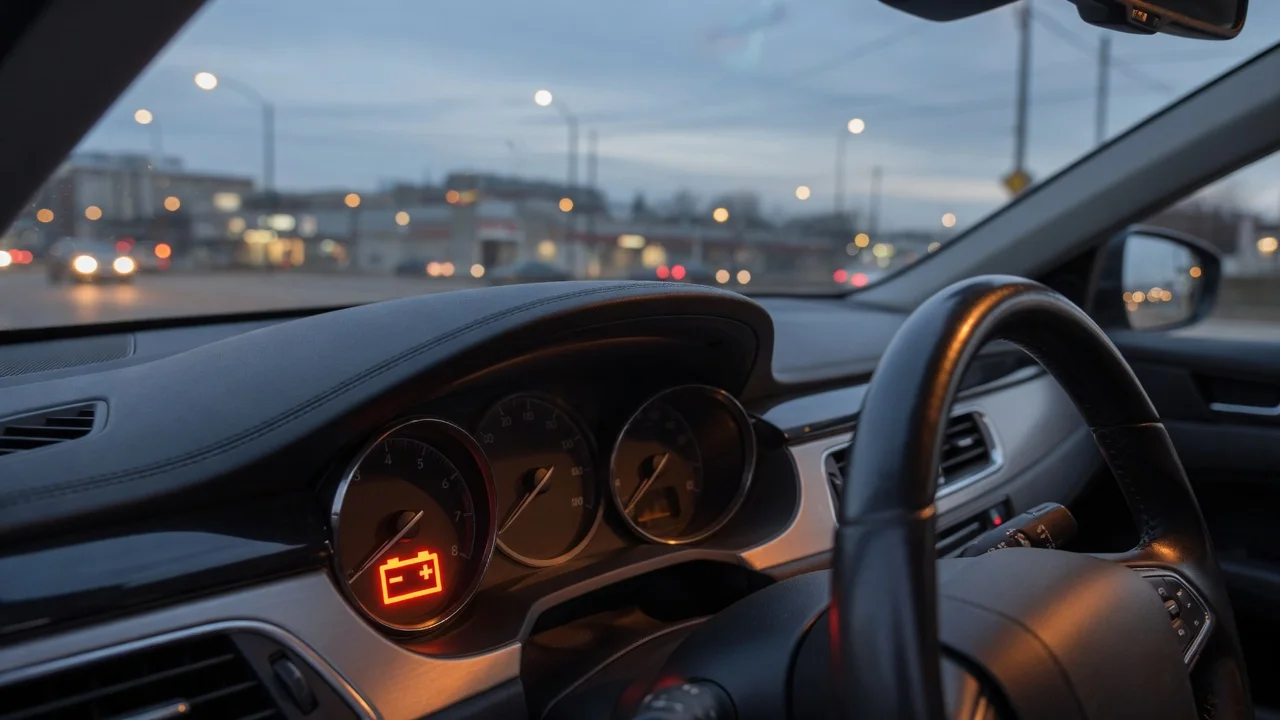
Many vehicles have a separate red warning lamp, often shaped like a battery, that indicates a charging system fault. That lamp usually means the alternator or related components are not supplying enough power while the engine runs. A battery discharge message, by contrast, is typically about consumption exceeding supply, often with the engine off. The two can overlap: if the charging system has failed, the battery will discharge while you drive, and some vehicles may show both alerts. Which warning you see, and when, is one of the most useful clues for diagnosis.
How the warning works
Modern vehicles monitor the 12-volt battery electronically. Many use a battery sensor, usually mounted on or near the negative terminal, that measures voltage, current and temperature. A control module uses those readings to estimate the battery's state of charge, meaning how much usable energy remains, and its state of health, meaning how well it can still hold and deliver charge. When the estimate falls below a threshold set by the manufacturer, or when the system sees sustained drain with no charging, it triggers the warning.
The practical purpose is to protect your ability to start the car. Starting an engine demands a large burst of current, and a battery that has been run down by accessories may not have enough left. On some vehicles, the warning is paired with automatic load shedding, in which the car switches off or limits non-essential features such as the infotainment screen, heated seats or interior lights to preserve starting capacity. Whether your vehicle does this, and which features it cuts, depends on the model.
What could be causing it
The warning points to a symptom, low or falling charge, rather than a specific failed part. The most plausible causes, roughly from most benign to most serious, are listed below.
Accessory use with the engine off: running the audio, lights, fan or charging devices with the ignition on but the engine stopped draws directly from the battery with nothing replacing the energy. Short or infrequent trips: brief drives may not give the alternator enough time to restore what starting and accessories used, so charge declines gradually over days or weeks. An ageing or weakened battery: as a battery wears, its usable capacity shrinks, so normal loads drain it faster and the warning appears more readily. Cold weather can make this more noticeable. Parasitic drain: something keeps drawing power after the car is locked, such as a module that fails to go to sleep, a light that stays on, or poorly installed aftermarket equipment like dash cameras, alarms or audio amplifiers. Poor connections: loose or corroded battery terminals or ground straps restrict current flow in both directions, affecting charging as well as supply. Charging system faults: a failing alternator, a worn or broken drive belt, or a wiring fault can leave the battery discharging even while the engine runs. Sensor or software faults: a faulty battery sensor, or a battery replaced without the vehicle being told about it where the manufacturer requires that step, can produce inaccurate warnings.
What to check next
Start with observations that cost nothing, then move to tests. The pattern of when the warning appears narrows the possibilities considerably.
What you observe | What it most likely indicates; Warning appears only when using accessories with the engine off, and clears after a normal drive | Ordinary discharge from accessory use; usually not a fault; Warning returns after the car sits for a day or more, or the car is slow to start in the morning | Weak battery, insufficient charging from short trips, or a parasitic drain; Warning appears while driving, especially with a red battery or charging lamp | Possible charging system fault; the battery may be running the car on its own; Warning appears soon after a new battery was fitted | Possible connection issue, incorrect battery type, or a battery registration step that was missed on vehicles that require it; Warning appears intermittently with no consistent pattern | Possible loose connection, sensor fault or software issue; a diagnostic scan is worthwhile
Once you have noted the pattern, work through these checks in order.
1) Reduce the load: switch off unneeded accessories and avoid sitting with the ignition on and the engine off. If the warning appeared during engine-off use, starting the engine and driving normally will usually let the battery recover. 2) Inspect the terminals visually: look for white or green crusty deposits, loose clamps or damaged cables. Do this with the engine off, wear eye protection, and avoid sparks or flames near the battery, because lead-acid batteries can release flammable hydrogen gas and contain corrosive acid. If cleaning or tightening is needed and you are unsure of the correct procedure for your vehicle, leave it to a technician. 3) Have the battery tested: many parts retailers and workshops can test battery health and the charging system. A test is more reliable than the warning alone, because the warning is an estimate made by the car's software. 4) Have the charging system tested: if the warning appears while driving, the alternator output and drive belt should be checked. The correct output range is specific to the vehicle and should be confirmed against manufacturer service information. 5) Consider a parasitic draw test: if the battery tests healthy and charges normally but still drains when parked, a technician can measure current draw with the car locked and asleep and isolate the circuit responsible. Note any aftermarket equipment you have fitted. 6) Scan for stored fault codes: a diagnostic scan may reveal codes from the battery sensor, charging system or modules that are not sleeping. Treat any code as evidence to investigate rather than proof that a particular part has failed.
You will know the issue is resolved when the warning no longer returns under the conditions that previously triggered it, the car starts normally after sitting, and a battery and charging test shows results within the vehicle's specification.
When to stop driving or get professional help
An engine-off discharge warning is often just a prompt to reduce electrical use. A warning that appears while driving deserves more urgency, because it may mean the car is running on stored battery power that will eventually run out. When it does, the engine may stall and electrically powered systems can stop working. Seek professional diagnosis promptly, and pull over safely and stop if any of the following occur.
The discharge warning appears with a red charging or battery lamp while the engine is running. Headlights or dashboard lights dim or flicker, or several unrelated warnings appear at once. The steering suddenly becomes heavy, which can happen on vehicles with electric power steering when voltage falls. You notice a burning smell, a hissing sound, or a rotten-egg odour from the engine bay. The battery case is swollen, cracked or leaking. A squealing noise or loss of other belt-driven functions suggests the drive belt has slipped or broken. On engines where the same belt drives the water pump, continuing to drive can also cause overheating, so check the temperature gauge.
For hybrids and electric vehicles, have a qualified technician handle diagnosis beyond the basic observations above. Although the warning relates to the 12-volt auxiliary battery, these vehicles also contain high-voltage components that require specific training and equipment.
Limits of this guidance
This explanation describes how battery discharge warnings generally work across modern vehicles. No manufacturer-specific documentation was available for this article, so it does not state the exact message wording, voltage thresholds, load-shedding behaviour or battery replacement procedures for any particular make, model or model year. Those details vary, and you should confirm them in your owner's manual or the manufacturer's service information before acting on them.