Bad Tie Rod End Symptoms and How to Check for Play
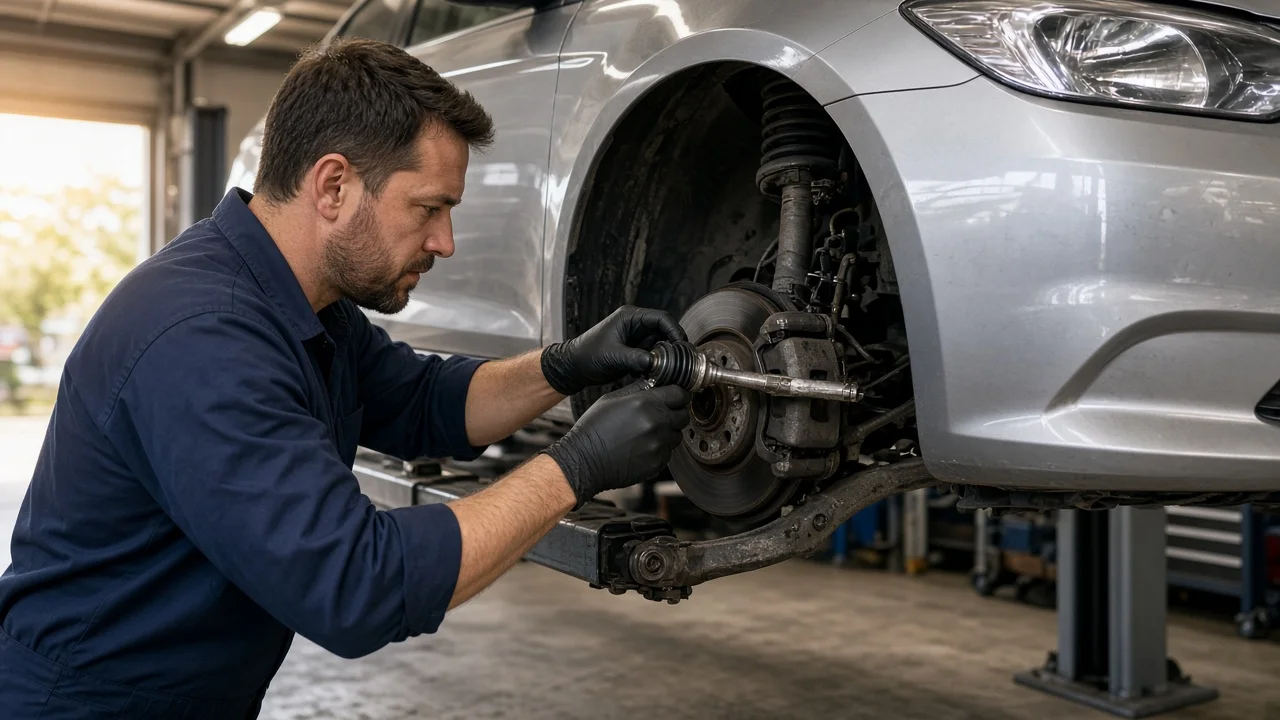
A worn tie rod end rarely fails without warning. This small ball-and-socket joint links the steering rack or linkage to each front steering knuckle, so wear usually shows up as loose steering, noises over bumps and tires that wear unevenly. The difficulty is that ball joints, wheel bearings and bushings can cause similar complaints. This guide explains how to recognize the signs of bad tie rod ends, how to separate them from look-alike faults, and how to check for joint play safely before you buy parts.
Establish the symptoms
The most common sign of a worn tie rod end is steering that feels vague or loose. You may notice free play at the steering wheel before the car responds, a tendency to wander on a straight road, or a need for constant small corrections. Many owners hear a clunk or knock from one front corner over bumps, potholes or driveway lips, or when turning slowly in a parking lot. Others feel a shimmy through the wheel that changes with the road surface rather than with speed alone. Uneven tire wear is another clue. A loose joint lets toe shift, which tends to feather the tread or scrub the inner or outer shoulder. A steering wheel that sits off center while you drive straight can point the same way. A torn boot with grease flung around the joint does not prove wear yet, but it does mean dirt and water are getting in.
Before you inspect anything, write down when the problem appears. Note whether the noise happens over bumps, while turning, when braking or at a steady highway speed, and whether it seems to come from one side. Record related signs such as a pull, a vibration, the steering wheel angle or warning lights. Recent changes matter too. A pothole strike, a curb impact, new tires, an alignment or other suspension work can each point the diagnosis in a particular direction. These notes help you and a technician avoid replacing the wrong part.
Distinguish plausible causes
Tie rod ends share symptoms with several other front-end parts, so treat your first suspicion as a hypothesis. Worn ball joints also clunk over bumps and cause wandering. Their play typically shows up when the wheel is rocked top to bottom, and the noise is often loudest over uneven pavement or while braking. A worn wheel bearing can feel like looseness at the wheel, but it usually adds a hum or growl that changes with speed or when weaving gently between lanes. If the vehicle also rumbles at speed, a bearing becomes more likely. If it is quiet except for clunks during steering input, the steering linkage becomes the stronger suspect.
Sway bar end links make a light rattle over small bumps but do not usually affect steering response. Worn control arm bushings or loose steering rack mounting points can produce lag and knocking that mimics joint play. A worn inner tie rod sits inside the rack boot, where it is easy to overlook. Not every steering complaint comes from mechanical play either. A pull or an off-center wheel with no clunks may simply come from wheel alignment drift, unequal tire pressures, a damaged tire, or a change in ride height after spring work or heavy loading. Each of these alternatives weakens the case against the tie rod ends unless an inspection shows actual movement.
Checks in a useful order
Start with checks that need no lifting. Park the car on level ground and look at the inner and outer edges of both front tires for feathering or one-sided wear. Turn the wheels to one side so you can see each outer tie rod end and its boot, and look for splits, missing grease, rust staining or a bent tie rod. Then do a dry-park check. With the wheels on the ground and pointing straight ahead, the parking brake applied and the transmission in park, have a helper rock the steering wheel a short distance each way while you watch and lightly feel each joint. The tie rod and the steering knuckle should move together. A visible delay or a click at the joint indicates looseness. Keep your hands away from pinch points while the parts move.
A lifted test is more revealing, but it needs correct vehicle support. Raise the front with a suitable jack at the lift points specified for your vehicle and rest it on rated jack stands on firm, level ground. Never work under a vehicle, or shake a wheel on one, that is held only by a jack. With the wheel off the ground, grip it at the three and nine o'clock positions and push and pull alternately. Then grip it at twelve and six o'clock and repeat. Watch the tie rod end, the hub and the steering rack as you do this. It is easier with a helper moving the wheel while you observe the parts at close range.
Some checks need tools, specifications or a qualified technician. You check an inner tie rod by feeling for movement through the rack boot while the wheel is rocked, which takes some experience. Many manufacturers publish an allowable play limit and a specific inspection method. On some suspension designs the ball joints must be checked with the suspension loaded or unloaded to get a valid result. Measuring alignment, confirming ride height, and inspecting the steering rack mounts or power steering components are jobs for a shop with proper equipment and service information.
Interpret the findings
Suppose you rock the wheel at three and nine o'clock and can see or feel movement at the tie rod end, with the stud shifting in its socket while the knuckle stays still. That points to the outer tie rod end. If the movement continues when a helper holds the tie rod firmly, or it appears at the hub center, suspect the wheel bearing instead. Play felt at twelve and six o'clock is more typical of ball joints or bearings. If the tie rod moves together with the whole rack housing, the rack mounting bushings are more likely worn than a joint. Movement felt through the inner boot while the outer end stays tight implicates the inner tie rod. A joint that rotates smoothly with some resistance is normal. What matters is free movement or knocking between the stud and the socket.
A torn boot or tire wear on its own only shows that something deserves a closer look. Joint play confirmed on both the dry-park and lifted tests is strong evidence. A careful repair still checks the neighboring parts on the same corner, because a pothole strike can damage several components at once. If the findings are borderline, compare them with the manufacturer's allowable play and inspection method before you order parts.
Urgency and next action
A tie rod end is what connects the steering to the wheel, so a joint that separates can leave that wheel steering itself. Stop driving and arrange a tow in any of these cases: the steering suddenly becomes very loose, one wheel looks visibly turned compared with the other, a loud clunk is followed by a pull or wobble, or the steering binds or jumps. A damaged boot alone is less urgent, but confirmed play should be repaired promptly. There is no reliable way to predict how many miles a loose joint will last, so do not plan around a figure.
Before the repair, gather the vehicle year, make, model, engine and drivetrain, the affected side, and whether the play was at the inner or outer joint, along with your notes on symptoms and recent events. Replacement involves separating a tapered joint and tightening new fasteners to the manufacturer's fastener specification. Castle nuts usually take a new cotter pin, and some self-locking nuts are single-use. Changing a tie rod end alters toe, so a wheel alignment should follow the repair, with ride height checked first so the readings are valid. Inspecting the boot and joint on the other side at the same visit can save a second trip.