B0229 Code: Vehicle-Specific Meaning, Symptoms and Diagnosis
When your vehicle stores a B0229 code, the meaning depends on the manufacturer, model year, and the module that reported it. Unlike standardized powertrain codes, body-system codes often carry different definitions across vehicles. Misinterpreting this code can lead to unnecessary part replacement. Instead, you need the correct vehicle-specific description, a complete scan result, and a logical diagnostic path. This guide explains how to move from a generic B0229 to a confirmed diagnosis without guessing.
Verify What B0229 Means for Your Vehicle
B0229 is a body diagnostic trouble code, but its definition is not universal. A body code can refer to a door module, HVAC controller, seat memory system, or another electronic function depending on the vehicle. Before interpreting the code, obtain the exact make, model, model year, and relevant equipment. The reporting control module and any code suffix or failure-type detail further narrow the meaning. Vehicle-specific service information is essential, because the same alphanumeric string may describe unrelated circuits on different platforms.
The code tells you that a control module detected a condition outside its expected range. It does not prove that a specific sensor, actuator, or module has failed. For example, B0229 might point to a communication error, a circuit voltage issue, or a data rationality fault. Only the confirmed manufacturer definition tells you which system to inspect. Avoid assigning B0229 a universal component name. Begin by looking up the exact description for your vehicle, then follow the diagnostic logic the manufacturer provides.
Record the Full B0229 Scan Result
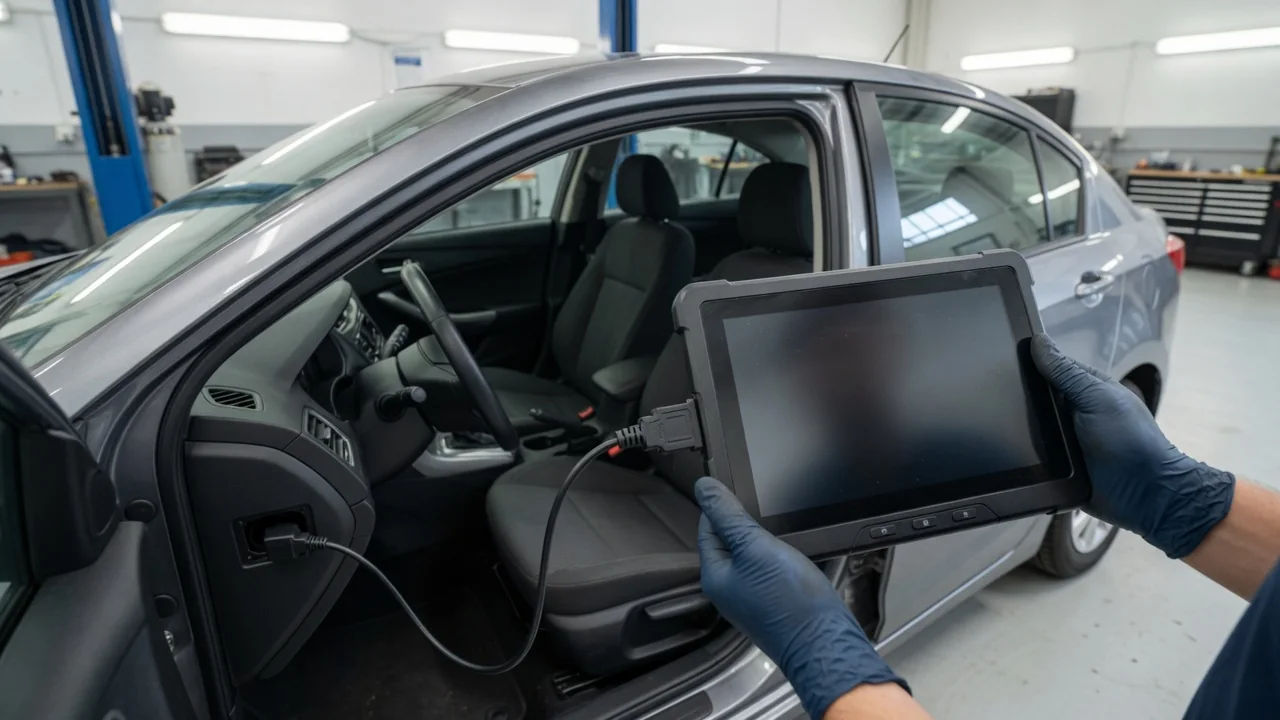
A complete scan result preserves evidence for diagnosis. Record the exact code text, the reporting module, and any fault status such as current, pending, or history. Note accompanying codes, because they may share a common power supply, ground, or data bus. Some body modules require an enhanced scan tool with vehicle-specific coverage. A generic scanner may show only the code number without the full description, leaving the affected system unknown. In that case, the scan result cannot establish what B0229 refers to.
Before clearing the code, store the scan report in a way you can retrieve later. Clearing erases freeze frame data, module identifiers, and sometimes the fault status. A technician may need that information to compare behavior after driving. If the concern returns, a fresh scan can be matched with the original findings. Incomplete code reads often lead to wasted diagnostic time. Preserve what you already have, and seek a tool or shop with the capability to read the full body-system fault information.
Connect Reported Symptoms to the Confirmed Definition
Symptoms only become meaningful after the confirmed definition identifies the system. Suppose B0229 relates to a memory mirror function on one vehicle. The driver might report that the mirror does not return to its saved position, or that the memory recall works intermittently. On another vehicle, the same code might involve a door lock actuator. Document the observed behavior without assuming a failed component. Write down any warning message, audible tone, or function that does not operate as expected, along with what still works normally.
Record when the issue appears. Does it happen at startup, while driving, or when operating a specific feature? Include environmental conditions such as outside temperature, rain, or recent battery charging. An intermittent B0229 may not show an obvious symptom, and that is useful information. A function that appears normal at the time of inspection does not rule out a stored fault. Electrical circuits can fail under particular thermal or vibratory conditions. Accurate symptom documentation helps a technician choose the right test conditions.
Assess Possible Triggers Without Guessing at Parts
Every possible cause must be tied to the verified circuit description. If the manufacturer defines B0229 as a horn relay control circuit problem, then testing focuses on the relay coil feed, the control wire, and the module driver. A different definition, such as an interior air temperature sensor rationality fault, points toward sensor wiring and signal plausibility. Do not borrow a cause list from another vehicle. Wiring, connectors, power supply, ground, component, or control module issues are only valid if the confirmed definition supports them.
Recent vehicle history can provide context without proving causation. Battery replacement, jump starting, water leaks, or collision repair near the affected area may be relevant. However, correlation is not diagnosis. A body code often appears after a temporary voltage drop, but that does not mean the battery or alternator is faulty. Likewise, a wiring repair does not automatically fix the code if the original fault was an intermittent connector. Use history to guide inspection, not to skip testing.
Use a Safe Checklist Before Professional Testing
Before seeking professional testing, gather the scan results, symptom notes, and any recent work records. Look around the area the confirmed definition points to, but only for readily visible damage. A loose connector, a pinched wire loom, or a visible water stain can be noted without disturbing the vehicle. Do not remove trim panels, unplug connectors, or pull on wiring. These actions can introduce new faults or disturb an intermittent connection enough to hide the original problem.
Avoid connector probing, circuit bypassing, and powered component tests. Those steps require safe service information and proper tools. Work on restraint systems, airbag circuits, or other safety-related systems must remain out of reach for untrained hands. B0229 itself does not prove the vehicle is unsafe to drive, but warning messages or impaired safety functions demand prompt assessment. If the body code is accompanied by a seat belt or airbag warning, treat that as a priority and seek qualified help.
Confirm the Repair and Check for a Returning Code
A technician follows the manufacturer service procedure to test the relevant circuit. That may begin with verifying power and ground at the appropriate module connector, then testing signal lines for shorts, opens, or high resistance. A scan tool may be used to command the affected output or read live sensor data. Only after the test results isolate a defect does the technician select a repair. The repair might be a terminal replacement, a wiring splice, or a module if a confirmed internal fault is found, but the choice follows evidence.
After the repair, any required initialization, calibration, or programming is performed only if the service information specifies it for that vehicle. Then the code is cleared, and the vehicle is driven or the affected function is cycled under the original fault conditions. A follow-up scan confirms that B0229 does not return and that the module reaches a completed self-test state. Clearing the code alone is not repair verification. The tested function must operate correctly while the module monitors it without setting a new fault.