B0103–B0107 Codes: Meaning and Side Impact Sensor Diagnosis
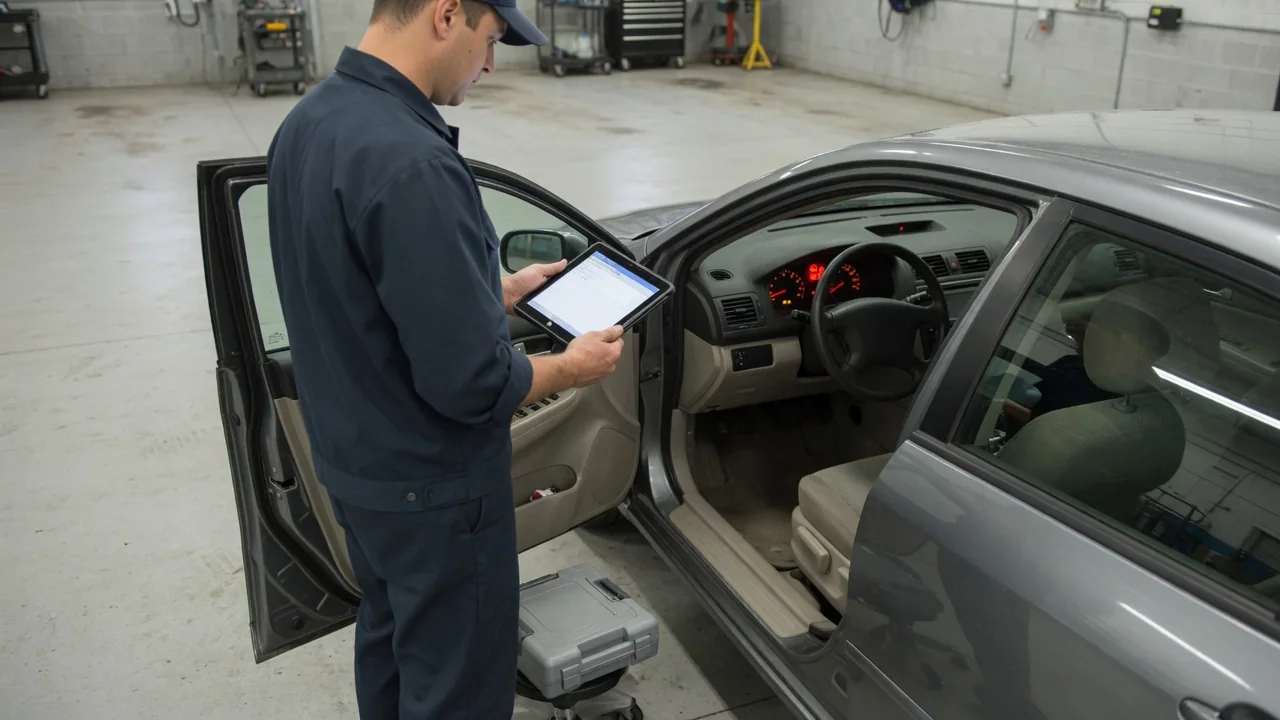
When a scan tool reports B0103, B0104, B0106, or B0107, many owners assume the vehicle has a failed side impact sensor. These codes often point to a side impact sensor circuit, but the actual definition depends on the manufacturer and application. This article explains why a B0103 code is evidence to interpret, not proof a part has failed, and how to approach diagnosis without making unsafe assumptions.
Verify the Vehicle-Specific Meaning Before Interpreting B0103
Before interpreting B0103, verify the vehicle year, make, model, reporting module, complete code, and any suffix or failure-type information. The B0103–B0107 code family is not universally defined as side impact sensor circuit faults; each manufacturer assigns its own meanings. For one application, B0103 might indicate a left-side impact sensor circuit problem, while for another it could refer to a different restraint component entirely. Vehicle-specific service information is required to confirm the definition before any diagnostic reasoning begins.
A circuit-related code does not by itself identify a failed sensor. The diagnostic trouble code is a starting point that tells the technician which circuit to test, not which part to replace. When the vehicle-specific definition confirms a side impact sensor circuit, the fault could be in the sensor, wiring, connector, or control module. A B0103 code should never be treated as a mandate to replace a sensor without first performing the tests outlined in the manufacturer’s diagnostic procedure.
Confirm What B0104, B0106, and B0107 Identify
For each recorded code, including B0104, B0106, and B0107, the application-specific definition must be confirmed. Consecutive code numbers do not necessarily identify consecutive sensor positions. Depending on the manufacturer, B0104 might refer to a different side impact sensor, a circuit condition, or a communication problem. Even if the scanner displays a brief description, the factory service information for the exact vehicle is the authoritative source. Recording all codes with their full suffixes and status is essential before interpreting one code in isolation.
Multiple stored codes require careful interpretation together. A B0104 code and a B0106 code appearing simultaneously could point to a shared wiring harness issue rather than two failed sensors. The reporting module also matters: a code stored in the restraint control module is different from one logged by another control unit. Each code’s status—current, history, or pending—and the conditions under which it set provide clues, but only vehicle-specific diagnostic charts can guide the next step.
Warning Lights and Other Signs Owners May Notice
When the code is confirmed to concern the supplemental restraint system, an illuminated airbag warning light or a vehicle-specific dashboard message is a common sign. The restraint control module typically turns on this warning when it detects a fault and stores a diagnostic trouble code. The light may remain steady or flash, depending on the system. However, the exact warning behavior varies by manufacturer, and some vehicles display a text message such as “Service Airbag System” instead of or in addition to the icon.
A restraint-system fault usually has no effect on how the vehicle starts, idles, or drives. The engine and transmission operate normally because the side impact sensor circuit is not part of the powertrain. The code and warning light alone cannot establish which restraints remain available or predict deployment behavior. Without manufacturer-specific information, it is impossible to know whether the airbags or seat-belt pretensioners are disabled. Owners should follow the vehicle’s warning-message guidance and have the system professionally assessed rather than assuming the vehicle is safe to drive because it feels normal.
Damage and Repair History That Can Guide Diagnosis
Damaged wiring, connector problems, sensor damage, and moisture are possible causes only where consistent with the verified circuit definition. For example, if the code refers to a side impact sensor located in a door, then door-area wiring is relevant. But if the sensor is mounted in a seat or pillar, that location becomes the focus. Prior collision damage can distort connectors or break wires even after body repairs. Water intrusion from a leaking door seal or sunroof drain can corrode terminals and create high resistance in the circuit.
A sensor-named code can originate elsewhere in its circuit. The sensor itself may be intact while a chafed wire intermittently shorts to ground or an open connector causes a loss of signal. That is why testing is required before parts are selected. The presence of a B0103 code in a side impact sensor circuit does not prove the sensor has failed any more than a check engine light for a misfire proves a spark plug is bad. The code simply points to the circuit that needs investigation.
Safe Information to Gather Before a Service Visit
Before a service visit, record when the warning first appeared, whether it is intermittent, and any recent collision, water exposure, or repair history. If the airbag light comes on only after driving over bumps, that suggests a loose connection. If the problem started after a body shop replaced a door or repaired a quarter panel, that history helps the technician focus on the affected area. Save an existing scan report with complete codes and their status without clearing codes or disconnecting the battery to reset the warning.
Owners should limit their observations to visible damage or moisture accessible without removing trim, moving wiring, or touching restraint components. For example, a wet carpet or a damaged door seal can be noted, but do not pull back interior panels to inspect wiring. Attempting to probe SRS circuits, unplug sensors, install bypass resistors, or disturb airbag and seat-belt pretensioner wiring is dangerous. The restraint system stores enough energy to deploy an airbag even with the battery disconnected, and improper handling can cause injury or unintended deployment.
Professional Testing and Confirmation of the Repair
Professional diagnosis requires a scan tool capable of communicating with the relevant restraint module. Basic emissions-code readers often cannot access SRS data. A technician needs a tool that can read and clear manufacturer-specific body and chassis codes, display live data from side impact sensors, and perform bidirectional tests where supported. The scan tool must also be able to retrieve freeze-frame data and code status to understand the conditions under which the fault occurred. Vehicle-specific diagnostic procedures and wiring diagrams are essential for interpreting the results.
The repair is confirmed only when the prescribed verification process is completed. After repairs, the technician clears the codes, performs the manufacturer’s specified test, and verifies that the warning light behaves appropriately. A follow-up scan should show no current or pending codes. Clearing a code alone does not confirm a repair; the fault may return after a drive cycle if the underlying problem remains. Only evidence that distinguishes a sensor fault from wiring, connector, power-supply, or module problems—using approved test equipment and procedures—can ensure the system is safe.