Audi Turbo Lag: How to Assess Your Engine's Response
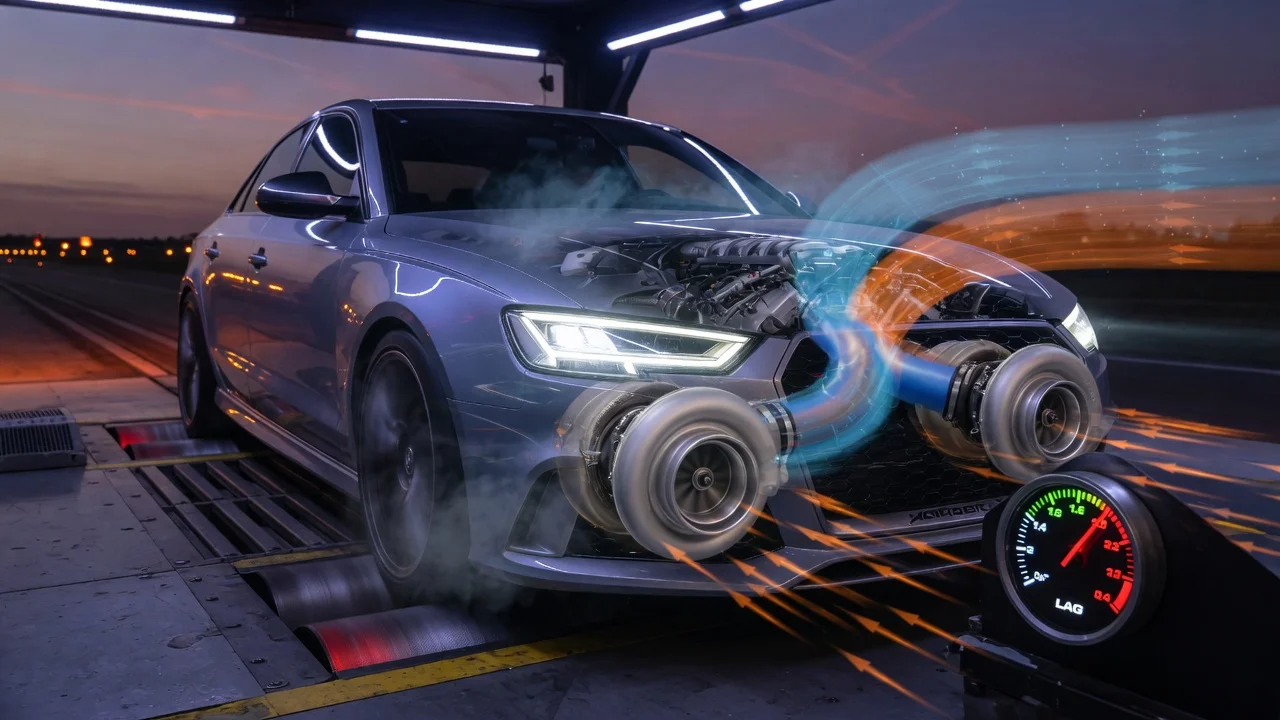
Many Audi drivers notice a brief pause between pressing the accelerator and feeling full thrust, especially when pulling away or accelerating from low engine speed. Some of that hesitation comes from how a turbocharged engine works. Some of it comes from the transmission and throttle programming rather than the turbo itself. This guide explains how to judge whether your car's response is normal for its engine configuration, what makes the delay worse, and when it points to a fault worth diagnosing.
Is Turbo Lag in an Audi Normal?
A small delay is normal on any turbocharged Audi, and modern TFSI and TDI engines are designed to keep it modest. A change in response is not normal. Watch for throttle response that used to be crisp and now feels sluggish, hesitation that comes with a warning light, a flat spot that appears only once the engine is warm, or power that builds and then cuts out. Those patterns suggest that something in the boost, fuel, ignition or drivetrain system is not working as intended.
Separate what you feel from what has been confirmed. A sluggish feeling is a symptom report. A verified failure is something a technician has measured or found, such as a stored fault code, actual boost pressure falling short of the requested value, a split hose or a stuck actuator. Many complaints about slow response turn out to involve gearbox behavior, throttle mapping or drive mode settings rather than the turbocharger. Do not assume the turbo is failing just because the car feels slow.
How Boost Builds and Why There Is a Delay
A turbocharger uses exhaust gas to spin a turbine. The turbine drives a compressor that pushes extra air into the engine. At low engine speed and light load there is little exhaust flow, so the turbine spins slowly and boost is low. When you press the pedal, the engine has to produce more exhaust before the turbo can deliver more air. That short build-up period is what drivers call lag. How quickly it passes depends on the size of the turbo, the length of the exhaust path to it and the engine's displacement.
The engine control unit manages the process. It reads pedal position, airflow and pressure sensors. It then commands the throttle opening, fuel injection, ignition timing and the wastegate, which regulates how much exhaust bypasses the turbine. The delay gets longer if a sensor reports incorrect values or if pressurized air escapes through a leak before reaching the cylinders, because the computer cannot reach its target boost. In cars with an automatic or dual-clutch gearbox, the transmission adds another layer. Which gear it holds and when it downshifts both affect how quickly you feel acceleration.
What Changes the Answer: Engine, Year and Settings
Engine configuration matters most. Four-cylinder TFSI engines with a single turbo behave differently from larger V6 and V8 units. Some Audi V6 engines use a supercharger rather than a turbo. The 3.0 TFSI in the B8-generation S4 and S5 is one example, so classic turbo lag does not apply to it. Later versions of the 3.0 TFSI moved to turbocharging. Some twin-turbo V6 and V8 engines place the turbos inside the V of the engine, which shortens the exhaust path and helps response. TDI diesel engines generally use variable-geometry turbos intended to build boost at low speed, but they have their own issues, such as particulate filter loading. Specifications differ by generation, so check your exact engine code and model year rather than relying on a general reputation.
Operating conditions also change what you feel. Response can feel softer with a cold engine, at high altitude, with very hot intake air, with low-quality fuel, in an economy-oriented drive mode, or when start-stop and coasting functions are active. Pulling away in a high gear or at very low engine speed always produces more delay than accelerating in a lower gear. Aftermarket changes such as a larger turbo or modified engine software can increase or reduce lag, depending on how they were set up.
Common Causes When Response Gets Worse
When a previously responsive Audi becomes noticeably slower, the usual suspects fall into a few groups. Cracked hoses, loose clamps, a damaged intercooler or a worn diverter valve can let pressurized air escape. A faulty wastegate or wastegate actuator can stop the turbo from building pressure on demand. Faulty pressure, airflow or temperature sensors can cause the engine computer to reduce power. On direct-injection gasoline engines, carbon deposits on the intake valves can gradually blunt response. On some engines, a failing crankcase ventilation valve causes vacuum or idle problems that affect drivability. Worn spark plugs or ignition coils can cause misfires that feel like hesitation.
Not every cause sits in the engine bay. Clutch wear on a manual, adaptation or software behavior in a dual-clutch or conventional automatic, a clogged air filter or a restricted exhaust can all mimic lag. A protective reduced-power mode, often called limp mode, makes the car feel severely down on power and usually triggers a warning light. Treat each of these as a possibility to check, not a conclusion, until an inspection confirms the actual fault.
How to Assess Your Own Car's Response
Start by recording the symptom conditions precisely. Note whether the delay happens from a stop, during overtaking or at a particular engine speed. Note whether it happens only when cold or only when hot, in every drive mode or just one, and whether it is constant or intermittent. Compare the car in its default mode and its sport or dynamic setting, and try manual gear selection if your transmission allows it. If the delay largely disappears when you hold a lower gear, the gearbox strategy probably explains much of what you are feeling.
Next, check the basics. Look for warning lights, inspect the air filter, and listen for a hiss or whoosh under acceleration that could indicate a leak. An inexpensive OBD-II scanner can read stored diagnostic codes. For example, P0299 indicates a turbocharger or supercharger underboost condition, although it does not identify which component is responsible. A scan tool that shows live data lets you compare requested and actual boost pressure during a safe, legal acceleration run, which tells you far more than impressions alone.
Finally, review the service history. Overdue spark plugs, an old air filter, skipped oil changes or a recent repair that disturbed the intake hoses are all relevant clues. Take your notes, any codes and the record of recent work to the shop. A clear description of when the problem occurs shortens diagnosis.
Limitations and When to See a Professional
Owner checks can narrow down the problem, but they rarely confirm it. Judging lag by feel is subjective, and expectations shaped by another car or a different engine variant can make a healthy Audi seem slow. Generic code readers may miss manufacturer-specific faults. Interpreting live boost data also requires the manufacturer specifications for your exact engine, which vary across model years and software versions.
See a qualified technician, preferably one with Audi diagnostic equipment, if any of these apply: a warning light is on, the car enters reduced-power mode, you notice smoke, unusual noises or a fuel smell, or response has deteriorated noticeably over a short period. A proper inspection typically includes a smoke test for boost leaks, checks of the wastegate and diverter valve, a review of sensor readings, and any applicable service bulletins or software updates. Avoid prolonged hard driving while a boost fault is unresolved, because some faults can cause further engine or turbo damage.