Audi Check Engine Light Codes: Meanings and Diagnostic Next Steps
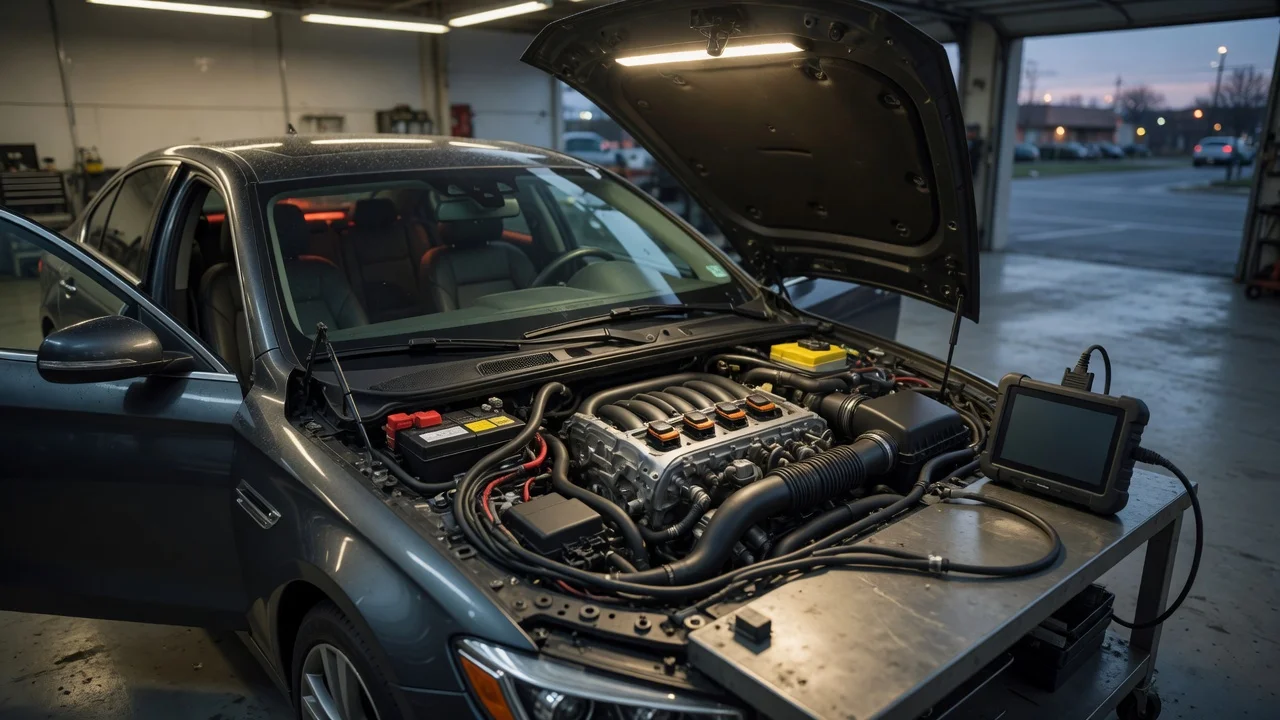
What Audi check engine light codes mean
On an Audi, the check engine light is the malfunction indicator lamp (MIL). It is the engine-control system’s warning that the onboard diagnostics have stored one or more diagnostic trouble codes (DTCs). Those codes are not a parts list. They identify a monitored circuit, sensor, or emissions-related condition that fell outside the control unit’s expected range.
Most Audi models sold in markets that adopted On-Board Diagnostics II (OBD-II) report standardized powertrain codes through the under-dash diagnostic connector, along with manufacturer-specific codes and freeze-frame data. The same lamp can also be described in the instrument cluster or driver information display as an engine malfunction warning. It is separate from other Audi warnings such as the electronic power control (EPC) lamp, oil-pressure warnings, and coolant-temperature warnings, even though more than one of those lamps can appear together.
A solid MIL usually means a confirmed fault that affects emissions or engine management but does not, by itself, tell you how urgent the repair is. A flashing MIL is treated as a more urgent misfire or catalyst-damaging condition. The exact cluster graphic, message wording, and lamp color can vary by model year, so the owner’s manual for that vehicle remains the authority for how the warning is presented.
How the codes are structured
An OBD-II trouble code is typically a letter followed by four digits. The letter shows the system family: P for powertrain (engine, transmission, and related emissions controls), B for body, C for chassis, and U for network or communication faults. Powertrain codes are the ones most often tied to the check engine light.
Within powertrain codes, P0 and many P2 codes are generic SAE-defined codes that mean the same thing across manufacturers. P1 codes, and some P3 codes, can be manufacturer-specific. Audi and other Volkswagen Group vehicles may also store additional control-module faults that a basic generic scan tool will not display. That is why a code read on a simple OBD-II reader can be incomplete on an Audi even when the generic code itself is valid.
Codes also have a status. A pending code has been detected but not yet confirmed over the required number of drive cycles. A confirmed or stored code has met the criteria to illuminate the MIL. A permanent code remains until the control unit itself verifies that the fault has cleared after a successful drive cycle; simply erasing it with a scan tool does not always remove it. Freeze-frame data captures engine operating conditions at the moment the fault was set, such as load, temperature, and fuel-trim context, and should be recorded before codes are cleared.
Common code families and what they point to
The following families appear often on Audi powertrains. Each describes a monitored condition, not a guaranteed failed part. Year, engine, and market calibration change which codes are used and how they should be interpreted.
Code family Typical meaning What it usually implicates; P0300–P0308 Random or cylinder-specific misfire Ignition, fuel delivery, compression, or intake issues on one or more cylinders; P0171, P0174, P2187, P2189 Fuel system too lean, including at idle on some calibrations Unmetered air, low fuel pressure, a dirty or failing mass airflow sensor, or a vacuum leak; P0172, P0175 Fuel system too rich Fuel pressure, leaking injectors, sensor bias, or restricted air measurement; P0420, P0430 Catalyst system efficiency below threshold Catalytic converter aging, exhaust leaks, or upstream misfire and mixture problems; P0440–P0457 Evaporative emission (EVAP) system leak or purge fault Fuel-cap seal, vapor hoses, purge or vent valves, or a small leak in the tank vapor system; P0010–P0017, P0011, P0014 Camshaft position or variable timing correlation Timing chain wear, oil-control solenoids, oil condition, or cam-position sensing; P0100–P0104 Mass or volume air-flow circuit Mass airflow sensor, wiring, or an air leak around the intake path; P0130–P0161 Oxygen or air-fuel sensor circuit and response Heater circuits, wiring, exhaust leaks, or a slow sensor; P0299 Turbocharger or supercharger underboost Boost leaks, wastegate or diverter control, or turbo mechanical problems on forced-induction engines; P0087 Fuel rail or system pressure too low Fuel pump, filter, pressure regulator, or demand that the pump cannot meet; P2015 Intake manifold runner position sensor or actuator Swirl or runner-flap mechanism and its position sensor, a recurring Volkswagen Group pattern; U-codes Lost communication between modules Wiring, a failing module, or a network issue rather than a single engine sensor
Manufacturer-specific P1 codes need the matching Audi definition for that model year and engine. A generic code library can mislabel them. When a scan tool returns only a hexadecimal or control-module address without a clear SAE definition, treat that as a gap that requires Audi-capable diagnostic software.
How to read the codes and what to do next
The practical task is to capture the warning state, retrieve the stored codes without erasing evidence, and decide whether the car can be driven to a diagnosis point. Exact scan-tool menus, readiness-monitor names, and adapter locations vary by model year. Confirm those details in the owner’s manual or a model-specific service procedure before disconnecting parts or clearing memory.
Note whether the lamp is steady or flashing, and write down any cluster message, loss of power, rough running, unusual noise, smoke, or warning that appeared at the same time. If the lamp is flashing, reduce engine load immediately. Avoid hard acceleration. Plan to stop as soon as it is safe if roughness, power loss, or a sulfur smell continues, because a severe misfire can overheat a catalytic converter. If the lamp is steady and the car still runs, drives, and shows no overheating, oil-pressure, or brake warnings, continue with a code read rather than ignoring the lamp. Locate the 16-pin diagnostic link connector, which on most Audis is under the driver’s-side instrument panel. Plug in an OBD-II scan tool with the ignition in the on position, following the tool’s instructions. Record every code exactly as displayed, including pending, confirmed, and permanent status. Save freeze-frame data before any repair or reset. Identify the engine code, model year, and transmission type. The same P-code can have different likely causes on a naturally aspirated four-cylinder than on a turbocharged or hybrid powertrain. Inspect only the items that the code family actually supports as first checks: a loose or missing fuel cap after an EVAP code, obvious intake or vacuum hose damage after a lean code, low oil level after a variable-timing code, or a disconnected electrical connector after a circuit code. Do not clear codes until the information is recorded. Clearing the MIL without a repair erases freeze-frame data and can reset readiness monitors that an emissions inspection may require. After a verified repair, complete a mixed driving cycle so the control unit can run its monitors. The lamp should remain off and, for permanent codes, the control unit should clear them after it has seen the fault stay gone.
Specialist equipment is required once the next step depends on live fuel-pressure values, relative compression, smoke testing for leaks, oscilloscope captures of crank or cam sensors, or access to Audi-specific measuring blocks and adaptation channels. A generic code reader is enough to retrieve standard P-codes. It is not enough to command many actuators, read all control modules, or interpret manufacturer-specific faults. Stop owner-level work and seek professional diagnosis if the code points to timing, turbo, high-pressure fuel, catalytic-converter efficiency after misfire has been ruled out, or network communication, or if any repair would require opening the fuel system, cooling system, or timing covers.
Task-specific hazards include a hot exhaust and catalytic converter, rotating belts, residual fuel pressure, and the risk of damaging connectors or control units with a poor-quality scan tool or a jump-start while a diagnostic session is open. Do not work under a vehicle supported only by a jack. Tightening specifications, fluid types, and sensor torque values are model-specific and are not listed here; use the applicable Audi service information for any fastener or fluid step.
What the warning can mean and what to check
The observation is the lamp itself, with or without a change in how the car runs. Possible causes sit in a wide range: a loose fuel cap, a failed sensor, an exhaust leak, a misfire, a boost leak, a fuel-pump problem, a timing-chain issue, or a catalytic converter that has already been damaged by an earlier fault. The code and freeze-frame data are what turn that list into a useful order of checks.
Start with conditions that are cheap to confirm and that commonly set the lamp without a failed major component. After an EVAP code, confirm the fuel cap is present, seated, and clicked down, then inspect the cap seal. After a lean or idle-quality code, look for cracked intake hoses, a loose oil-filler cap, and disconnected vacuum lines. After a misfire code, note whether the fault is on one cylinder or random, and whether it appeared after low fuel, a recent service, or water exposure. After a catalyst-efficiency code, look first for upstream misfire, rich or lean mixture, and exhaust leaks before treating the converter as the primary failure.
Stop using the car and arrange diagnosis or recovery if the MIL is flashing and the engine is shaking, if power drops sharply, if coolant temperature rises, if oil-pressure or oil-level warnings appear, if there is a fuel smell, or if there is exhaust smoke that was not present before. Drive only as far as needed for a scan and inspection if the lamp is steady, idle is stable, and there are no temperature, oil, or brake warnings. Avoid towing, steep grades, and wide-open throttle until the codes are known. Seek diagnosis rather than continued owner checks if multiple unrelated codes appear at once, if U-codes show module communication loss, if the same code returns immediately after a reset with no repair, or if the engine has a rattling noise that could indicate timing-chain or turbo distress. Treat a recurring misfire or underboost condition as more urgent than a one-time EVAP small-leak code, because misfire and boost faults can damage the catalytic converter or, on turbo engines, the turbocharger.
Owner documentation for the specific Audi should be used to confirm whether the vehicle may be driven with a steady MIL, how the cluster presents an engine malfunction, and whether an emissions inspection will fail with the lamp on or with incomplete readiness monitors. Service information for that VIN or engine code is required for live-data specifications, test limits, and any replacement procedure. Those figures are not generic across the Audi range, and they are not supplied here.