Audi Car Lineup
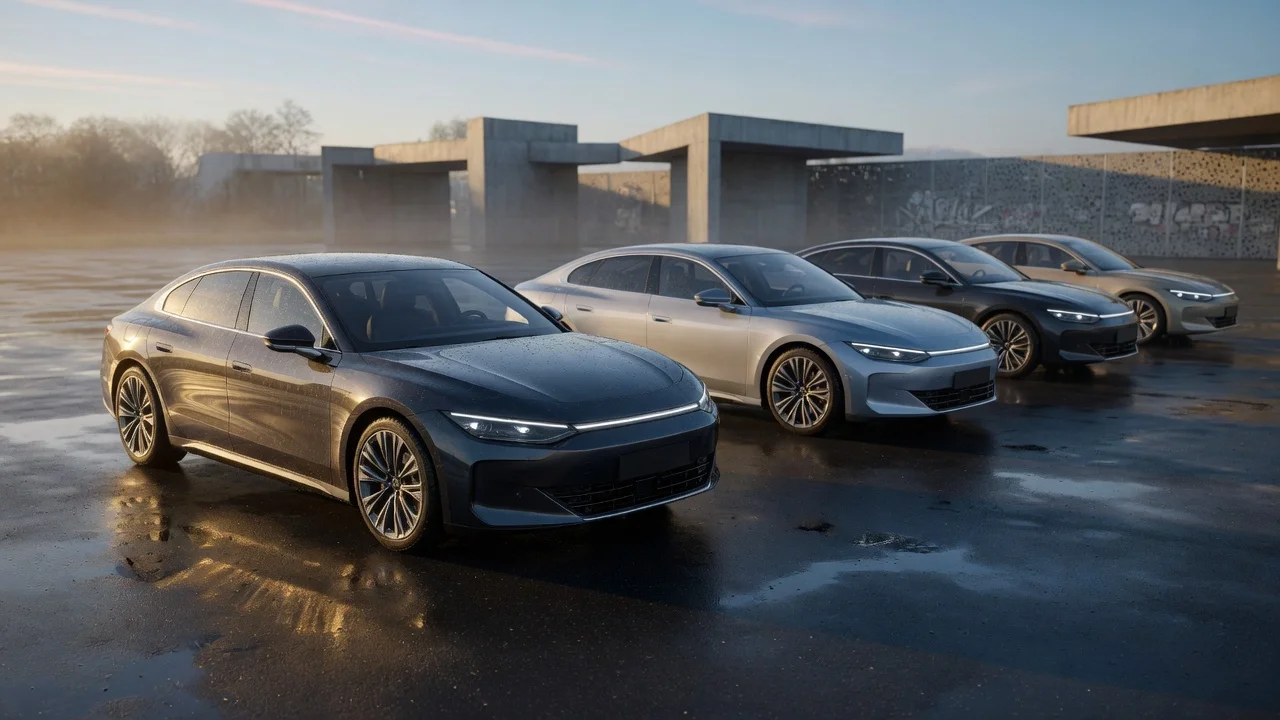
What Audi’s lineup includes
Audi’s car lineup is a range of passenger cars, SUVs and electric models named mainly with a letter and a number. A-series vehicles are cars (sedans, hatchbacks, Sportbacks and wagons). Q-series vehicles are crossovers and SUVs. Within each series, a higher number generally marks a larger, more expensive model. S and RS badges identify factory performance versions, and e-tron identifies battery-electric models. Which nameplates, body styles and powertrains are actually on sale depends on the model year and the market; a U.S., European or Chinese catalog will not match in full.
How the names work
The letter tells you the vehicle’s role. The number is the size and price rung. Extra letters describe body style or a regional stretch: Sportback is a four-door car with a sloping roofline and a hatch; Avant is Audi’s name for a wagon; an L suffix in some markets, especially China, marks a long-wheelbase version. S models are sport-tuned versions of the matching A or Q car. RS models sit above S as the highest-performance road versions. e-tron is used either as a standalone model name or as a suffix on an A or Q nameplate for a battery-electric vehicle.
Badge What it usually means How size is signaled; A series Passenger cars: sedans, hatchbacks, Sportbacks, wagons Higher number, larger car; Q series Crossovers and SUVs Higher number, larger SUV; S Factory sport variant of an A or Q model Same size class as the base model; RS Highest-performance road-going variant Same size class as the base model; e-tron Battery-electric model Used as a name or a suffix
Audi has adjusted this naming scheme while it adds electric models, so the same number has not always meant the same powertrain. Treat the letter-and-number as a family name, then confirm the specific generation, model year and drivetrain for the market you are shopping.
A-series passenger cars
The A series is Audi’s core car range, scaled from compact hatchbacks and sedans up to a flagship luxury sedan. Not every rung is sold in every country, and recent generations have moved some compact-executive volume from the A4 name to the A5 name in several markets.
A1: a small hatchback offered in some regions; it is not part of the typical U.S. range. A3: the compact car, commonly a sedan and, in some markets, a hatchback, with S3 and RS 3 performance versions where sold. A4 and A5: the compact executive class. Historically the A4 was the sedan and Avant, and the A5 covered coupe, cabriolet and Sportback body styles. In recent generations, several markets use A5 for the car that previously wore the A4 badge, so whether you see an A4, an A5, or both is model-year and market specific. A6: the midsize executive sedan and, in some markets, Avant wagon, with S6 and RS 6 performance versions where offered. A separate A6 e-tron is the battery-electric model in this size class. A7: a five-door Sportback based around A6 packaging, with S7 and RS 7 versions in markets that sell them. A8: the flagship luxury sedan, including long-wheelbase versions in some markets, with an S8 performance variant where offered.
Diesel TDI engines remain part of some non-U.S. A-series catalogs. Gasoline models are typically labeled TFSI. Plug-in hybrid versions, often labeled TFSI e, appear on selected A models in selected markets. Those powertrain labels are trim- and region-specific and should be read from the window sticker or configurator for the year in question.
Q-series SUVs and crossovers
The Q series is Audi’s crossover and SUV range and, in many markets, the brand’s highest-volume group. Numbers again scale with size, from subcompact crossovers up to three-row and coupe-styled full-size SUVs. Electric Q models use the e-tron suffix rather than sharing a combustion model’s exact mechanical package.
Q2: a subcompact crossover sold mainly in Europe and some other regions, not a standard U.S. nameplate. Q3: the compact crossover, often with an SQ3 performance version. Q4 e-tron: a compact battery-electric crossover; it is an electric model in its own right rather than an electrified Q3. Q5: the midsize two-row SUV and a core volume model in markets including the United States, with SQ5 and plug-in hybrid versions where offered. Q6 e-tron: a midsize battery-electric SUV in the electric half of this size class, separate from the combustion Q5. Q7: a three-row SUV, with SQ7 versions in some catalogs. Q8: a coupe-styled full-size SUV related in size class to the Q7, with SQ8 and RS Q8 performance versions where sold. Q8 e-tron: a battery-electric full-size SUV. It succeeded the model previously sold simply as e-tron; the current name is the one to look for in recent catalogs.
Dedicated electric models
Battery-electric Audis are either e-tron versions of A or Q nameplates or standalone e-tron models. In current catalogs the main electric families are the Q4 e-tron, Q6 e-tron, A6 e-tron, Q8 e-tron and the e-tron GT, a low four-door gran turismo with an RS e-tron GT high-performance version. Range, charging speed, battery size and motor output are generation- and variant-specific; those figures are not interchangeable across e-tron nameplates.
A combustion A or Q model and its e-tron counterpart can share a size class and some design language without sharing a platform, interior layout or driving character. If the goal is an electric Audi, shop the e-tron nameplate directly rather than assuming an A4, A6, Q5 or Q7 has a fully electric twin under the same number.
S and RS performance models
S models add power, firmer chassis tuning, distinctive styling and, typically, standard quattro all-wheel drive on the matching A or Q vehicle. RS models go further, with higher output, more aggressive hardware and a sharper road focus. Common RS nameplates in recent catalogs include RS 3, RS 5, RS 6, RS 7, RS Q8 and RS e-tron GT, but which RS cars are sold is tightly tied to market and year. Quattro is Audi’s all-wheel-drive system; it is common on S and RS models and available or standard on many other Audis, yet it is not automatic on every trim.
What changes the answer
Market is the largest qualifier. North America concentrates on A3 and larger cars plus Q3 and larger SUVs, with a subset of S, RS and e-tron models. Europe adds smaller cars such as the A1 and Q2 and a wider mix of wagons, diesels and plug-in hybrids. China adds long-wheelbase L models and market-specific nameplates that do not appear elsewhere. Two-door sports cars that once sat at the top of the range, including the TT and R8, have left regular production and should not be treated as current lineup fixtures.
Model year is the next qualifier. Audi has been replacing older combustion generations while introducing new electric ones, and some compact-executive volume has moved between the A4 and A5 names. Trim lines, infotainment generations, driver-assistance packages and whether a given engine, plug-in hybrid or electric motor is offered can change between years even when the badge stays the same. Published specifications apply only to the stated generation, powertrain, trim and market.
How to narrow the choice
Start with body style: an A-series car if you want a sedan, Sportback or wagon; a Q-series model if you want crossover ride height and cargo space, and a Q7-class vehicle if you need a third row. Then choose powertrain: TFSI gasoline, TDI diesel where sold, TFSI e plug-in hybrid, or e-tron battery-electric. Then decide how much performance you want from the standard model, an S variant or an RS variant. Finally, confirm the exact vehicle for your country and model year, because that is the only catalog that determines which engines, batteries, seating layouts and options you can actually order.
Pricing, horsepower, towing ratings, electric range and cargo volumes are omitted here because they vary by generation, output tune, wheel and battery choice, and market. Those figures belong to the specific configuration you are comparing, not to the Audi lineup as a whole.