Audi B5 S4 Adjustable Control Arms: Fitment and Selection
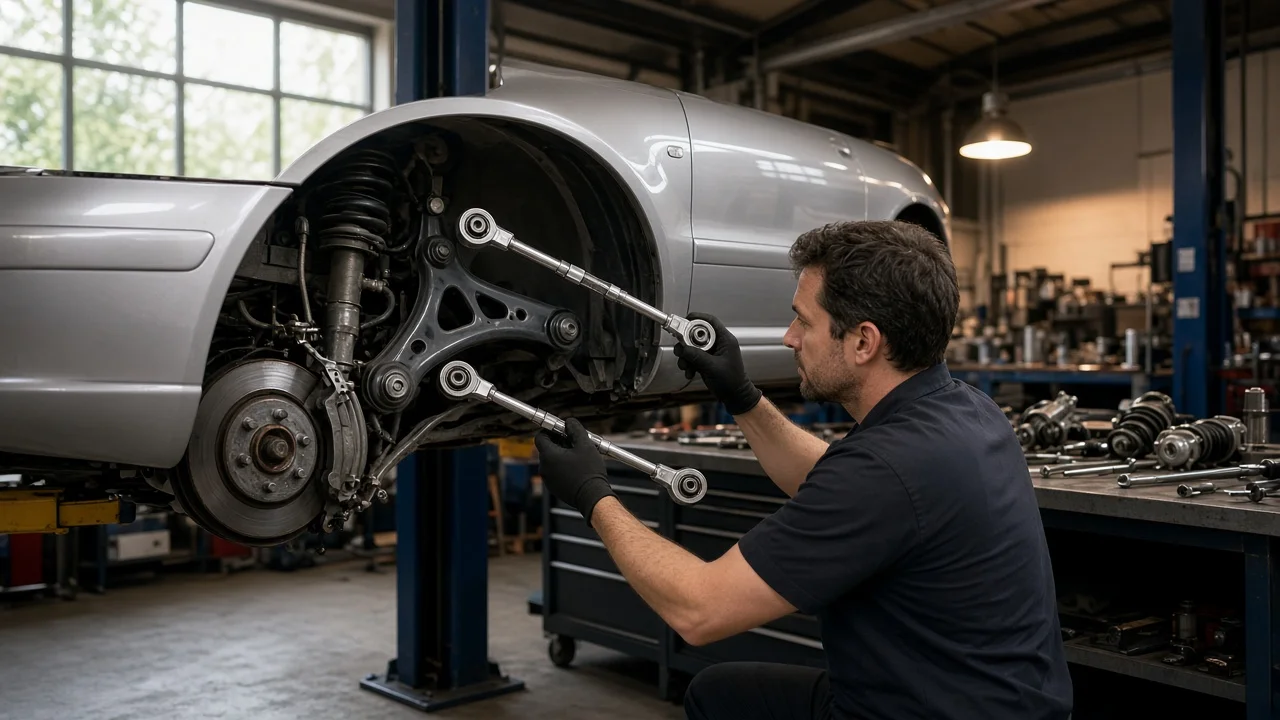
Owners usually buy adjustable control arms for an Audi B5 S4 for one of three reasons. They want to restore alignment range after lowering the car, replace tired factory arms with serviceable parts, or dial in front camber for track use. These arms are not a universal upgrade. The right set depends on how the car is driven, how far it sits from stock ride height, and how much noise and maintenance you will accept. This guide covers matching a kit to the car and to the job.
Define the job the product must do
Start with the problem you are trying to solve, not the part. The most common case is a car lowered on springs or coilovers. As the car drops, front camber goes more negative and the inner tire edges wear faster. The factory front suspension offers little direct camber adjustment, so an alignment shop may not be able to bring the car back into a sensible range without different arms. A second case is worn factory arms. If the owner is replacing them anyway, they may want adjustability for future changes. A third case is autocross or track driving, where the driver wants more negative camber than stock geometry allows.
Then list your practical constraints. Consider whether the car is a daily driver in a road-salt climate, whether you plan to lower it further later, and how much you can spend on the parts plus a professional wheel alignment. Also decide whether you will do the installation yourself with proper equipment. If the car sits at stock height and only has worn arms, quality OE-style replacements may be the better buy. Adjustable arms solve an alignment-range problem; they are not a cure for general suspension wear.
Check compatibility
The S4 was built on the B5 platform from the late 1990s through 2002. It shares its front four-link suspension layout with the B5 A4 and the related Volkswagen Passat of that era, so many kits are listed as fitting all of them. That shared design is a useful starting point, but it does not prove fitment. Confirm that the listing covers the S4 with quattro and your model year, and compare part numbers against the arms on your car. Facelift and performance variants within the family may use different components, so check the part number rather than assuming a match.
Know which arms a kit replaces. Each front corner has two upper links and two lower links. Adjustable kits most often replace the upper links, because the uppers determine camber. The quattro rear suspension uses its own separate links, and rear adjustable arms for camber or toe are a different purchase. The interfaces that decide whether a part fits are the ball joint taper and pinch-bolt fit at the steering knuckle, the bushing sleeve width and bolt diameter at the body and subframe mounting points, and clearance to wheels, brake hoses, ABS wiring and axle boots through full steering lock and suspension travel.
Finally, match the adjustment range to your ride height. Ask for the camber range the manufacturer states for the kit, and confirm it covers your target at the height the car will actually sit. A kit with plenty of range for a mild drop may run out on a heavily lowered car.
Features that affect the choice
The adjustment method matters more than the finish. Some arms adjust their length with a threaded sleeve or turnbuckle and lock nuts. Others use an eccentric bushing or adjustable pivot. Arms that can be adjusted on the car let the alignment technician make changes directly. Designs that must be removed and reset to a measured length can turn a routine alignment into a longer, trial-and-error appointment.
Joint type sets the character of the car. Rubber bushings isolate noise and vibration best and suit street cars. Polyurethane is firmer and more precise but can squeak and may need periodic lubrication. Spherical bearings remove almost all compliance, which suits track use, but they pass more noise and vibration into the cabin and need closer inspection. Look at the ball joint too: whether it is replaceable separately, how its boot is retained, and whether the manufacturer sells service parts.
Treat marketing labels such as race-proven or motorsport-grade as claims, not evidence. Useful evidence includes published dimensions and adjustment range, the joint and material specifications, clear installation instructions that reference the correct fastener specification, written warranty terms, and the availability of replacement joints and hardware. Forged aluminum and steel arms can both work well. The design and joint quality matter more than the material name.
Limitations and ownership costs
Plan the installation before you order. Use safe vehicle support: rated jack stands at the correct lift points, never a jack alone. Follow the factory service manual or the kit instructions for removal steps and torque values instead of guessing. On this platform, rubber-bushed suspension joints are generally tightened with the car at its normal loaded ride height, so the bushings are not preloaded in a twisted position. Check whether your kit's instructions call for the same. Budget for a wheel alignment immediately afterward. Driving on an unaligned front end can wear tires quickly.
Ongoing costs depend on joint type. Check for joint play, torn boots, loose jam nuts and corroded adjustment threads at every tire rotation, and more often on a car that sees track days or winter roads. Spherical bearings and polyurethane bushings wear and need replacement or service over time. Rubber-bushed arms wear as well, just more quietly. Anti-seize on the threads, where the instructions permit it, makes later adjustment easier.
Know what the arms cannot do. They will not fix worn struts or shocks, tie rod ends, wheel bearings, sway bar end links or subframe bushings, and they do not change ride height. Toe is still set through the tie rods. A clunk or wander caused by another worn part will remain after the new arms go in, so inspect the whole front end first and replace any worn related parts at the same time.
Build a practical shortlist
Narrow the field with a short checklist. Confirm the kit is listed for the B5 S4 and your model year, and verify part numbers against your factory arms. Note exactly which arms are included and whether new hardware comes with them. Compare the stated adjustment range with your camber target at your ride height. Choose the joint type that matches your use: rubber for a quiet daily driver, firmer joints only if you accept the extra noise and inspection. Check whether ball joints and bushings can be serviced separately, and whether the instructions give a clear procedure and fastener specification.
Compare two or three kits on paper using that list, then add the full cost: the arms, any new bolts or ancillary parts, and the alignment. Before buying, ask your alignment shop whether it has worked with the adjustment style you are considering and how long the job usually takes. A kit that fits your car, covers your target range and is easy to adjust and service is a better choice than one with the strongest marketing claims.