Audi A8 Air Suspension Valve Block Location
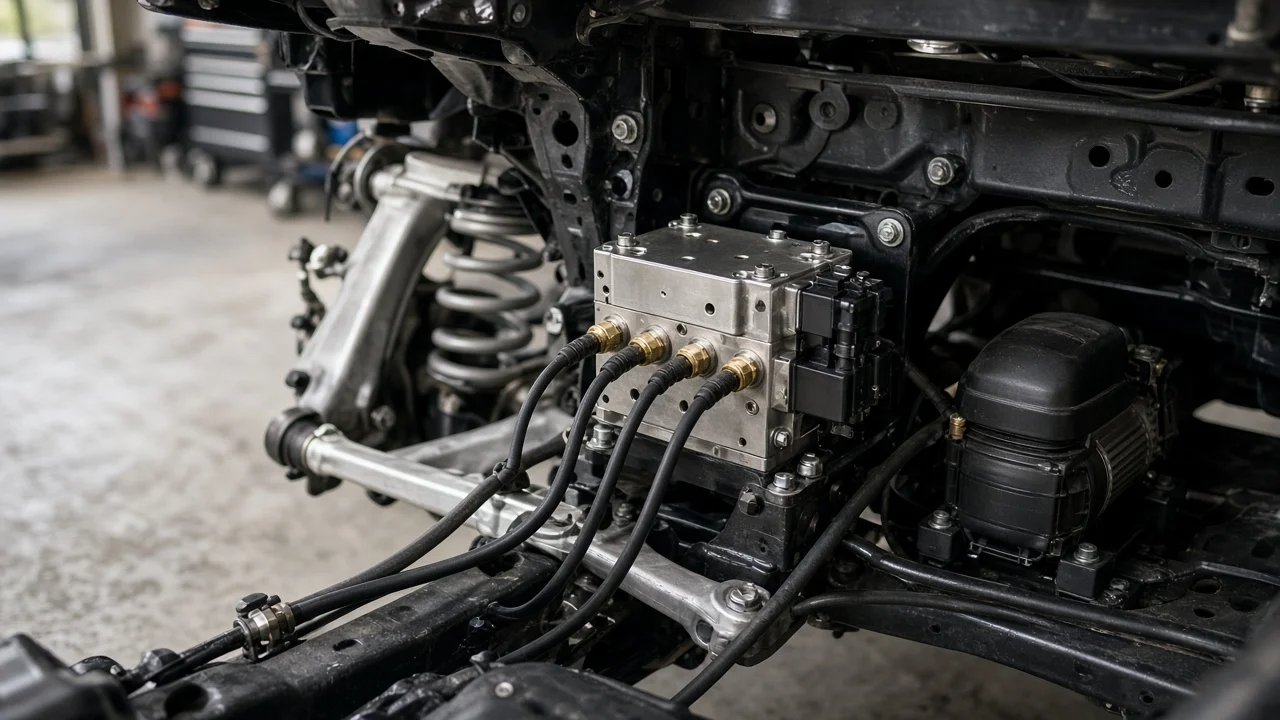
If your Audi A8 sags at one corner, levels slowly or stores valve-related fault codes, the solenoid valve block is one of the first parts worth locating. On most cars it is not in the cabin or trunk. It sits low on the vehicle, close to the air supply hardware. This guide explains where to look, how the block fits into the system, what changes its position and what to do before you touch any air line.
Where the Valve Block Sits on an A8
On A8 generations fitted with Audi's adaptive air suspension, the valve block is generally mounted at the front of the car, low on the left side (the driver's side on US vehicles). It is usually near the front left wheel arch and close to the air compressor. Reaching it normally means removing the front left wheel and the inner wheel-arch liner. On some versions you also have to remove part of the underbody paneling or bumper trim. You are looking for a compact block with an electrical connector and several air lines. One line runs to each air spring, and others connect to the pressure reservoir and the compressor.
Treat that description as a starting point, not as the layout of your specific car. Audi revised the system across the D3, D4 and later A8 generations. The mounting bracket, the orientation of the block and the parts you must remove to reach it differ between them. Before you start taking panels off, check the model-year service information or the parts diagram for your VIN.
How the Valve Block Controls the Air Springs
The compressor produces pressurized air, which passes through a dryer and can be stored in a reservoir. The valve block is the distribution point. It contains a solenoid valve for each air spring and one for the reservoir. The suspension control module opens and closes these valves based on signals from the ride height sensors at each corner. To raise a corner, the module opens that spring's valve while supply pressure is available. To lower it, the module vents air through the compressor's exhaust path. A pressure sensor, typically housed in or on the block, reports system pressure to the module. Residual pressure retention valves keep a minimum pressure in the springs so the air bellows do not fold over when the car is parked or lifted.
A faulty block can cause several symptoms: • A worn valve seal can let one corner, or the whole car, drop slowly while parked. • A sticking valve can stop a corner from rising or make the compressor run for long periods. • An electrical fault in a solenoid or its connector usually sets a stored fault. • Moisture from a failing dryer can corrode the internals. The same symptoms often come from a leaking air spring or air line instead. That is why the block should be confirmed as the cause rather than assumed.
What Changes Where You Look
Generation and model year matter most, because the compressor and valve block packaging was reworked between platforms. Engine and equipment variants can also change what surrounds the block and how much you must remove to reach it. Right-hand-drive vehicles should not be assumed to be a simple mirror image of a left-hand-drive car. Check the documentation for that specific build.
Previous repairs can change the picture too. An aftermarket compressor or valve block may sit on a different bracket or use different line fittings from the original. A car converted to coil springs may have no valve block at all. Also make sure you are looking at the right part. The compressor, its relay, the reservoir and the ride height sensors are all nearby or easy to mistake for the block. The valve block is the unit that several air lines branch out from, not the motor-driven pump.
What the Owner Can Check Safely
Start with observations that need no tools: • Note which corner drops, how far and how quickly. • Note whether the compressor runs more often than it used to. • Read the suspension module's fault memory with a scan tool that supports Audi systems, and record the ride height values it reports. With the system pressurized and the liner removed, spray soapy water on the reachable fittings and on the block itself. Steady bubbles point to a leak at that spot. A leak at one fitting does not prove the block's internal valves are faulty.
Proper vehicle support is essential. If your A8 has a jack or lift mode in its vehicle settings, turn it on so the system does not try to re-level while the car is raised. Lift only at the designated jacking points. Then support the car on rated stands placed at the correct mounting points. Never work under a car held up only by its air suspension or by a jack. Do not disconnect any air line until the system has been depressurized according to the service procedure. The springs and reservoir hold enough pressure to whip a line or eject a fitting. Label each line before removal, and tighten the bracket fasteners to the fastener specification in the service information rather than estimating.
After a valve block is replaced, or after lines have been disconnected, the system usually needs to be refilled and its ride height recalibrated with diagnostic software. A change in ride height can affect wheel alignment, so have the alignment checked if the heights were reset. While the wheel arch is open, you can also note any obvious joint play or damaged bushings. Treat those as separate repairs.
Limitations and Next Step
A general location description cannot confirm the layout of your particular car. This guide also does not give torque values, pressures or ride height settings, because those must come from the service information for your vehicle. Depressurizing, refilling and calibrating the system typically require Audi-capable diagnostic software, and a mistake can leave the car at the wrong height or damage the air springs.
Do not drive the car if it is sitting on its bump stops or a tire is touching the wheel arch. Have it transported instead. If you cannot confirm the block's location from the documentation for your VIN, or you lack the tools to depressurize and recalibrate the system, a shop familiar with Audi air suspension is the safer next step.