Audi A4 steering angle sensor: location and fault

A steering angle sensor fault on an Audi A4 usually appears after the stability control light comes on, the steering feels inconsistently weighted, or a scan tool records a steering angle signal error. The sensor measures how far and how quickly the wheel is turned so the ABS and stability systems can compare driver intent with vehicle motion. When that value is missing, implausible, or not calibrated, the control module may disable traction and stability assistance. The same basic idea also applies to Audi A3 and A6 models, where the unit may be integrated into the steering column or the clock spring area.
Direct answer
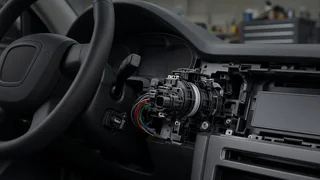
The steering angle sensor is typically mounted in the steering column, often combined with the clockspring or a steering column control module. On many A4 generations, it is accessed behind the steering wheel, around the area where the column passes through the trim. The exact location varies, so the B6 arrangement may differ from a B8, and the part sometimes resembles a plastic ring with an electrical connector rather than a separate bolt-on component.
A fault does not automatically mean the sensor is defective. Interrupted communication, a low battery, recent alignment work, or a mismatched calibration can all create a steering angle signal error. Confirming the physical location first helps separate a wiring or connector problem from an internal failure. Because these Audi models share the basic system design, owners of an A3 or A6 often follow the same process of checking the column area, the connector, and the stored diagnostic codes.
Identification and location
Look for a round sensor body built into the steering column assembly, often clipped or screwed near the back of the steering wheel. It may share a housing with the clockspring, so the flat ribbon connector for the airbag and steering wheel controls passes through it. The sensor usually has a multi-pin electrical plug and may include alignment marks or a locking tab that prevents rotation before installation.
Access normally begins by removing the driver airbag and steering wheel, but exact steps depend on the model year. On an A3 the column layout is similar, while the A6 may place the sensor slightly farther down the column. Before removing anything, inspect the lower trim and wiring near the column. A pinched harness or loose connector can mimic an internal sensor fault, so the physical inspection should include the routing and locking of the electrical connector.
Interpreting symptoms and test results
A stored steering angle sensor code usually indicates that the control unit received no plausible steering position value. This can happen after the battery is disconnected or the sensor is replaced, because the unit may need a calibration or basic setting procedure. An alignment change can also create an offset between the straight-ahead steering position and the value the module expects, which may set a fault without any part being defective.
A mechanical fault description in a scan report should not be treated as proof that the steering column sensor is broken. The reading may point to a communication interruption, a voltage supply issue, or wrong coding. Useful next checks include confirming clean power and ground at the connector, watching whether the angle value changes smoothly in live data, and checking that no other steering or ABS fault is present. These results can separate a calibration issue from a failed sensor.