Allison Transmission Service Intervals: Finding the Right Maintenance Schedule
The essential answer
Allison automatic transmissions are serviced on a schedule that is specific to the transmission family, calibration, approved fluid, filter arrangement, and how the vehicle is used. The interval that applies to a given truck, bus, motorhome, or piece of vocational equipment is the one published for that unit in the Allison operator’s literature and in the chassis maker’s maintenance schedule for the same model year and vocation. A single mileage, hour, or calendar figure does not cover the full product range.
That qualification is the whole answer in practice. A highway tractor on an approved synthetic fluid with oil-life prognostics is maintained on a different cadence than a refuse packer, transit bus, or dump truck on severe-duty cycles. The same physical series can also carry different fluid and filter tasks depending on whether the unit is set up for prognostics, a conventional calendar or odometer plan, or a fleet oil-analysis program. Until those identifiers are known, any quoted interval is only a guess.
What “Allison transmission” covers here
In ownership and shop use, the name usually refers to Allison fully automatic planetary transmissions fitted to medium- and heavy-duty commercial chassis, plus related applications such as school and transit buses, motorhomes, and off-highway or vocational trucks. Common on-highway families include the 1000 and 2000 series in lighter and medium-duty ratings, and the 3000 and 4000 series in heavier on-highway and vocational ratings. Military, industrial, and some specialty calibrations exist as well, and those follow their own service publications.
This guide addresses fluid, filter, and related inspection timing for those commercial automatics. It does not replace a model-specific operator’s manual, a body builder’s or OEM vocational supplement, or a dealer diagnostic report. Exact hour, mile, and month figures for each family, fluid specification, and duty cycle were not supplied as a single published table, so those numbers must be read from the documents that match the serial plate on the case.
The factors that change the interval
Allison treats service as a combination of fluid life, filter life, and operating severity, not as one universal oil-change mileage. The items below are the ones that materially change the answer for a given vehicle.
Transmission family and generation, read from the identification tag on the case (series, model, and serial number). Whether the unit is equipped with prognostics or fluid-life monitoring, which can replace or extend a fixed calendar or odometer plan when the system is enabled and functioning. The Allison TES fluid specification the sump is filled with, and whether that fluid is still within the specification the calibration was approved for. Duty cycle: on-highway linehaul, pickup and delivery, transit, school bus, refuse, construction, fire and emergency, motorhome, or other vocational use with frequent shifting, retarder use, or power take-off. Filter hardware: spin-on or remote filters, internal filters, and any suction or main filter that is serviced on a different cadence than the fluid. Operating conditions that raise sump temperature or contamination, including high ambient heat, mountain grades, stop-and-go routes, dusty sites, and frequent PTO or retarder operation. Who wrote the in-service schedule: Allison’s operator literature, the truck or bus OEM’s maintenance manual, or a fleet program that uses oil analysis to adjust drain intervals.
How to identify the schedule for your unit
Start with the transmission identification tag and the vehicle’s build records. You need the Allison model designation, serial number, and, if listed, the software or calibration identity. Match those to the operator’s manual and lubrication chart for that family. Then overlay the chassis OEM’s maintenance chapter for the same model year, engine, and vocation. When the two documents differ, shops typically follow the more conservative of the two for fluid and filter work unless the OEM or Allison has issued a superseding bulletin for that configuration.
Confirm the fluid in the sump against the current Allison TES approval for that transmission. Commercial Allison units have historically been associated with TES-approved fluids, including specifications such as TES 389, TES 295, and later TES 668, depending on generation and regional availability. Using an approved fluid of the correct specification is part of the interval, because extended or prognostics-based plans assume that fluid. Mixing unspecified automatic transmission fluid, or topping up with a different TES category than the fill of record, puts the unit back on a conventional, shorter service path until the sump is restored to a documented fill.
If the dash, shift selector, or diagnostic software shows prognostics or oil-life status, that display is the in-service clock for fluid condition when the feature is specified for that calibration. A prognostics reading of remaining fluid life, a filter-life indicator, or a prognostic prognostic alert is the prompt to service, together with any mandatory inspection items that still run on miles, hours, or months. Units without prognostics stay on the published time, distance, or hour chart for their duty cycle.
Item to confirm Why it sets the interval; Model, series, and serial on the case tag Service charts are written by family and sometimes by generation or calibration. TES fluid specification actually in the sump Approved fluids and the matching fill are what extended or prognostic schedules assume. Prognostics enabled and reporting Fluid and filter life may be monitored in service rather than drained on a fixed odometer mark. Vocation and duty cycle in the OEM manual Severe or vocational charts apply to refuse, transit, dump, and similar work; highway charts apply to linehaul-type use. Filter type and location Main, spin-on, and internal filters can have separate replacement points from the fluid drain. Hours versus miles versus months Vocational and PTO-intensive equipment is often limited by hours or calendar time as well as distance.
Fluid, filters, and related service items
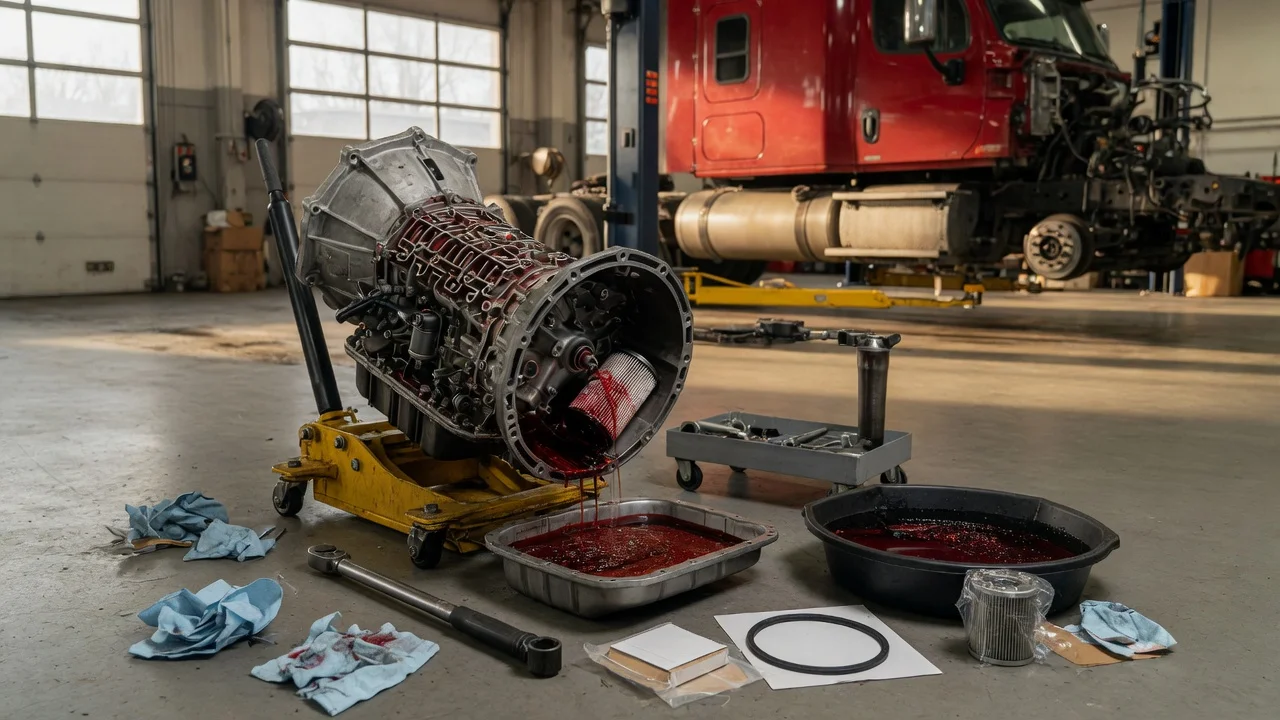
A complete Allison service interval is more than a drain-and-fill. Typical published tasks, depending on family, include fluid level and condition checks, main or spin-on filter replacement, inspection of cooler lines and the cooler itself, connector and harness condition, and, on some calibrations, output or input speed-sensor and prognostic-system health. Fluid level is checked at the specified operating temperature and with the selector in the position the manual calls for, because a cold or running-in-the-wrong-range reading will misstate the sump level.
Filter intervals can fall due before a full fluid change, especially on vocational charts or when a prognostic filter-life alert sets. Replacing the filter without addressing fluid that is oxidized, fuel-diluted, or heavily contaminated leaves the new filter working in degraded oil. Conversely, changing fluid while leaving a loaded filter in place is incomplete service. Follow the task list for that model rather than treating “transmission service” as a single combined job with one due date.
Oil analysis is a common fleet method for adjusting drain points on Allison automatics that are already on an approved fluid. A lab program can support an extended drain only when the samples stay within the wear-metal, viscosity, and contamination limits the fleet and the transmission maker accept, and when the filter is still changed as specified. Analysis does not by itself authorize a skip of a prognostic alert or a mandatory OEM inspection.
Duty cycle is a first-order qualifier
Allison and chassis OEMs group vehicles by how they work, because heat and shift density drive fluid life. On-highway, relatively steady cruise with moderate retarder use is the milder case. Severe or vocational use includes refuse collection, transit and shuttle work, school-bus stop cycles, dump and mixer service, fire and emergency response, and any application with long idle, frequent PTO, or high converter and retarder heat. Those charts typically call for earlier fluid and filter work, closer inspection of coolers, and more attention to hours and calendar time.
A vehicle that has changed vocation since it was built should be moved onto the chart that matches current use. A tractor that now does local dump or plow work is a vocational unit for maintenance purposes, even if the original sales order listed it as highway. The operator’s manual’s severe-service or vocational column is the one that then applies, along with any OEM vocational supplement.
What this article cannot specify, and the next action
No universal mile, hour, or month number is stated here because those figures are variant-dependent and were not supplied as a single Allison-wide specification. Publishing a round number such as a generic 25,000-mile or 50,000-mile drain would be inaccurate for many 1000/2000, 3000, and 4000 applications, and it would be unsafe as a substitute for prognostics on units that are designed to run to a fluid-life indication.
The supported next action is to read the transmission tag, confirm the TES fluid in the sump, note whether prognostics are active, classify the duty cycle, and then service to the matching Allison operator chart and OEM maintenance schedule. If the records and the sump fluid do not agree, or if prognostic data is unavailable on a unit that should have it, have an Allison-trained shop identify the calibration and restore the fill and filters to the documented specification before setting the next interval.