Air Suspension Compressor Fuse: Identification and Testing
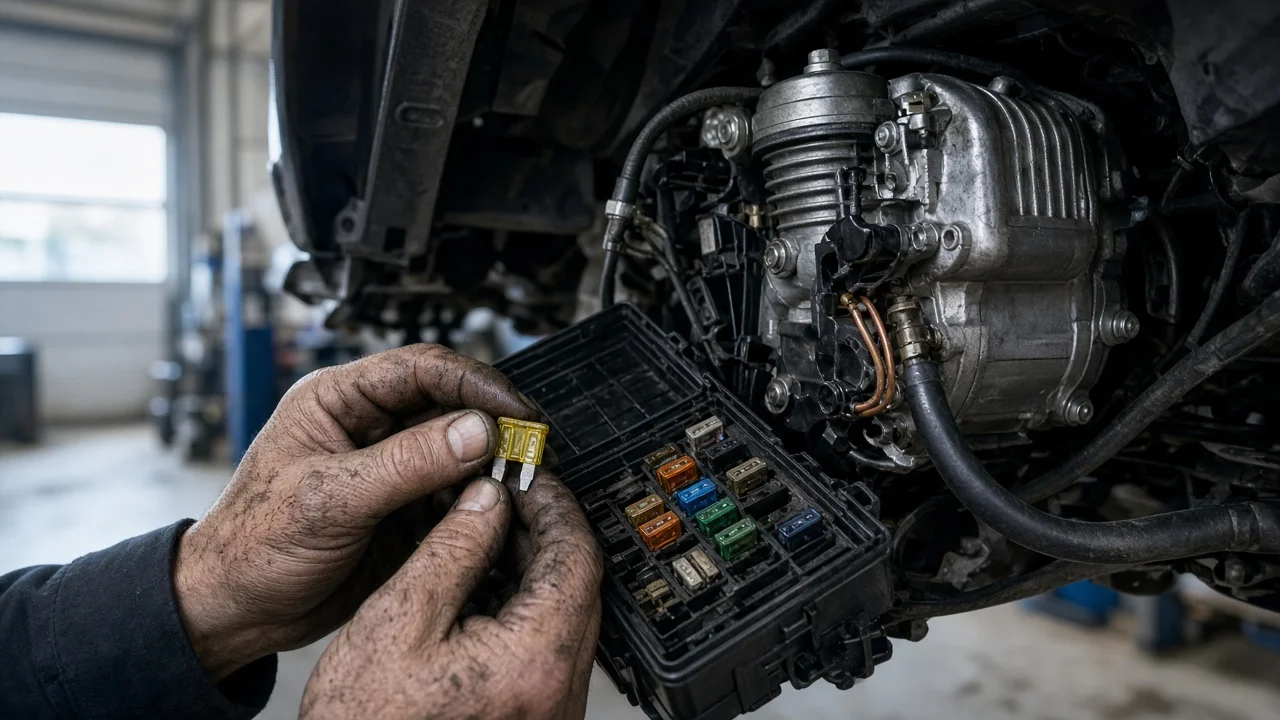
When an air suspension compressor stops running, the fuse is the cheapest part to check and the easiest to misjudge. A fuse that looks intact can still be open, and a fuse that keeps blowing is reporting a fault elsewhere in the circuit. This guide explains how to find the correct fuse, test it properly on the vehicle's 12-volt system, and decide what the result means before buying parts.
How the compressor circuit is laid out
On most vehicles the compressor is powered from the low-voltage starter battery system through a dedicated fuse and a relay. The suspension control module switches the relay coil, and the relay contacts carry the compressor's high working current. Because of that load, the compressor fuse is often a higher-rated cartridge or blade fuse in an underhood, trunk or underseat fuse box, and the relay may have a separate, smaller fuse for its control side. Fuse box lid labels are abbreviated and sometimes shared across trims, so confirm the position and fuse rating against the wiring diagram or owner's manual for your exact model and year rather than relying on a generic chart.
Hybrid and electric vehicles need extra caution. The air suspension compressor normally still runs on the 12-volt network, which is supplied by a DC-DC converter instead of an alternator, but the same vehicle carries a high-voltage traction battery and orange-sheathed cables. Nothing in this procedure requires touching high-voltage components. If a fuse or connector you need sits near orange wiring or a service disconnect, stop and leave that work to a technician trained in high-voltage isolation.
Establish the symptoms
Write down exactly what happens and when. Note whether the vehicle sits low after parking, whether it fails to rise at startup, whether a suspension warning appears, and whether you hear the compressor at all. A compressor that never makes a sound points toward power supply or control. One that runs for long periods, or runs with the ignition off, points toward a leak or a relay stuck closed. Record whether the problem started after a battery replacement, jump start, accessory installation, car wash or work near the fuse box, since those events disturb exactly the connections involved.
Also note battery behavior. A battery that goes flat overnight can indicate parasitic draw from a compressor that keeps running. Conversely, low system voltage from a weak battery or poor charging output can make the suspension module refuse to run the compressor, so the symptom can resemble a fuse fault when the fuse is fine.
Distinguish plausible causes
An open fuse is the simplest explanation, and it fits a silent compressor with no other electrical complaints. A one-off failure after a jump start or a wiring disturbance is plausible. A replacement fuse that blows again immediately or within a few cycles, however, is a symptom rather than the fault. Repeated failure usually traces to a compressor drawing excessive current because its motor or piston assembly is worn or seized, to a harness shorting against the body, or to corrosion and water entry at the compressor connector.
Relay faults compete with fuse faults. A relay that never closes produces a silent compressor with a good fuse. A relay with welded contacts keeps the compressor running until the fuse blows, the compressor's thermal protection trips or the battery is drained. Air leaks in the springs, lines or valve block weaken the fuse theory: they make the compressor run often and long, which overheats it and can eventually lead to blown fuses or a module-imposed shutdown, but the root fault is the leak. Finally, a control module that has disabled the compressor because of a stored fault or low voltage leaves the fuse and relay healthy, which a scan tool will reveal.
Checks in a useful order
Start with observations that need no tools. With the vehicle parked on level ground, listen for the compressor when the ignition is switched on or a door is opened, check the instrument cluster for suspension or battery messages, and look for a corner that sits noticeably lower. Before any work beneath or around the vehicle, put the suspension into its jack or service mode if the manufacturer provides one, because an air suspension can lower without warning. Switch the ignition off and remove the key or move the smart key away before pulling fuses or relays.
Then test the fuse. Visual inspection is unreliable, especially with cartridge fuses. Either remove it and check continuity with a multimeter, or leave it installed and measure voltage to ground at both test points while the circuit should be live; voltage on only one side means the fuse is open. Make sure any replacement matches the specified rating exactly. Next, measure voltage at the battery terminals with the engine off and running to rule out low system voltage or weak charging output. If the fuse is good, check for supply at the compressor connector while the module commands it to run, and perform a voltage drop test on the power and ground sides under load. Relay testing, current measurement and commanding the compressor through a scan tool require the correct specifications and equipment; without them, this stage belongs with a qualified technician.
Interpret the findings
A blown fuse proves only that current exceeded the fuse rating at some point. If a correctly rated replacement holds and the compressor works normally through several cycles, a transient event is a reasonable conclusion, but keep watching ride height and battery condition. If the new fuse fails, do not install a larger one; an oversized fuse removes protection for the wiring and can lead to melted insulation or fire. Instead, have compressor current draw measured against specification and inspect the harness for chafing before condemning the compressor.
A good fuse with no voltage at the compressor during a commanded run moves suspicion to the relay, its control circuit or the module. Voltage present but no operation, with a sound ground, points to the compressor itself. Excessive voltage drop on either side identifies a resistive connection that should be repaired first, since it can cause the heating that blew the fuse. A compressor that runs but cannot reach height, or runs frequently, indicates a leak that needs its own leak check. Each result narrows the fault, but none alone justifies replacing an expensive compressor without confirming supply and current draw under load.
Urgency and next action
Stop driving and arrange inspection if the vehicle sits on its bump stops, leans to one side, a tire contacts the body or wheel arch, steering feels unusual, or you notice a burning smell or melted plastic near a fuse box or the compressor. These conditions affect handling or can indicate a short circuit. A compressor that runs continuously with the ignition off can flatten the starter battery; removing its fuse or relay is a reasonable temporary measure while you arrange repair, accepting that the suspension will not maintain height. There is no reliable distance a vehicle can safely cover with a failed air suspension, because that depends on how far it has dropped and on the vehicle design.
When you book a repair, give the technician the model, year and VIN, the fuse position and rating you checked, whether the fuse was blown and whether a replacement failed again, your battery voltage readings, any warning messages or stored codes, and when the symptoms started. That information lets the shop go straight to current-draw, relay and leak testing instead of repeating basic checks.