Adjustable vs Non-Adjustable Control Arms: Which Should You Choose?
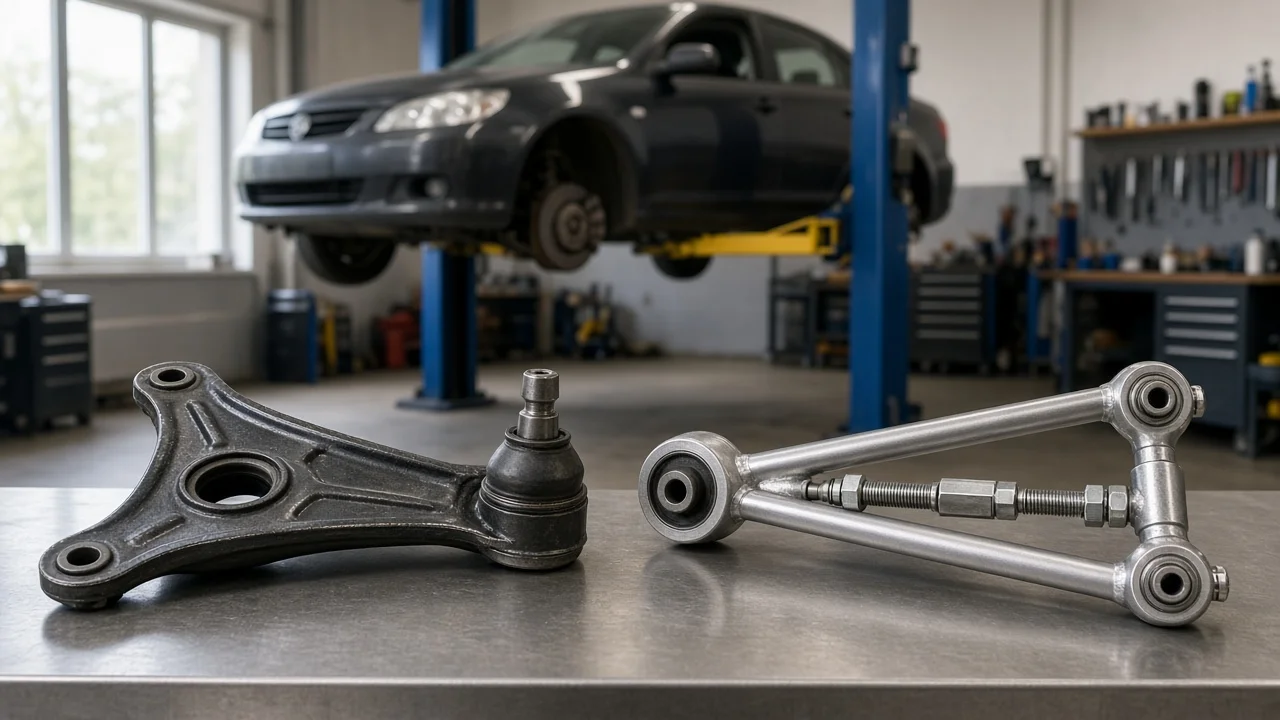
Choosing between adjustable and non-adjustable control arms affects wheel alignment, ride quality and how much attention your suspension needs over time. Neither design is better in every case. A stock-height commuter and a lowered or lifted vehicle have very different needs. This guide explains what each label actually means, compares the two designs on the same criteria, covers the compatibility checks that come before any purchase, and shows which option fits which kind of use.
What is being compared
A non-adjustable control arm has a fixed length and fixed pivot locations set by the vehicle manufacturer. It is usually made from stamped steel, cast iron or forged aluminum, with rubber bushings at the frame end and a ball joint at the knuckle end. Its geometry is designed around factory ride height, so any alignment correction has to come from adjusters the vehicle already has, such as cam bolts, shims or tie rod ends.
An adjustable control arm lets you change its effective length or pivot position. Common designs use a threaded sleeve or turnbuckle, a threaded rod end, an eccentric cam bushing or an offset ball joint. Depending on where it mounts, it can add camber, caster or toe range, or, on a solid rear axle located by multiple links, center the axle and set pinion angle.
The label alone tells you little. A listing that says adjustable does not state which angle it changes, how much range it offers or whether it can move in both directions. Bushing material is a separate specification: rubber, polyurethane and spherical bearings each behave differently whether the arm is fixed or adjustable. Read the published adjustment range, intended arm position, joint type and whether a ball joint is included before comparing prices.
Compare on the same criteria
Alignment range is the clearest difference. A fixed arm reproduces factory geometry and relies on existing adjusters, while an adjustable arm adds range within whatever limits its manufacturer publishes. Ride quality and noise depend mostly on the joints: fixed replacement arms usually keep rubber bushings that isolate vibration, whereas many adjustable arms use polyurethane or spherical joints that transmit more road noise and harshness in exchange for more precise wheel location.
Fitment and service also differ. A fixed arm for the correct application bolts in where the old one came out, and alignment is checked afterward. An adjustable arm must be preset close to the target length before installation, then fine-tuned during the alignment. Over its life, a fixed arm is a sealed unit replaced when a bushing tears or the ball joint develops play. An adjustable arm adds threads and jam nuts to inspect, and spherical joints should be checked for joint play at service intervals; some designs are rebuildable. Ownership cost follows from that: adjustable arms typically cost more to buy and take more time to set up and inspect.
Where the differences matter
Ride height changes are the main reason adjustable arms exist. Lowering a vehicle usually tilts the top of the tire inward, adding negative camber, and on many cars the factory adjusters cannot bring it back into specification. The result is inner-edge tire wear and less predictable tracking. An adjustable upper arm or camber arm can restore the setting. Lifting a truck or SUV with independent front suspension can reduce caster and push upper ball joints toward their angular limits, and aftermarket upper arms are often designed to address both.
On solid-axle vehicles with a four-link or similar rear suspension, a lift changes link angles. Adjustable links let the installer recenter the axle side to side and set pinion angle so the driveshaft joints operate within their intended range. At stock height, none of these problems exist, and an adjustable arm mainly adds parts that can loosen or wear. Where roads are salted in winter, exposed threads also need cleaning and protection so the adjuster does not seize before you need it.
Compatibility comes first
An attractive arm is useless if it does not match the vehicle. Confirm year, model, drivetrain and suspension type, plus whether the part is front or rear, upper or lower, and side-specific. Check ball joint stud size and taper, bushing sleeve width and bolt diameter at the mounting points, and provisions for ABS sensor wiring and brake hose brackets. Aftermarket arms are often designed for a specific ride height range; outside it, they may not deliver the expected correction or may reduce tire and component clearance at full steering lock or full suspension travel.
Some conditions rule out both options until they are fixed. Bent or corroded mounting brackets, a damaged subframe or a cracked knuckle will keep any arm from aligning correctly. Likewise, if an alignment problem at stock height comes from worn bushings, a worn ball joint or a bent part, an adjustable arm only masks the cause. Repair or replace the damaged component first.
Installation and alignment basics
Raise the vehicle only at the lift points listed in its service information and keep it on rated jack stands; never work under a vehicle supported by a jack alone. Follow the fastener specification for every bolt and ball joint nut from the vehicle service manual or the arm manufacturer, and replace single-use fasteners where specified. Many rubber-bushed arms must have their pivot bolts tightened with the suspension at normal ride height, because tightening them with the wheel hanging can preload the bushing and shorten its life.
With adjustable arms, tighten jam nuts or other locking hardware after setting the length, and recheck them after initial driving if the manufacturer recommends it. Either type needs a professional wheel alignment after installation, since driving on unverified geometry can wear tires rapidly.
Which option fits which use
If the vehicle sits at factory height and you are replacing worn or damaged arms, a quality non-adjustable arm with OE-style bushings is usually the better choice. It restores the original geometry and ride feel and keeps maintenance simple. If you have lowered or lifted the vehicle and the alignment shop reports that camber or caster is out of specification with the factory adjusters at their limits, choose an adjustable arm designed for that specific angle and ride height range.
For track days, autocross or other driving where you want settings beyond the factory range, adjustable arms make sense, provided you accept firmer joints, more noise and more frequent inspection. For a lifted solid-axle vehicle, adjustable links are often the practical way to set pinion angle and axle position. If you are unsure, start with an alignment printout: it shows which angle is out, by how much and whether existing adjustment is used up, which tells you whether an adjustable arm solves a real problem or adds complexity you do not need.